• Fri frakt över 249 kr
  • •
  • Snabba leveranser
  • •
  • Billiga böcker
Kundservice

Du är på sajten för privatpersoner.

Företag, bibliotek eller offentlig verksamhet?

Du handlar på classic.bokus.com, där alla dina funktioner finns intakta.
Till classic.bokus.com
Bokus logotyp. Gå till startsidan.
  • Erbjudanden
  • Nyheter
  • Student
  • Topplistor
  • Barn & ungdom
  • Bokus Play
  • E-böcker
  • Pocketböcker
  • Spel & pussel

Må bättre, för mindre! Upp till 50% rabatt på hälsoböcker

Sidfot

Mina sidor

    Hjälp

    • Kundservice
    • Vanliga frågor och svar
    • Frakt och leverans
    • Retur vid ångerrätt
    • Reklamera vara
    • Betalning
    • Köpvillkor
    • Allmänna villkor
    • Information om webbplatsens tillgänglighet

    Om Bokus

    • Om oss
    • Pressrum
    • För studenter
    • För företag
    • För bibliotek och offentlig verksamhet
    • För leverantörer
    • Hållbarhet

    Populärt

    • Aktuella erbjudanden
    • Presentkort
    • Studentlitteratur
    • Nya böcker
    • Topplistor
    • Signerade böcker
    • Engelska böcker

    Inspiration

    • Boktips
    • BookTok
    • Populära bokserier
    • Barnbokskaraktärer
    • Populära författare
    Logotyp för Bokus
    Följ oss på Facebook (extern länk)Följ oss på Instagram (extern länk)Följ oss på YouTube (extern länk)Följ oss på TikTok (extern länk)
    bokus @ CookiesAnpassa cookiesIntegritetspolicyKöpvillkor
    Till Citymail hemsida (extern länk)Till Budbee hemsida (extern länk)Till Postnord hemsida (extern länk)Till Schenker hemsida (extern länk)Till Early Bird hemsida (extern länk)Till Walleys hemsida (extern länk)
    1. Ekonomi och Ledarskap
    2. Nationalekonomi
    3. Ekonomisk politik

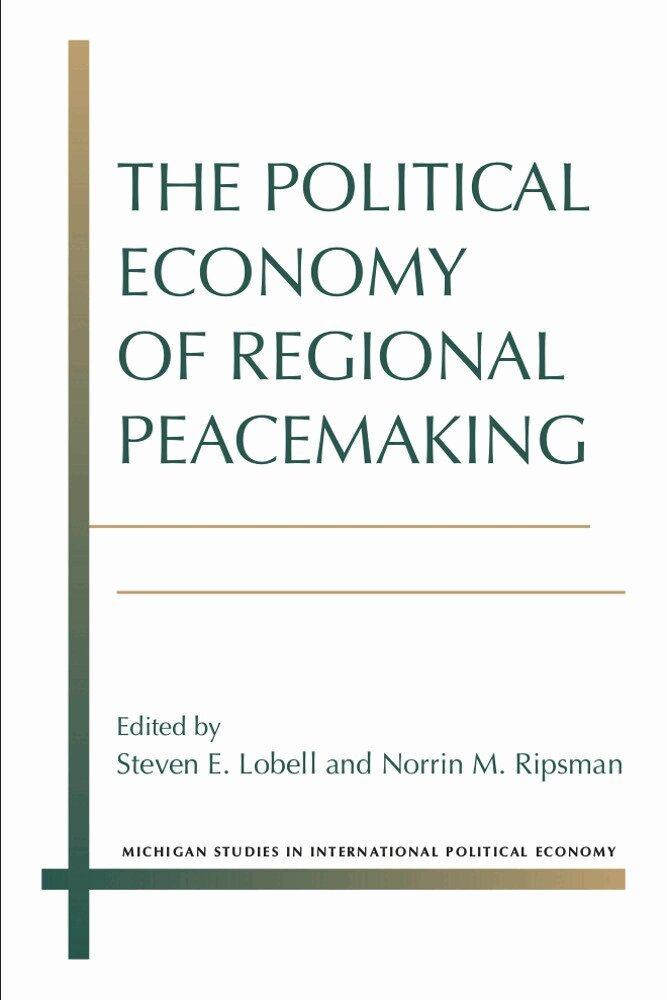
    Political Economy of Regional Peacemaking

    AvSteven E. Lobell,Norrin M. Ripsman

    Häftad, Engelska, 2016

    Del i serien Michigan Studies in International Political Economy

    610 kr

    Beställningsvara. Skickas inom 5-8 vardagar. Fri frakt över 249 kr.

    Beskrivning

    In The Political Economy of Regional Peacemaking, scholars examine the efficacy of trade agreements, economic sanctions, and other strategies of economic statecraft for the promotion of peace both between rival states and across conflict-ridden regions more generally. In the introduction, Steven E. Lobell and Norrin M. Ripsman pose five central questions: (1) What types of economic statecraft, including incentives and sanctions, can interested parties employ? (2) Who are the appropriate targets in the rival states—state leaders, economic and social elites, or society as whole? (3) When should specific economic instruments be used to promote peace—prior to negotiations, during negotiations, after signature of the treaty, or during implementation of the treaty? (4) What are the limits and risks of economic statecraft and economic interdependence? (5) How can economic statecraft be used to move from a bilateral peace agreement to regional peace?The chapters that follow are grouped in three sections, corresponding to the three stages of peacemaking: reduction or management of regional conflict; peacemaking or progress toward a peace treaty; and maintenance of bilateral peace and the regionalization of the peace settlement. In each chapter, the contributors consider the five key questions from a variety of methodological, historical, cultural, and empirical perspectives, drawing data from the Pacific, the Middle East, Europe, Asia, and Latin America. The conclusion expands on several themes found in the chapters and proposes an agenda for future research.

    Produktinformation

    • Utgivningsdatum:2016-02-02
    • Mått:152 x 229 x undefined mm
    • Format:Häftad
    • Språk:Engelska
    • Serie:Michigan Studies in International Political Economy
    • Antal sidor:276
    • Förlag:The University of Michigan Press
    • ISBN:9780472053070

    Utforska kategorier

    • Ekonomisk politik inom Ekonomi och Ledarskap
    • Internationella relationer inom Samhälle och politik

    Mer om författaren

    Steven E. Lobell is Professor of Political Science at the University of Utah. Norrin M. Ripsman is Professor of Political Science at Concordia University in Montréal, Canada.

    Recensioner i media

    This valuable collection of essays succeeds notably in bridging the gap that has long existed between the fields of international political economy and security studies. An A-list of distinguished scholars addresses the political economy of peacemaking, which has rarely received the attention it deserves. This is a must-read for anyone interested in the role that economic statecraft can play in today’s greatly troubled world.”—Benjamin Jerry Cohen, University of California, Santa Barbara""Lobell and Ripsman have assembled a nicely integrated collection of studies which provide a new perspective on economic statecraft. Influence is sometimes targeted at elites, and at other times at interest groups or mass publics. Sometimes influence may be overt (as with sanctions), at other times its channels are much more subtle (e.g., interdependence). Varying time dimension and higher-order effects can lead to unintended consequences. Lobell and Ripsman offer a framework for thinking about such complexities, and the chapters provide colorful evidence and illustration. Do not miss this one.” —Brian M. Pollins, The Ohio State University""This volume successfully leverages the topic of regional peacemaking to confront big questions on the economic causes of peace. The mix of essays complement each other well, offering carefully reasoned and balanced judgments on the conditions under which economic policy tools have both succeeded and failed in helping resolve some of the world’s most pressing conflicts.”—Patrick J. McDonald, University of Texas at Austin""The study of the relationship between economic interactions and militarized conflict has deep roots in international relations. This volume provides a refined advancement in that field. The contributors not only narrow and deepen this analysis, they do so by employing an array of conceptual and methodological approaches. The outcome of interest is narrowed to regional peacemaking, providing focus and allowing the authors to develop more powerful models and empirical approaches.”—Lisa L. Martin, Professor of Political Science, University of Wisconsin–Madison