• Fri frakt över 249 kr
  • •
  • Snabba leveranser
  • •
  • Billiga böcker
Kundservice

Du är på sajten för privatpersoner.

Företag, bibliotek eller offentlig verksamhet?

Du handlar på classic.bokus.com, där alla dina funktioner finns intakta.
Till classic.bokus.com
Bokus logotyp. Gå till startsidan.
  • Erbjudanden
  • Nyheter
  • Student
  • Topplistor
  • Barn & ungdom
  • Bokus Play
  • E-böcker
  • Pocketböcker
  • Spel & pussel

10% rabatt på allt med kod: NYSTART10 →

Sidfot

Mina sidor

    Hjälp

    • Kundservice
    • Vanliga frågor och svar
    • Frakt och leverans
    • Retur vid ångerrätt
    • Reklamera vara
    • Betalning
    • Köpvillkor
    • Allmänna villkor
    • Information om webbplatsens tillgänglighet

    Om Bokus

    • Om oss
    • Pressrum
    • För studenter
    • För företag
    • För bibliotek och offentlig verksamhet
    • För leverantörer
    • Hållbarhet

    Populärt

    • Aktuella erbjudanden
    • Presentkort
    • Studentlitteratur
    • Nya böcker
    • Topplistor
    • Signerade böcker
    • Engelska böcker

    Inspiration

    • Boktips
    • BookTok
    • Populära bokserier
    • Barnbokskaraktärer
    • Populära författare
    Logotyp för Bokus
    Följ oss på Facebook (extern länk)Följ oss på Instagram (extern länk)Följ oss på YouTube (extern länk)Följ oss på TikTok (extern länk)
    bokus @ CookiesAnpassa cookiesIntegritetspolicyKöpvillkor
    Till Citymail hemsida (extern länk)Till Budbee hemsida (extern länk)Till Postnord hemsida (extern länk)Till Schenker hemsida (extern länk)Till Early Bird hemsida (extern länk)Till Walleys hemsida (extern länk)
    1. Ekonomi och Ledarskap
    2. Ledarskapsböcker
    3. Ledarskap och motivation

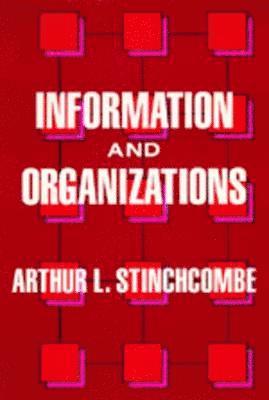
    Information and Organizations

    AvArthur L. Stinchcombe

    Häftad, Engelska, 1990

    Del 19 i serien California Series on Social Choice and Political Economy

    318 kr

    Beställningsvara. Skickas inom 5-8 vardagar. Fri frakt över 249 kr.

    Fler format och utgåvor

    E-bok

    520 kr

    Beskrivning

    An ambitious new work by a well-respected sociologist, Information and Organizations provides a bold perspective of the dynamics of organizations. Stinchcombe contends that the "information problem" and the concept of "uncertainty" provide the key to understanding how organizations function. In a delightful mix of large theoretical insights and vivid anecdotal material, Stinchcombe explores the ins and outs of organizations from both a macro and micro perspective. He reinterprets the work of the renowned scholars of business, Alfred Chandler, James March and Oliver Williamson, and looks in depth at corporations like DuPont and General Motors. Along the way, Stinchcombe explores subjects as varied as class consciousness, innovation, contracts and university administration. All of these analyses are distinguished by incisive thinking and creative new approaches to issues that have long confronted business people and those interested in organizational theory. A tour de force, Information and Organizations is a must-read for business people and scholars of many stripes. It promises to be a widely discussed and debated work.

    Produktinformation

    • Utgivningsdatum:1990-06-11
    • Mått:152 x 229 x 23 mm
    • Vikt:544 g
    • Format:Häftad
    • Språk:Engelska
    • Serie:California Series on Social Choice and Political Economy
    • Antal sidor:404
    • Förlag:University of California Press
    • ISBN:9780520067813

    Utforska kategorier

    • Ledarskap och motivation inom Ekonomi och Ledarskap
    • Affärsförhandlingar inom Ekonomi och Ledarskap

    Mer om författaren

    Arthur L. Stinchcombe is Professor of Sociology at Northwestern University and author of a number of books, including Stratification and Organization: Selected Papers (1989) and Theoretical Methods in Social History (1978).

    Innehållsförteckning

    • Acknowledgments xi1. INFORMATION, UNCERTAINTY, STRUCTURE, AND FUNCTION IN ORGANIZATIONAL SOCIOLOGYRationality Uncertainty Uncertainty About What? Information Structure and Function The Plan of the Book 2. INDIVIDUALS' SKILLS AS INFORMATION PROCESSING:CHARLES F. SABEL AND THE DIVISION OF LABOR Introduction Relations Between Routines and Skills Two Relations Between Routines and Human Decisions Complexity of the Routine Artisans at the Beginning of the Industrial Revolution The Division of Skill Between Workers and Professionals Three Organizations for Learning Routines and Decision Skills Earnings Curves for Craftsmen, Professionals, and Managers Jurisdictions of Occupations The Determinants of the Division of Labor Between Engineers and Skilled Workers Manufacturing Artisans in the Early Industrial Revolution Economic and Technical Threats to Artisan Organization Authority Reorganization and Artisan Skill The Ideology of Mass Production Management Scientific Management Authority in Practice Conflict over the New Authority System "Fordism" The Impact of Certainty and Uncertainty on Fordism Sources of Uncertainty in the Market Conclusion 3. MANUFACTURING INFORMATION SYSTEMS:SOURCES OF TECHNICAL UNCERTAINTY AND THE INFORMATION FOR TECHNICAL DECISIONS 73Introduction People Driving versus Information Systems in Management Some Data on Manufacturing Information Systems Operating Characteristics of Information Systems Types of Operating Information Systems Summary of Dimensions That Differentiate Operating Information Systems Conclusion 4. MARKET UNCERTAINTY AND DIVISIONALIZATION:ALFRED D. CHANDLER'S STRATEGY AND STRUCTURE Introduction The Concepts of Centralization and Decentralization A Definition of Methodological Individualism Individuals in Du Pont: Organizing Information Flows Individuals in Du Pont: Organizational Theory Individuals in Du Pont: Responsibility for Inventing and Adopting a Remedy Individuals in Du Pont and HUD: How Decentralization Works Is It Still Sociology? The Causes of Divisionalization General Motors Creates a Multidivisional Structure by Centralizing The Centralization Revolution at General Motors The Theoretical Problem of Sears Regional Information in Merchant Wholesaling and Sears Commodity Line Rationality versus Store Inventory Rationality The General Problem of Wholesaling Organizational Problems of the Service Sector What Is Chandler's Independent Variable? Conclusion 5. TURNING INVENTIONS INTO INNOVATIONS: SCHUMPETER'S ORGANIZATIONAL SOCIOLOGY MODERNIZED Introduction Innovation, the Learning Curve of Cost Reduction, and Monopoly Cases in Which the Follower and Innovator Have Learning Curves of Different Shape Innovation, the Marketing Network, and Monopoly The Theory or Doctrine of an Innovation A "Zero Resources Innovation" Described in Detail The Multidivisional Structure of Chandler as an Innovation Social Predictors of Success in Introducing Innovations Technological Utopianism Investment Approval Cost Reduction and Manufacturing Improvements Markets and Innovation Success The Division of Benefits Examples of Incentives for Innovation Divisionalization and Innovation Conclusion 6. ORGANIZING INFORMATION OUTSIDE THE FIRM:CONTRACTS AS HIERARCHICAL DOCUMENTS Introduction An Extended Definition of Hierarchy Prediction of Performance Requirements and Performance Measurement Elements of Hierarchy in Contract Contents Theoretical Conclusion Notes 7. SEGMENTATION OF THE LABOR MARKET AND INFORMATION ON THE SKILL OF WORKERS The Fundamental Uncertainty of the Labor Contract Institutional Substitutes for Measurement of Productivity Types of Information About Work Performance A General Theory of Certification The Great Segmenting Factor Is Who Holds the Job Now Segmentation by Internal Labor Markets: Promotions Go to Those Now Employed by Big Firms and Government Worker-Controlled Recruitment in Professional and Craft Occupations Family Recruitment in Small Firm Sectors Union Membership as a Certificate of Productivity The Secondary Labor Market Conclusion 8. CLASS CONSCIOUSNESS AND ORGANIZATIONAL SOCIOLOGY: E. P. THOMPSON APPLIED TO CONTEMPORARY CLASS CONSCIOUSNESS Introduction Unity in Diversity: Why Are Societies with Factories So Much Alike? E. P. Thompson's Conception of Working-Class Consciousness Cross-national Variation in Class Consciousness Class Consciousness in Soviet Societies Class Consciousness in Corporatist Capitalism The Culture in Which Class Consciousness Grew The Cultural Perception of Exploitation,Oppression, and the Wage Bargain Constitutionalism in Modern Organizations Debureaucratization, or Individualizing the Labor Contract Low Unionization of the Modern Service Sector:Theory Service-Sector Class Consciousness: Demography Service-Sector Class Consciousness: Selling Status Symbols Service-Sector Class Consciousness: The Small Firm Effect Conclusion 9. UNIVERSITY ADMINISTRATION OF RESEARCH SPACE AND TEACHING LOADS: MANAGERS WHO DO NOT KNOW WHAT THEIR WORKERS ARE DOINGTypes of Information About Work Performance A General Theory of Certification The Great Segmenting Factor Is Who Holds the Job Now Segmentation by Internal Labor Markets:Promotions Go to Those Now Employed by Big Firms and Government Worker-Controlled Recruitment in Professional and Craft Occupations Family Recruitment in Small Firm Sectors Union Membership as a Certificate of Productivity The Secondary Labor Market Conclusion 8. CLASS CONSCIOUSNESS AND ORGANIZATIONAL SOCIOLOGY: E. P. THOMPSON APPLIED TO CONTEMPORARY CLASS CONSCIOUSNESS Introduction Unity in Diversity: Why Are Societies with Factories So Much Alike? E. P. Thompson's Conception of Working-Class Consciousness Cross-national Variation in Class Consciousness Class Consciousness in Soviet Societies Class Consciousness in Corporatist Capitalism The Culture in Which Class Consciousness Grew The Cultural Perception of Exploitation,Oppression, and the Wage Bargain Constitutionalism in Modern Organizations Debureaucratization, or Individualizing the Labor Contract Low Unionization of the Modern Service Sector:Theory Service-Sector Class Consciousness: Demography Service-Sector Class Consciousness: Selling Status Symbols Service-Sector Class Consciousness: The Small Firm Effect Conclusion 9. UNIVERSITY ADMINISTRATION OF RESEARCH SPACEAND TEACHING LOADS: MANAGERS WHO DO NOT KNOW WHAT THEIR WORKERS ARE DOING