• Fri frakt över 249 kr
  • •
  • Snabba leveranser
  • •
  • Billiga böcker
Kundservice

Du är på sajten för privatpersoner.

Företag, bibliotek eller offentlig verksamhet?

Du handlar på classic.bokus.com, där alla dina funktioner finns intakta.
Till classic.bokus.com
Bokus logotyp. Gå till startsidan.
  • Erbjudanden
  • Nyheter
  • Student
  • Topplistor
  • Barn & ungdom
  • Bokus Play
  • E-böcker
  • Pocketböcker
  • Spel & pussel

10% rabatt på allt med kod: NYSTART10 →

Sidfot

Mina sidor

    Hjälp

    • Kundservice
    • Vanliga frågor och svar
    • Frakt och leverans
    • Retur vid ångerrätt
    • Reklamera vara
    • Betalning
    • Köpvillkor
    • Allmänna villkor
    • Information om webbplatsens tillgänglighet

    Om Bokus

    • Om oss
    • Pressrum
    • För studenter
    • För företag
    • För bibliotek och offentlig verksamhet
    • För leverantörer
    • Hållbarhet

    Populärt

    • Aktuella erbjudanden
    • Presentkort
    • Studentlitteratur
    • Nya böcker
    • Topplistor
    • Signerade böcker
    • Engelska böcker

    Inspiration

    • Boktips
    • BookTok
    • Populära bokserier
    • Barnbokskaraktärer
    • Populära författare
    Logotyp för Bokus
    Följ oss på Facebook (extern länk)Följ oss på Instagram (extern länk)Följ oss på YouTube (extern länk)Följ oss på TikTok (extern länk)
    bokus @ CookiesAnpassa cookiesIntegritetspolicyKöpvillkor
    Till Citymail hemsida (extern länk)Till Budbee hemsida (extern länk)Till Postnord hemsida (extern länk)Till Schenker hemsida (extern länk)Till Early Bird hemsida (extern länk)Till Walleys hemsida (extern länk)
    1. Kultur
    2. Scenkonst och film
    3. Film

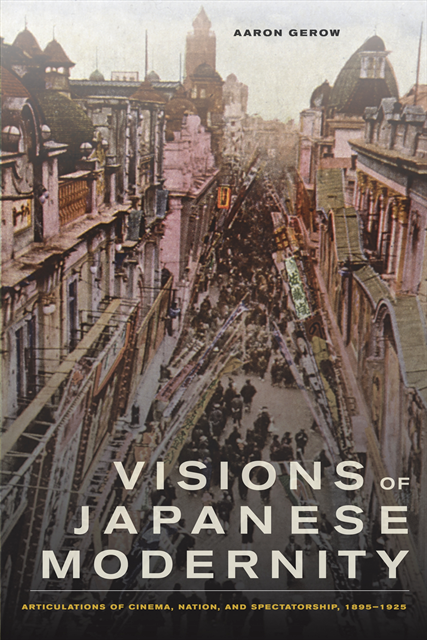
    Visions of Japanese Modernity

    Articulations of Cinema, Nation, and Spectatorship, 1895-1925

    AvAaron Gerow

    Inbunden, Engelska, 2010

    1 188 kr

    Beställningsvara. Skickas inom 5-8 vardagar. Fri frakt över 249 kr.

    Fler format och utgåvor

    Häftad

    310 kr

    E-bok

    534 kr

    Beskrivning

    Japan has done marvelous things with cinema, giving the world the likes of Kurosawa, Mizoguchi, and Ozu. But cinema did not arrive in Japan fully formed at the end of the nineteenth century, nor was it simply adopted into an ages-old culture. Aaron Gerow explores the processes by which film was defined, transformed, and adapted during its first three decades in Japan. He focuses in particular on how one trend in criticism, the 'Pure Film Movement', changed not only the way films were made, but also how they were conceived. Looking closely at the work of critics, theorists, intellectuals, benshi artists, educators, police, and censors, Gerow finds that this trend established a way of thinking about cinema that would reign in Japan for much of the twentieth century.

    Produktinformation

    • Utgivningsdatum:2010-05-14
    • Mått:152 x 229 x 23 mm
    • Vikt:680 g
    • Format:Inbunden
    • Språk:Engelska
    • Antal sidor:344
    • Förlag:University of California Press
    • ISBN:9780520256729

    Utforska kategorier

    • Film inom Kultur

    Mer om författaren

    Aaron Gerow is Associate Professor of Japanese Cinema in the Film Studies Program and East Asian Languages and Literatures at Yale University. He is the author of Kitano Takeshi, A Page of Madness: Cinema and Modernity in 1920s Japan, and Reference Guide to Japanese Film Studies, coauthored with Abe Mark Nornes.

    Recensioner i media

    "The author offers not just a history of early Japanese cinema but also a history of Japanese film studies that describes the struggles to define cinema, control spectatorship, and articulate modernity." Choice "Remarkable for it breadth and precision." -- Alexander Jacoby Sight & Sound Magazine "The book has a wealth of information." -- Vili Maunula Akirakurosawa.info

    Innehållsförteckning

    • Contents List of Illustrations Acknowledgments Introduction 1. The Motion Pictures as a Problem 2. Gonda Yasunosuke and the Promise of Film Study 3. Studying the Pure Film 4. The Subject of the Text: Benshi, Authors, and Industry 5. Managing the Internal Conclusion: Mixture, Hegemony, and Resistance Notes Selected Bibliography Index