• Fri frakt över 249 kr
  • •
  • Snabba leveranser
  • •
  • Billiga böcker
Kundservice

Du är på sajten för privatpersoner.

Företag, bibliotek eller offentlig verksamhet?

Du handlar på classic.bokus.com, där alla dina funktioner finns intakta.
Till classic.bokus.com
Bokus logotyp. Gå till startsidan.
  • Erbjudanden
  • Nyheter
  • Student
  • Topplistor
  • Barn & ungdom
  • Bokus Play
  • E-böcker
  • Pocketböcker
  • Spel & pussel

10% rabatt på allt med kod: NYSTART10 →

Sidfot

Mina sidor

    Hjälp

    • Kundservice
    • Vanliga frågor och svar
    • Frakt och leverans
    • Retur vid ångerrätt
    • Reklamera vara
    • Betalning
    • Köpvillkor
    • Allmänna villkor
    • Information om webbplatsens tillgänglighet

    Om Bokus

    • Om oss
    • Pressrum
    • För studenter
    • För företag
    • För bibliotek och offentlig verksamhet
    • För leverantörer
    • Hållbarhet

    Populärt

    • Aktuella erbjudanden
    • Presentkort
    • Studentlitteratur
    • Nya böcker
    • Topplistor
    • Signerade böcker
    • Engelska böcker

    Inspiration

    • Boktips
    • BookTok
    • Populära bokserier
    • Barnbokskaraktärer
    • Populära författare
    Logotyp för Bokus
    Följ oss på Facebook (extern länk)Följ oss på Instagram (extern länk)Följ oss på YouTube (extern länk)Följ oss på TikTok (extern länk)
    bokus @ CookiesAnpassa cookiesIntegritetspolicyKöpvillkor
    Till Citymail hemsida (extern länk)Till Budbee hemsida (extern länk)Till Postnord hemsida (extern länk)Till Schenker hemsida (extern länk)Till Early Bird hemsida (extern länk)Till Walleys hemsida (extern länk)
    1. Historia och arkeologi
    2. Historia
    3. Historia: särskilda händelser och ämnen
    4. Socialhistoria och kulturhistoria

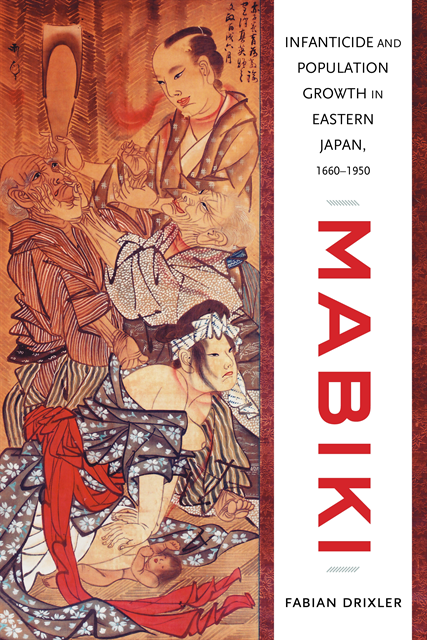
    Mabiki

    Infanticide and Population Growth in Eastern Japan, 1660-1950

    AvFabian Drixler

    Inbunden, Engelska, 2013

    Del 25 i serien Asia: Local Studies / Global Themes

    722 kr

    Beställningsvara. Skickas inom 5-8 vardagar. Fri frakt över 249 kr.

    Fler format och utgåvor

    E-bok

    1 226 kr

    Beskrivning

    This book tells the story of a society reversing deeply held worldviews and revolutionizing its demography. In parts of eighteenth-century Japan, couples raised only two or three children. As villages shrank and domain headcounts dwindled, posters of child-murdering she-devils began to appear, and governments offered to pay their subjects to have more children. In these pages, the long conflict over the meaning of infanticide comes to life once again. Those who killed babies saw themselves as responsible parents to their chosen children. Those who opposed infanticide redrew the boundaries of humanity so as to encompass newborn infants and exclude those who would not raise them. In Eastern Japan, the focus of this book, population growth resumed in the nineteenth century. According to its village registers, more and more parents reared all their children. Others persisted in the old ways, leaving traces of hundreds of thousands of infanticides in the statistics of the modern Japanese state. Nonetheless, by 1925, total fertility rates approached six children per women in the very lands where raising four had once been considered profligate.This reverse fertility transition suggests that the demographic history of the world is more interesting than paradigms of unidirectional change would have us believe, and that the future of fertility and population growth may yet hold many surprises.

    Produktinformation

    • Utgivningsdatum:2013-05-25
    • Mått:152 x 229 x 38 mm
    • Vikt:816 g
    • Format:Inbunden
    • Språk:Engelska
    • Serie:Asia: Local Studies / Global Themes
    • Antal sidor:439
    • Förlag:University of California Press
    • ISBN:9780520272439

    Utforska kategorier

    • Socialhistoria och kulturhistoria inom Historia och arkeologi
    • Asiens historia inom Historia och arkeologi

    Mer om författaren

    Fabian Drixler teaches Japanese history at Yale University.

    Recensioner i media

    "Mabiki is a fabulous piece of historical scholarship on an important topic that until now had been relegated to the realm of traditional Japanese folktales." -- Martin Dusinberre American Historical Review "This complex and immensely valuable book is certainly essential reading." -- Luke S. Roberts Journal of Interdisciplinary History "Innovative, interesting, and rewarding ... [an] extremely stimulating book." -- Osamu Saito Harvard Journal of Asiatic Studies "Mabiki skillfully blends statistical and textual analysis... Drixler's methodology is rich and complex... The book is packed with interesting insights that will appeal to a wide range of readers." -- Robert Eskildsen Public Affairs "Mabiki is a model of methodological sophistication, imaginative and thorough use of primary sources, and incisive writing... an immensely important work and a must-read." Monumenta Nipponica

    Innehållsförteckning

    • List of Illustrations Acknowledgements A Note on Conventions 1. Introduction: Contested Worldviews and a Demographic Revolution PART I. THE CULTURE OF LOW FERTILITY, CA. 1660--1790 2. Three Cultures of Family Planning 3. Humans, Animals, and Newborn Children 4. Infanticide and Immortality: The Logic of the Stem Household 5. The Material and Moral Economy of Infanticide 6. The Logic of Infant Selection 7. The Ghosts of Missing Children: Four Approaches to Estimating the Rate of Infanticide PART II. REDEFINING REPRODUCTION: THE LONG RETREAT OF INFANTICIDE, CA. 1790--1950 8. Infanticide and Extinction 9. "Inferior Even to Animals": Moral Suasion and the Boundaries of Humanity 10. Subsidies and Surveillance 11. Even a Strong Castle Cannot be Defended without Soldiers: Infanticide and National Security 12. Infanticide and the Geography of Civilization 13. Epilogue: Infanticide in the Shadows of the Modern State 14. Conclusion Appendix 1. The Own-Children Method and Its Mortality Assumptions Appendix 2. Sampling Biases, Sources of Error, and the Characteristics of the Ten Provinces Dataset Appendix 3. The Villages of the Ten Provinces Dataset Appendix 4. Total Fertility Rates in the Districts of the Ten Provinces Appendix 5. Infanticide Reputations Appendix 6. Scrolls and Votive Tablets with Infanticide Scenes Appendix 7. Childrearing Subsidies and Pregnancy Surveillance by Domain Notes Bibliography Index