• Fri frakt över 249 kr
  • •
  • Snabba leveranser
  • •
  • Billiga böcker
Kundservice

Du är på sajten för privatpersoner.

Företag, bibliotek eller offentlig verksamhet?

Du handlar på classic.bokus.com, där alla dina funktioner finns intakta.
Till classic.bokus.com
Bokus logotyp. Gå till startsidan.
  • Erbjudanden
  • Nyheter
  • Student
  • Topplistor
  • Barn & ungdom
  • Bokus Play
  • E-böcker
  • Pocketböcker
  • Spel & pussel

10% rabatt på allt med kod: NYSTART10 →

Sidfot

Mina sidor

    Hjälp

    • Kundservice
    • Vanliga frågor och svar
    • Frakt och leverans
    • Retur vid ångerrätt
    • Reklamera vara
    • Betalning
    • Köpvillkor
    • Allmänna villkor
    • Information om webbplatsens tillgänglighet

    Om Bokus

    • Om oss
    • Pressrum
    • För studenter
    • För företag
    • För bibliotek och offentlig verksamhet
    • För leverantörer
    • Hållbarhet

    Populärt

    • Aktuella erbjudanden
    • Presentkort
    • Studentlitteratur
    • Nya böcker
    • Topplistor
    • Signerade böcker
    • Engelska böcker

    Inspiration

    • Boktips
    • BookTok
    • Populära bokserier
    • Barnbokskaraktärer
    • Populära författare
    Logotyp för Bokus
    Följ oss på Facebook (extern länk)Följ oss på Instagram (extern länk)Följ oss på YouTube (extern länk)Följ oss på TikTok (extern länk)
    bokus @ CookiesAnpassa cookiesIntegritetspolicyKöpvillkor
    Till Citymail hemsida (extern länk)Till Budbee hemsida (extern länk)Till Postnord hemsida (extern länk)Till Schenker hemsida (extern länk)Till Early Bird hemsida (extern länk)Till Walleys hemsida (extern länk)
    1. Historia och arkeologi
    2. Historia
    3. Europas historia

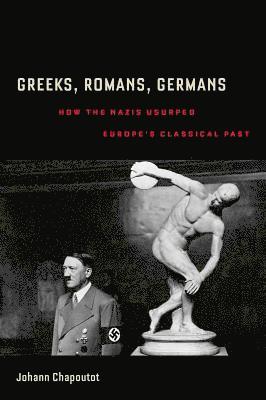
    Greeks, Romans, Germans

    How the Nazis Usurped Europe's Classical Past

    AvJohann Chapoutot

    Häftad, Engelska, 2016

    Del i serien University of California Press

    259 kr

    Beställningsvara. Skickas inom 5-8 vardagar. Fri frakt över 249 kr.

    Fler format och utgåvor

    Inbunden

    806 kr

    E-bok

    432 kr

    Beskrivning

    Much has been written about the conditions that made possible Hitler's rise and the Nazi takeover of Germany, but when we tell the story of the National Socialist Party, should we not also speak of Julius Caesar and Pericles? Greeks, Romans, Germans argues that to fully understand the racist, violent end of the Nazi regime, we must examine its appropriation of the heroes and lessons of the ancient world. When Hitler told the assembled masses that they were a people with no past, he meant that they had no past following their humiliation in World War I of which to be proud. The Nazis' constant use of classical antiquity-in official speeches, film, state architecture, the press, and state-sponsored festivities-conferred on them the prestige and heritage of Greece and Rome that the modern German people so desperately needed. At the same time, the lessons of antiquity served as a warning: Greece and Rome fell because they were incapable of protecting the purity of their blood against mixing and infiltration. To regain their rightful place in the world, the Nazis had to make all-out war on Germany's enemies, within and without.

    Produktinformation

    • Utgivningsdatum:2016-09-20
    • Mått:152 x 229 x 33 mm
    • Vikt:680 g
    • Format:Häftad
    • Språk:Engelska
    • Serie:University of California Press
    • Antal sidor:520
    • Förlag:University of California Press
    • ISBN:9780520292970
    • Översättare:Richard R. Nybakken

    Utforska kategorier

    • Europas historia inom Historia och arkeologi
    • Forntidens historia inom Historia och arkeologi

    Mer om författaren

    Johann Chapoutot is Professor at the Sorbonne, where he teaches contemporary history.

    Recensioner i media

    "Official Nazi racial doctrine inverted traditional analyses by interpreting antiquity as a product of Nordicism. Although Hitler, Himmler, Goebbels, and Speer understood the limited archaeological evidence of early German society differently, biological determinism (the struggle between races) defined the baseline of historical change. In this light, Rome declined as it shed its Nordic blood in battle against Carthage. Alexander the Great's empire declined as it absorbed foreign elements, including Persians. Beyond Max Weinreich's Hitler's Professors (1946), Chapoutot (Sorbonne) identifies largely German classicists and philologists, including Hans F. K. Günther and Joseph Vogt, who coupled social Darwinistic ideas and biological racism into their interwar publications on antiquity. Consistent with Michael Wildt's Hitler's Volksgemeinschaft (CH, Feb'13, 50-3486), the pre-war Nazi curriculum reforms, Berlin's Olympiastadion, the German pavilion for the Paris International Exposition in 1937, the Reichsautobahn, and Nuremberg's Reichsparteitagsgelände united Germans with an illustrious history and physical reminders of its continuity under Nazi leadership, generally, and Adolf Hitler, specifically. Although racial scientists and academics had established the foundations of biological racism decades earlier, Nazi party officials and pedagogues (for example, Dietrich Klagges) endorsed Nordicism in new textbooks and a revised secondary curriculum. In short, the Nazis usurped Europe's classical past. Summing Up: Highly recommended." -- D. A. Meier, Dickinson State University

    Innehållsförteckning

    • INTRODUCTION PART ONE. ANNEXING ANTIQUITY 1. ORIGIN MYTHS: EX SEPTENTRIONE LUX 2. A NORDIC MEDITERRANEAN: GREECE, ROME, AND THE NORTH, BETWEEN GERMAN COUSINS 3. MENS SANA: ANTIQUITY, THE HUMANITIES, AND GERMAN YOUTH PART TWO. IMITATING ANTIQUITY 4. FROM STONE TO FLESH: THE BODY OF THE NEW ARYAN MAN BETWEEN AESTHETICS AND EUGENICS 5. THE RACIAL STATE AND TOTALITARIAN SOCIETY: PLATO AS PHILOSOPHER-KING, OR THE THIRD REICH AS SECOND SPARTA 6. FROM EMPIRE TO REICH: THE LESSONS OF ROMAN RULE AND CLASSICAL COLONIALISM PART THREE. RELIVING ANTIQUITY 7. HISTORY AS RACIAL STRUGGLE: THE CLASH OF CIVILIZATIONS BETWEEN EAST AND WEST IN ANTIQUITY 8. VOLKSTOD OR RASSENSELBSTMORD: HOW CIVILIZATIONS DIE 9. THE CHOREOGRAPHY OF THE END: AESTHETICISM, NIHILISM, AND THE STAGING OF THE FINAL CATASTROPHE CONCLUSION NOTES INDEX