• Fri frakt över 249 kr
  • •
  • Snabba leveranser
  • •
  • Billiga böcker
Kundservice

Du är på sajten för privatpersoner.

Företag, bibliotek eller offentlig verksamhet?

Du handlar på classic.bokus.com, där alla dina funktioner finns intakta.
Till classic.bokus.com
Bokus logotyp. Gå till startsidan.
  • Erbjudanden
  • Nyheter
  • Student
  • Topplistor
  • Barn & ungdom
  • Bokus Play
  • E-böcker
  • Pocketböcker
  • Spel & pussel

10% rabatt på allt med kod: NYSTART10 →

Sidfot

Mina sidor

    Hjälp

    • Kundservice
    • Vanliga frågor och svar
    • Frakt och leverans
    • Retur vid ångerrätt
    • Reklamera vara
    • Betalning
    • Köpvillkor
    • Allmänna villkor
    • Information om webbplatsens tillgänglighet

    Om Bokus

    • Om oss
    • Pressrum
    • För studenter
    • För företag
    • För bibliotek och offentlig verksamhet
    • För leverantörer
    • Hållbarhet

    Populärt

    • Aktuella erbjudanden
    • Presentkort
    • Studentlitteratur
    • Nya böcker
    • Topplistor
    • Signerade böcker
    • Engelska böcker

    Inspiration

    • Boktips
    • BookTok
    • Populära bokserier
    • Barnbokskaraktärer
    • Populära författare
    Logotyp för Bokus
    Följ oss på Facebook (extern länk)Följ oss på Instagram (extern länk)Följ oss på YouTube (extern länk)Följ oss på TikTok (extern länk)
    bokus @ CookiesAnpassa cookiesIntegritetspolicyKöpvillkor
    Till Citymail hemsida (extern länk)Till Budbee hemsida (extern länk)Till Postnord hemsida (extern länk)Till Schenker hemsida (extern länk)Till Early Bird hemsida (extern länk)Till Walleys hemsida (extern länk)
    1. Samhälle och politik
    2. Politik och statsskick
    3. Statsskick och politiska processer

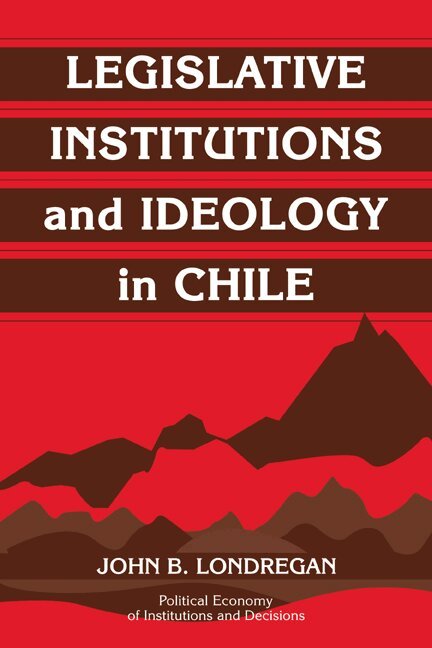
    Legislative Institutions and Ideology in Chile

    AvJohn B. Londregan

    Häftad, Engelska, 2007

    Del i serien Political Economy of Institutions and Decisions

    463 kr

    Beställningsvara. Skickas inom 10-15 vardagar. Fri frakt över 249 kr.

    Fler format och utgåvor

    Inbunden

    839 kr

    Beskrivning

    The 1980s and 1990s have seen several authoritarian governments voluntarily cede power to constitutionally elected democratic governments. John Londregan uses Chile as a case study of this phenomenon, exploring what sorts of guarantees are required for those who are ceding power and how those guarantees later work out in practice. He constructs an analytical model of a democratic transition and provides a new statistical technique for analysing legislative votes, based upon a detailed empirical analysis of Chile's legislative politics. Legislative Institutions and Ideology in Chile extends existing spatial models of policy preferences by incorporating a valence component to policy choices. The valence component enables an agenda setter, in Chile the democratically elected president, to overcome veto players' objections to reform. Londregan specifically also uses Senate committee voting records to study the impact of human rights concessions on the political debate.

    Produktinformation

    • Utgivningsdatum:2007-05-17
    • Mått:154 x 229 x 17 mm
    • Vikt:450 g
    • Format:Häftad
    • Språk:Engelska
    • Serie:Political Economy of Institutions and Decisions
    • Antal sidor:292
    • Förlag:Cambridge University Press
    • ISBN:9780521037266

    Utforska kategorier

    • Statsskick och politiska processer inom Samhälle och politik

    Recensioner i media

    'Londregan's book poses a powerful question: to what extent does a quasi-democratic constitution crafted by a military government constrain a liberal electorate from enacting laws consistent with their preferences? In answering this question, Londregan combines state-of-the-art methodology with a deep understanding of the Chilean case. The scintillating analysis of legislative politics in the final chapter is proof positive that high-tech statistical methods are a tool, not a barrier, to compelling narrative. I recommend this book to all comparativists.' David Latin, Stanford University

    Innehållsförteckning

    • Acknowledgements; Introduction; 1. Ideology and valence; 2. Accident and force; 3. Legislative institutions in the constitution of 1980; 4. Roll-call votes and senate committees; 5. The Labor committee; 6. The Education committee; 7. The Constitution committee; 8. Legislative politics and Chile's transition toward democracy; Conclusion; Appendix: estimating preferences from voting records; Bibliography; Index.