• Fri frakt över 249 kr
  • •
  • Snabba leveranser
  • •
  • Billiga böcker
Kundservice

Du är på sajten för privatpersoner.

Företag, bibliotek eller offentlig verksamhet?

Du handlar på classic.bokus.com, där alla dina funktioner finns intakta.
Till classic.bokus.com
Bokus logotyp. Gå till startsidan.
  • Erbjudanden
  • Nyheter
  • Student
  • Topplistor
  • Barn & ungdom
  • Bokus Play
  • E-böcker
  • Pocketböcker
  • Spel & pussel

10% rabatt på allt med kod: NYSTART10 →

Sidfot

Mina sidor

    Hjälp

    • Kundservice
    • Vanliga frågor och svar
    • Frakt och leverans
    • Retur vid ångerrätt
    • Reklamera vara
    • Betalning
    • Köpvillkor
    • Allmänna villkor
    • Information om webbplatsens tillgänglighet

    Om Bokus

    • Om oss
    • Pressrum
    • För studenter
    • För företag
    • För bibliotek och offentlig verksamhet
    • För leverantörer
    • Hållbarhet

    Populärt

    • Aktuella erbjudanden
    • Presentkort
    • Studentlitteratur
    • Nya böcker
    • Topplistor
    • Signerade böcker
    • Engelska böcker

    Inspiration

    • Boktips
    • BookTok
    • Populära bokserier
    • Barnbokskaraktärer
    • Populära författare
    Logotyp för Bokus
    Följ oss på Facebook (extern länk)Följ oss på Instagram (extern länk)Följ oss på YouTube (extern länk)Följ oss på TikTok (extern länk)
    bokus @ CookiesAnpassa cookiesIntegritetspolicyKöpvillkor
    Till Citymail hemsida (extern länk)Till Budbee hemsida (extern länk)Till Postnord hemsida (extern länk)Till Schenker hemsida (extern länk)Till Early Bird hemsida (extern länk)Till Walleys hemsida (extern länk)
    1. Skönlitteratur
    2. Litteraturvetenskap
    3. Litteraturvetenskap

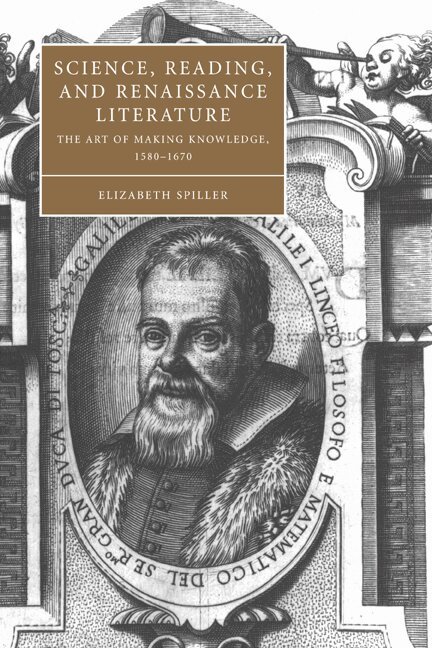
    Science, Reading, and Renaissance Literature

    The Art of Making Knowledge, 1580-1670

    AvElizabeth Spiller

    Häftad, Engelska, 2007

    Del 46 i serien Cambridge Studies in Renaissance Literature and Culture

    764 kr

    Beställningsvara. Skickas inom 10-15 vardagar. Fri frakt över 249 kr.

    Fler format och utgåvor

    Inbunden

    1 535 kr

    Beskrivning

    Science, Reading, and Renaissance Literature brings together key works in early modern science and imaginative literature (from the anatomy of William Harvey and the experimentalism of William Gilbert to the fictions of Philip Sidney, Edmund Spenser and Margaret Cavendish). The book documents how what have become our two cultures of belief define themselves through a shared aesthetics that understands knowledge as an act of making. Within this framework, literary texts gain substance and intelligibility by being considered as instances of early modern knowledge production. At the same time, early modern science maintains strong affiliations with poetry because it understands art as a basis for producing knowledge. In identifying these interconnections between literature and science, this book contributes to scholarship in literary history, history of reading and the book, science studies and the history of academic disciplines.

    Produktinformation

    • Utgivningsdatum:2007-07-12
    • Mått:151 x 228 x 13 mm
    • Vikt:344 g
    • Format:Häftad
    • Språk:Engelska
    • Serie:Cambridge Studies in Renaissance Literature and Culture
    • Antal sidor:232
    • Förlag:Cambridge University Press
    • ISBN:9780521037686

    Utforska kategorier

    • Litteraturvetenskap inom Skönlitteratur

    Mer om författaren

    Elizabeth Spiller is Associate Professor and Director of Graduate Studies at the Department of English, Texas Christian University. She has published in a number of journals including Renaissance Quarterly, Criticism, Studies in English Literature, and Modern Language Quarterly.

    Recensioner i media

    'Nowadays, we tend to think of science and literature as two cultures which have little in common, but Elizabeth Spiller's excellent study, Science, Reading, and Renaissance Literature, explores an age when these disciplines were united by a 'shared aesthetics of knowledge'. Spiller skilfully dismantles our current assumption that 'literature is fiction and science is fact', arguing that early modern writers understood that 'knowledge involves form as well as content … Spiller's perceptive parallel readings of texts usually kept separate is a valuable addition to scholarship on the early modern period, as well as to the study of science and literature.' The Times Literary Supplement

    Innehållsförteckning

    • List of figures; Acknowledgements; Introduction: making early modern science and literature; 1. Model worlds: Philip Sidney, William Gilbert and the experiment of worldmaking; 2. From embryology to parthenogenesis: the birth of the writer in Edmund Spenser and William Harvey; 3. Reading through Galileo's telescope: Johannes Kepler's dream for reading knowledge; 4. Books written of the wonders of these glasses: Thomas Hobbes, Robert Hooke and Margaret Cavendish's theory of reading; Afterword: fiction and the Sokal hoax; Notes; Index.