• Fri frakt över 249 kr
  • •
  • Snabba leveranser
  • •
  • Billiga böcker
Kundservice

Du är på sajten för privatpersoner.

Företag, bibliotek eller offentlig verksamhet?

Du handlar på classic.bokus.com, där alla dina funktioner finns intakta.
Till classic.bokus.com
Bokus logotyp. Gå till startsidan.
  • Erbjudanden
  • Nyheter
  • Student
  • Topplistor
  • Barn & ungdom
  • Bokus Play
  • E-böcker
  • Pocketböcker
  • Spel & pussel

Må bättre, för mindre! Upp till 50% rabatt på hälsoböcker

Sidfot

Mina sidor

    Hjälp

    • Kundservice
    • Vanliga frågor och svar
    • Frakt och leverans
    • Retur vid ångerrätt
    • Reklamera vara
    • Betalning
    • Köpvillkor
    • Allmänna villkor
    • Information om webbplatsens tillgänglighet

    Om Bokus

    • Om oss
    • Pressrum
    • För studenter
    • För företag
    • För bibliotek och offentlig verksamhet
    • För leverantörer
    • Hållbarhet

    Populärt

    • Aktuella erbjudanden
    • Presentkort
    • Studentlitteratur
    • Nya böcker
    • Topplistor
    • Signerade böcker
    • Engelska böcker

    Inspiration

    • Boktips
    • BookTok
    • Populära bokserier
    • Barnbokskaraktärer
    • Populära författare
    Logotyp för Bokus
    Följ oss på Facebook (extern länk)Följ oss på Instagram (extern länk)Följ oss på YouTube (extern länk)Följ oss på TikTok (extern länk)
    bokus @ CookiesAnpassa cookiesIntegritetspolicyKöpvillkor
    Till Citymail hemsida (extern länk)Till Budbee hemsida (extern länk)Till Postnord hemsida (extern länk)Till Schenker hemsida (extern länk)Till Early Bird hemsida (extern länk)Till Walleys hemsida (extern länk)
    1. Naturvetenskap och teknik
    2. Matematik och naturvetenskap
    3. Matematik

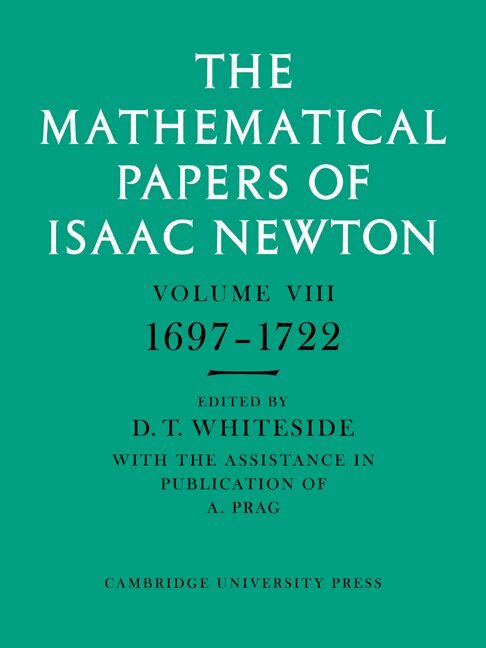
    The Mathematical Papers of Isaac Newton: Volume 8

    AvIsaac Newton,D. T. Whiteside

    Häftad, Engelska, 2008

    Del i serien The Mathematical Papers of Sir Isaac Newton

    670 kr

    Beställningsvara. Skickas inom 10-15 vardagar. Fri frakt över 249 kr.

    Beskrivning

    When Newton left Cambridge in April 1696 to take up, at the age of 53, a new career at the London Mint, he did not entirely 'leave off Mathematicks' as he so often publicly declared. This last volume of his mathematical papers presents the extant record of the investigations which for one reason and another he pursued during the last quarter of his life. In January 1697 Newton was tempted to respond to two challenges issued by Johann Bernoulli to the international community of mathematicians, one the celebrated problem of identifying the brachistochrone; both he resolved within the space of an evening, producing an elegant construction of the cycloid which he identified to be the curve of fall in least time. In the autumn of 1703, the appearance of work on 'inverse fluxions' by George Cheyne similarly provoked him to prepare his own ten-year-old treatise De Quadratura Curvarum for publication, and more importantly to write a long introduction to it where he set down what became his best-known statement of the nature and purpose of his fluxional calculus.

    Produktinformation

    • Utgivningsdatum:2008-01-03
    • Mått:210 x 280 x 40 mm
    • Vikt:1 725 g
    • Format:Häftad
    • Språk:Engelska
    • Serie:The Mathematical Papers of Sir Isaac Newton
    • Antal sidor:772
    • Förlag:Cambridge University Press
    • ISBN:9780521045919

    Utforska kategorier

    • Matematik inom Naturvetenskap och teknik
    • Matematikens historia inom Naturvetenskap och teknik
    • Naturvetenskapens historia inom Naturvetenskap och teknik

    Innehållsförteckning

    • Part I. Solutions to Challenge-Problems, Revisions of Earlier Researches, and General Retrospections: 1. The Twin Problems of Bernoulli's 1697 'Programma' solved; 2. The 'De Quadratura Curvarum' Revised for Publication; 3. Miscellaneous Writings on Mathematics; 4. The 'Method of [Finite] Differences'; 5. The 'De Quadratura' Amplified as an 'Analysis per Quantitates Fluentes et Earum Momenta'; 6. Proposition X of the Principa's Second Book Reworked; 7. Response to Bernoulli's Second Problem; 8. Analysis and Synthsis: Newton's Declaration of the Manner of their Application in the 'Principia'; 9. Minor Compliments to the 'Arithemetica Universalis'; Part II. Newton's Varied Efforts to Substantiate His Claims to Calculus Priority: Appendix 1; Appendix 2; Appendix 3; Appendix 4; Appendix 5; Appendix 6; Appendix 7; Appendix 8; Appendix 9; Appendix 10; Index of Names

    Betyg & recensioner

    5/5