• Fri frakt över 249 kr
  • •
  • Snabba leveranser
  • •
  • Billiga böcker
Kundservice

Du är på sajten för privatpersoner.

Företag, bibliotek eller offentlig verksamhet?

Du handlar på classic.bokus.com, där alla dina funktioner finns intakta.
Till classic.bokus.com
Bokus logotyp. Gå till startsidan.
  • Erbjudanden
  • Student
  • Topplistor
  • Barn & ungdom
  • Bokus Play
  • E-böcker
  • Ljudböcker
  • Pocketböcker
  • Spel och pussel

Pocketfynda! Hundratals böcker för 49 kr/st →

Sidfot

Mina sidor

    Hjälp

    • Kundservice
    • Vanliga frågor och svar
    • Frakt och leverans
    • Retur vid ångerrätt
    • Reklamera vara
    • Betalning
    • Köpvillkor
    • Allmänna villkor
    • Information om webbplatsens tillgänglighet

    Om Bokus

    • Om oss
    • Pressrum
    • För studenter
    • För företag
    • För bibliotek och offentlig verksamhet
    • För leverantörer
    • Hållbarhet

    Populärt

    • Aktuella erbjudanden
    • Presentkort
    • Studentlitteratur
    • Nya böcker
    • Topplistor
    • Signerade böcker
    • Engelska böcker

    Inspiration

    • Boktips
    • BookTok
    • Barnbokskaraktärer
    • Populära författare
    Logotyp för Bokus
    Följ oss på Facebook (extern länk)Följ oss på Instagram (extern länk)Följ oss på YouTube (extern länk)Följ oss på TikTok (extern länk)
    bokus @ CookiesAnpassa cookiesIntegritetspolicyKöpvillkor
    Till Citymail hemsida (extern länk)Till Budbee hemsida (extern länk)Till Postnord hemsida (extern länk)Till Schenker hemsida (extern länk)Till Early Bird hemsida (extern länk)Till Walleys hemsida (extern länk)
    1. Samhälle och politik
    2. Politik och statsskick
    3. Politiskt förtryck

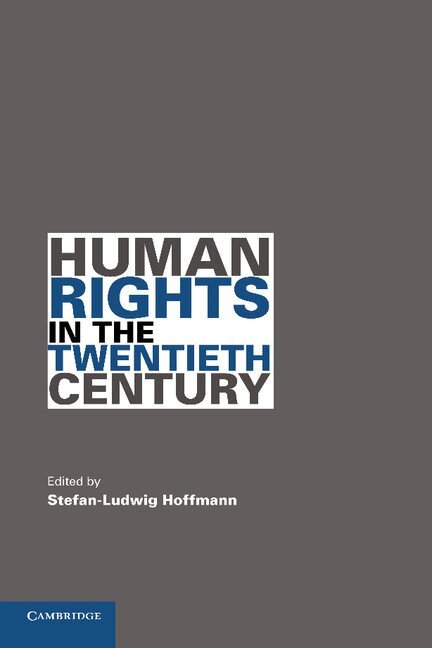
    Human Rights in the Twentieth Century

    AvStefan-Ludwig Hoffmann

    Häftad, Engelska, 2010

    Del i serien Human Rights in History

    443 kr

    Beställningsvara. Skickas inom 7-10 vardagar. Fri frakt över 249 kr.

    Beskrivning

    Has there always been an inalienable 'right to have rights' as part of the human condition, as Hannah Arendt famously argued? The contributions to this volume examine how human rights came to define the bounds of universal morality in the course of the political crises and conflicts of the twentieth century. Although human rights are often viewed as a self-evident outcome of this history, the essays collected here make clear that human rights are a relatively recent invention that emerged in contingent and contradictory ways. Focusing on specific instances of their assertion or violation during the past century, this volume analyzes the place of human rights in various arenas of global politics, providing an alternative framework for understanding the political and legal dilemmas that these conflicts presented. In doing so, this volume captures the state of the art in a field that historians have only recently begun to explore.

    Produktinformation

    • Utgivningsdatum:2010-12-13
    • Mått:155 x 235 x 19 mm
    • Vikt:520 g
    • Format:Häftad
    • Språk:Engelska
    • Serie:Human Rights in History
    • Antal sidor:366
    • Förlag:Cambridge University Press
    • ISBN:9780521142571

    Utforska kategorier

    • Politiskt förtryck inom Samhälle och politik

    Mer om författaren

    Stefan-Ludwig Hoffmann is Research Director at the Center for Research in Contemporary History, Potsdam, Germany, and has been a visiting scholar at the University of California, Berkeley and Stanford University. He is the author of the prizewinning The Politics of Sociability: Freemasonry and German Civil Society 1840–1918 (2007). Currently, he is preparing a short history of human rights and a book on Berlin in the wake of World War II.

    Recensioner i media

    'Human Rights in the Twentieth Century is a landmark in a field of supreme importance. It is enlightening and therefore disenchanting in the most constructive sense. It brings together a fine group of scholars, mainly historians, to provide historical perspective on a topic that is sorely lacking it and shows the contingency of the deployment of human rights as a political language, the varied roots of that language, and the diversity of objects that it can address.' Donald Bloxham, University of Edinburgh

    Innehållsförteckning

    • Introduction Stefan-Ludwig Hoffmann; Part I. The Emergence of Human Rights Regimes: 1. The end of civilization and the rise of human rights: the mid-20th century disjuncture Mark Mazower; 2. The 'human rights revolution' at work: displaced persons in post-war Europe G. Daniel Cohen; 3. Legal diplomacy: law, politics, and the genesis of postwar European human rights Mikael Rask Madsen; Part II. Postwar Universalism and Legal Theory: 4. Personalism, community, and the origins of human rights Samuel Moyn; 5. René Cassin: les droit de l'homme and the universality of human rights, 1945–66 Glenda Sluga; 6. Rudolf Laun and the human rights of Germans in occupied and early West Germany Lora Wildenthal; Part III. Human Rights, State Socialism, and Dissent: 7. Embracing and contesting: the Soviet Union and the Universal Declaration of Human Rights, 1948–58 Jennifer Amos; 8. Soviet rights-talk in the post-Stalin era Benjamin Nathans; 9. Charter 77 and the Roma: human rights and dissent in socialist Czechoslovakia Celia Donert; Part IV. Genocide, Humanitarianism, and the Limits of Law: 10. Toward world law? Human rights and the failure of the legalist paradigm of war Devin O. Pendas; 11. 'Source of embarrassment': human rights, state of emergency, and the wars of decolonization Fabian Klose; 12. The United Nations, humanitarianism and human rights: war crimes/genocide trials for Pakistani soldiers in Bangladesh, 1971–4 A. Dirk Moses; Part V. Human Rights, Sovereignty, and the Global Condition: 13. African nationalists and human rights, 1940s to 1970s Andreas Eckert; 14. The International Labour Organization and the globalization of rights, 1944–70 Daniel Roger Maul; 15. 'Under a magnifying glass': the international human rights campaign against Chile in the 1970s Jan Eckel.