Häftad, Engelska, 2014
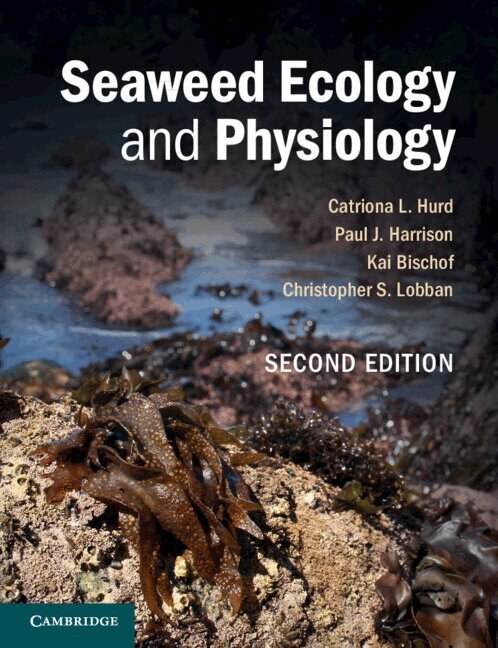
Seaweed Ecology and Physiology
Av Catriona L. Hurd, Paul J. Harrison, Kai Bischof, Christopher S. Lobban
1058 kr
Beställningsvara. Skickas inom 5-8 vardagar. Fri frakt över 249 kr.
Beskrivning
Produktinformation
- Utgivningsdatum: 2014-07-17
- Mått: 190 x 246 x 25 mm
- Vikt: 1 220 g
- Format: Häftad
- Språk: Engelska
- Antal sidor: 562
- Upplaga: 2
- Förlag: Cambridge University Press
- ISBN: 9780521145954
Utforska kategorier
Mer om författaren
Catriona L. Hurd is an Associate Professor in the Institute for Marine and Antarctic Studies, University of Tasmania, Australia. She is known for her work on water motion, photosynthetic and nutrient physiology along environmental gradients in the intertidal and subtidal and, most recently, on ocean acidification. Paul J. Harrison is Professor Emeritus in the Department of Earth and Ocean Sciences at the University of British Columbia, Vancouver, Canada. He is an expert in nutrient ecophysiology of seaweeds and phytoplankton, with over 40 years of research experience. Kai Bischof is Head of the Department of Marine Botany at the University of Bremen, Germany. His research covers all aspects of seaweed ecophysiology, with a focus on the field of light acclimation and oxidative stress management. Christopher S. Lobban is Professor of Biology in the Division of Natural Sciences at the University of Guam, Mangilao, USA. He has over 40 years of experience working with marine algae, including 25 years on coral reefs in Guam. He is currently investigating biodiversity of coral reef diatoms.
Recensioner i media
'The first edition has always been my desk-side reading for my courses on Biology of Algae and Ecophysiology and Biochemistry of Seaweeds, and a reference book for my undergraduate and graduate students. With the incorporation of the latest knowledge on seaweeds and the functioning of coastal ecosystems, and reference to the latest key papers, this significantly augmented second edition adds new content on topical subjects such as coalescence, molecular biology, community interactions, invasive species, chemical defenses, kleptoplasty, nutrient availability and eutrophication, UV exposure, and adaptation to wave action and other environmental changes such as ocean acidification. The chapter on seaweed mariculture has been considerably expanded and will be very useful for any aquaculture course in which seaweeds deserve full recognition for the biomass they represent (fifty-one per cent of the world mariculture production), their highly diversified applications and the key ecosystem services they provide.' Thierry Chopin, University of New Brunswick
Betyg & recensioner
0 recensioner
Inga recensioner tillgängliga.