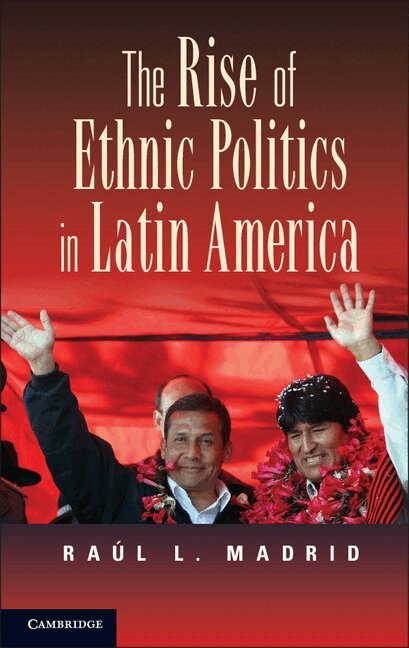
Häftad, Engelska, 2012
The Rise of Ethnic Politics in Latin America
455 kr
Beställningsvara. Skickas inom 5-8 vardagar. Fri frakt över 249 kr.
Beskrivning
Produktinformation
- Utgivningsdatum: 2012-03-30
- Mått: 155 x 234 x 15 mm
- Vikt: 360 g
- Format: Häftad
- Språk: Engelska
- Antal sidor: 256
- Förlag: Cambridge University Press
- ISBN: 9780521153256
Utforska kategorier
Mer om författaren
Raúl L. Madrid is Associate Professor in the Department of Government at the University of Texas, Austin. He is the author of Retiring the State: The Politics of Pension Privatization in Latin America and Beyond (2003) and is a co-editor of Leftist Governments in Latin America: Successes and Shortcomings (Cambridge University Press, 2010). His articles have appeared in Comparative Politics, Electoral Studies, Journal of Latin American Studies, Latin American Politics and Society, Latin American Research Review, Political Science Quarterly and World Politics.
Recensioner i media
'This is a well-executed and timely book. Madrid offers a novel theory about the success of ethnic parties under conditions of ethnic fluidity and intra-ethnic group fragmentation. Empirically, the author impressively triangulates qualitative and quantitative evidence from in-depth country studies to illustrate his story. The book contributes both to the general theoretical literature about the success of ethnic parties and the literature specifically focusing on Latin America. The policy implications drawn out in the last chapter and, to a lesser degree, in the substantive chapters are interesting and thought provoking. This book is an excellent read for anyone interested in ethnic politics in Latin America and beyond.' Jóhanna K. Birnir, University of Maryland
Betyg & recensioner
0 recensioner
Inga recensioner tillgängliga.