• Fri frakt över 249 kr
  • •
  • Snabba leveranser
  • •
  • Billiga böcker
Kundservice

Du är på sajten för privatpersoner.

Företag, bibliotek eller offentlig verksamhet?

Du handlar på classic.bokus.com, där alla dina funktioner finns intakta.
Till classic.bokus.com
Bokus logotyp. Gå till startsidan.
  • Erbjudanden
  • Nyheter
  • Student
  • Topplistor
  • Barn & ungdom
  • Bokus Play
  • E-böcker
  • Pocketböcker
  • Spel & pussel

10% rabatt på allt med kod: NYSTART10 →

Sidfot

Mina sidor

    Hjälp

    • Kundservice
    • Vanliga frågor och svar
    • Frakt och leverans
    • Retur vid ångerrätt
    • Reklamera vara
    • Betalning
    • Köpvillkor
    • Allmänna villkor
    • Information om webbplatsens tillgänglighet

    Om Bokus

    • Om oss
    • Pressrum
    • För studenter
    • För företag
    • För bibliotek och offentlig verksamhet
    • För leverantörer
    • Hållbarhet

    Populärt

    • Aktuella erbjudanden
    • Presentkort
    • Studentlitteratur
    • Nya böcker
    • Topplistor
    • Signerade böcker
    • Engelska böcker

    Inspiration

    • Boktips
    • BookTok
    • Populära bokserier
    • Barnbokskaraktärer
    • Populära författare
    Logotyp för Bokus
    Följ oss på Facebook (extern länk)Följ oss på Instagram (extern länk)Följ oss på YouTube (extern länk)Följ oss på TikTok (extern länk)
    bokus @ CookiesAnpassa cookiesIntegritetspolicyKöpvillkor
    Till Citymail hemsida (extern länk)Till Budbee hemsida (extern länk)Till Postnord hemsida (extern länk)Till Schenker hemsida (extern länk)Till Early Bird hemsida (extern länk)Till Walleys hemsida (extern länk)
    1. Historia och arkeologi
    2. Historia
    3. Europas historia

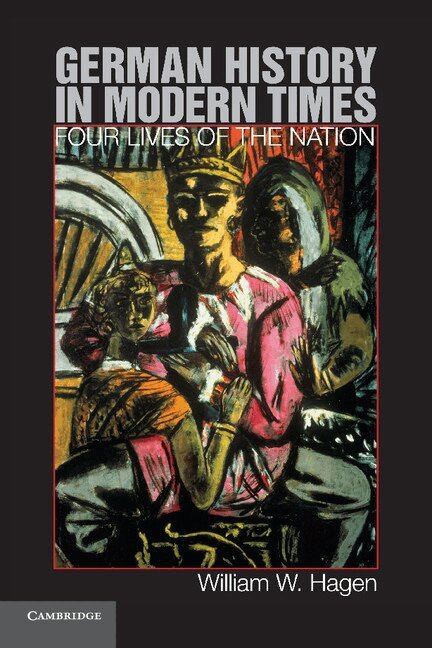
    German History in Modern Times

    Four Lives of the Nation

    AvWilliam W. Hagen

    Häftad, Engelska, 2012

    417 kr

    Beställningsvara. Skickas inom 10-15 vardagar. Fri frakt över 249 kr.

    Fler format och utgåvor

    Inbunden

    1 123 kr

    E-bok

    488 kr

    E-bok

    489 kr

    Beskrivning

    This history of German-speaking central Europe offers a very wide perspective, emphasizing a succession of many-layered communal identities. It highlights the interplay of individual, society, culture and political power, contrasting German with Western patterns. Rather than treating 'the Germans' as a collective whole whose national history amounts to a cumulative biography, the book presents the pre-modern era of the Holy Roman Empire; the nineteenth century; the 1914-45 era of war, dictatorship and genocide; and the Cold War and post-Cold War eras since 1945 as successive worlds of German life, thought and mentality. This book's 'Germany' is polycentric and multicultural, including the multinational Austrian Habsburg Empire and the German Jews. Its approach to National Socialism offers a conceptually new understanding of the Holocaust. The book's numerous illustrations reveal German self-presentations and styles of life, which often contrast with Western ideas of Germany.

    Produktinformation

    • Utgivningsdatum:2012-02-13
    • Mått:155 x 234 x 28 mm
    • Vikt:700 g
    • Format:Häftad
    • Språk:Engelska
    • Antal sidor:482
    • Förlag:Cambridge University Press
    • ISBN:9780521175210

    Utforska kategorier

    • Europas historia inom Historia och arkeologi

    Mer om författaren

    William W. Hagen is Professor of History at the University of California, Davis. He has held fellowships from the Alexander von Humboldt Foundation, the National Endowment for the Humanities, the Max-Planck Society and the Institute for Advanced Study, Princeton. He is the author of Germans, Poles, and Jews: The Nationality Conflict in the Prussian East, 1772–1914 and the prize-winning Ordinary Prussians: Brandenburg Junkers and Villagers, 1500–1840 (Cambridge University Press, 2003). His wide-ranging research articles have appeared in many publications, including The Journal of Modern History, Foreign Affairs, the American Historical Review, Past and Present, Historische Zeitschrift and Geschichte und Gesellschaft.

    Recensioner i media

    “Bill Hagen has written a remarkable book that reconceptualizes the course of German history in several critical dimensions. Not only does Hagen take on and challenge several of the most conventional historiographical interpretations of the longue durée of German history (the Sonderweg thesis, etc.), but he shows in a very compelling way that one cannot understand German history in the twentieth century without a deep and profound knowledge of the history of the several competing German nations before 1866 and even before 1806. The result is an elegantly written book of great ambition and fascinating detail, particularly strong in social and political history and filled with surprising interpretive suggestions. The many illustrations, deeply integrated into the multiple, cascading narratives of the book, are also quite noteworthy.” —John W. Boyer, University of Chicago

    Innehållsförteckning

    • 1. Master narratives and rival interpretations of modern German history; Part I. German Central Europe before Modern Nationalism: 2. The pyramid of power in pre-modern Germany; 3. Baroque and Enlightenment Germany, 1648–1789; 4. Power states (Machtstaaten): the rise of the Prussian and Austrian military-bureaucratic monarchies; 5. Aufklärung: the German Enlightenment and other spirits of the age; Part II. German Identities between Liberalism, Nationalism, and Socialism, 1789–1914: 6. Revolution on the march: French challenge, German response, 1789–1815; 7. 'Land of poets and thinkers': the transition from Enlightenment universalism to German national culture; 8. Freedom and voice, 'blood and iron': the struggle over liberalism and nationalism, 1815–1914; 9. Power to the people: German social democracy in the age of industrialization; 10. Women, family, feminism, 1789–1914; 11. Habsburg Austria: a multinational path in German history; 12. Jews, Germans, German Jews, 1789–1914; Part III. Nation in Crisis: Defeat, Turmoil, Aggression, 1914–15: 13. The Prussian-German monarchy's sudden death: World War I and postwar revolution, 1914–20; 14. Democracy's bitter fruits: society and politics, 1918–33; 15. The rise of Hitlerism: middle-class discontent and populist utopia; 16. The 'people's community' at Hitler's command: national and socialist Germany, 1933–45; 17. Lebensraum: the war for empire in Eastern Europe; 18. Banned from nation and earth: German Jews after 1914, Nazi 'Jewish policy', and the Holocaust; Part IV. The Cold War Germanies and their Post-1989 Fusion: A Nation Reforged from Its Remnants?: 19. Return from the abyss: defeated Germany and the West German Federal Republic, 1949–89; 20. 'Real existing socialism': Soviet-occupied Germany and the German Democratic Republic, 1949–90; 21. Present-day Germany: the post-unification scene in West and East.