• Fri frakt över 249 kr
  • •
  • Snabba leveranser
  • •
  • Billiga böcker
Kundservice

Du är på sajten för privatpersoner.

Företag, bibliotek eller offentlig verksamhet?

Du handlar på classic.bokus.com, där alla dina funktioner finns intakta.
Till classic.bokus.com
Bokus logotyp. Gå till startsidan.
  • Erbjudanden
  • Nyheter
  • Student
  • Topplistor
  • Barn & ungdom
  • Bokus Play
  • E-böcker
  • Pocketböcker
  • Spel & pussel

10% rabatt på allt med kod: NYSTART10 →

Sidfot

Mina sidor

    Hjälp

    • Kundservice
    • Vanliga frågor och svar
    • Frakt och leverans
    • Retur vid ångerrätt
    • Reklamera vara
    • Betalning
    • Köpvillkor
    • Allmänna villkor
    • Information om webbplatsens tillgänglighet

    Om Bokus

    • Om oss
    • Pressrum
    • För studenter
    • För företag
    • För bibliotek och offentlig verksamhet
    • För leverantörer
    • Hållbarhet

    Populärt

    • Aktuella erbjudanden
    • Presentkort
    • Studentlitteratur
    • Nya böcker
    • Topplistor
    • Signerade böcker
    • Engelska böcker

    Inspiration

    • Boktips
    • BookTok
    • Populära bokserier
    • Barnbokskaraktärer
    • Populära författare
    Logotyp för Bokus
    Följ oss på Facebook (extern länk)Följ oss på Instagram (extern länk)Följ oss på YouTube (extern länk)Följ oss på TikTok (extern länk)
    bokus @ CookiesAnpassa cookiesIntegritetspolicyKöpvillkor
    Till Citymail hemsida (extern länk)Till Budbee hemsida (extern länk)Till Postnord hemsida (extern länk)Till Schenker hemsida (extern länk)Till Early Bird hemsida (extern länk)Till Walleys hemsida (extern länk)
    1. Ekonomi och Ledarskap
    2. Nationalekonomi
    3. Mikroekonomi

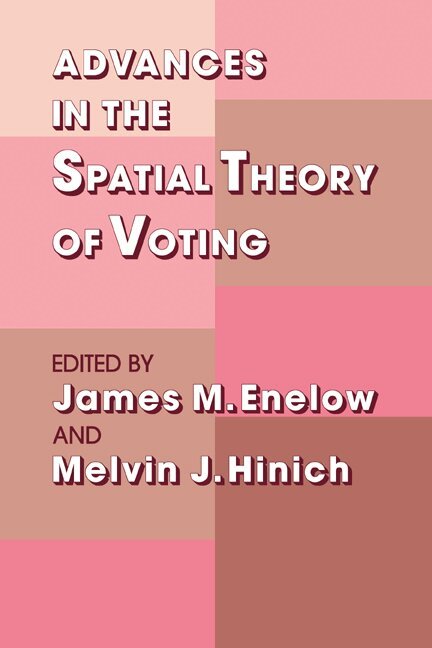
    Advances in the Spatial Theory of Voting

    AvJames M. Enelow,Melvin J. Hinich

    Inbunden, Engelska, 1990

    1 375 kr

    Beställningsvara. Skickas inom 10-15 vardagar. Fri frakt över 249 kr.

    Beskrivning

    This volume brings together eight original essays selected to provide an overview of the developments in the spatial theory of voting. The spatial theory of self-interest and explores the consequences of this assumption for elite behaviour and for the choices voters make in representative and direct democracies. The book summarizes work in eight major areas: elections with possible entry by new candidates who have policy preferences, experimental testing of spatial models of committees and elections, elections with imperfect information about voting intentions, voting on alternatives that are linked to future decisions, elections with candidates who have policy preferences, experimental testing of spatial manoeuvres designed to alter voting outcomes, elections with experimental testing of spatial models of committees and elections, elections with imperfect information about voting intentions, voting on alternatives that are linked to future decisions, elections with more than two candidates under different election rules, and bureaucratic efforts to manipulate referendum voting. Recognized scholars in these areas summarize the major results of their own and others' work, providing self-contained discussions that will apprise readers of important recent advances.

    Produktinformation

    • Utgivningsdatum:1990-06-29
    • Mått:152 x 240 x 22 mm
    • Vikt:475 g
    • Format:Inbunden
    • Språk:Engelska
    • Antal sidor:256
    • Förlag:Cambridge University Press
    • ISBN:9780521352840

    Utforska kategorier

    • Mikroekonomi inom Ekonomi och Ledarskap

    Recensioner i media

    "This is a first-rate collection useful to students, practitioners, and critics." George Rabinowitz, Contemporary Sociology

    Innehållsförteckning

    • Foreword; 1. Introduction James M. Enelow and Melvin J. Hinich; 2. Multiparty competition, entry, and entry deterrence in spatial models of elections Kenneth A. Shepsle and Ronald N. Cohen; 3. Heresthetic and rhetoric in the spatial model William H. Riker; 4. Spatial strategies when candidates have policy preferences Donald Wittman; 5. A decade of experimental research on spatial models of elections and committees Richard D. McKelvey and Peter C. Ordeshook; 6. Candidate uncertainty and electoral equilibria Peter J. Coughlin; 7. The theory of predictive mappings James M. Enelow and Melvin J. Hinich; 8. Multicandidate spatial competition Gary W. Cox; 9. The setter model Howard Rosenthal; Author index; Subject index.