Melvin J. Hinich - Böcker
Visar alla böcker från författaren Melvin J. Hinich. Handla med fri frakt och snabb leverans.
9 produkter
9 produkter
Del 17 - International Symposia in Economic Theory and Econometrics
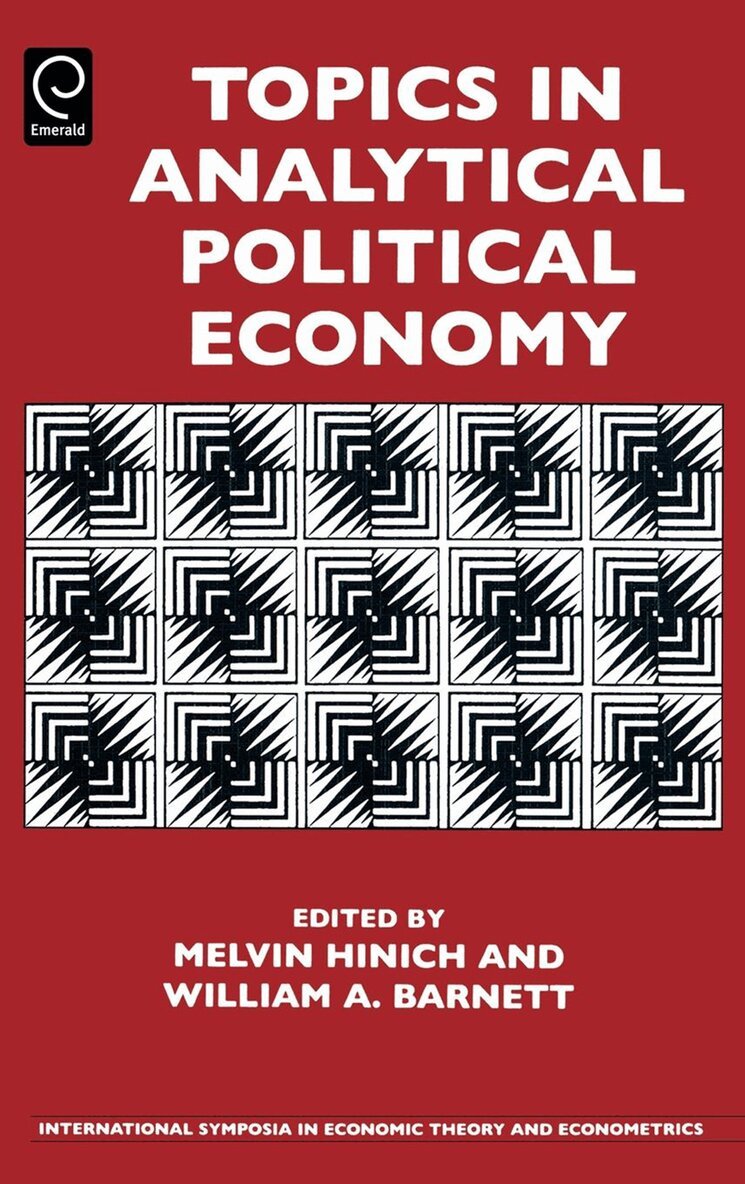
Topics in Analytical Political Economy
Inbunden, Engelska, 2007
2 007 kr
Skickas inom 5-8 vardagar
The nine papers in this volume are a diverse set of quality contributions to the field in economics that is called political economy. It is important to understand that social scientists hold different interpretations of the term political economy. Most mainstream economists expect a paper in the field to use the same models as are used in neoclassical economics, be it micro or macro. The field of political economy is seen by most economists to be exclusively the purview of their field. However, the political system of a country determines the nature of its economics system. The economy feeds back to the political system but the rules of the game are determined by the political system. The study of politics is the hardest task in the social sciences. The political system defines the scope of the economics system while taking resources from the economy in order to run campaigns and produce the types of compromises that are required of a stable political system that allows economic agents to make sensible investments. The interaction between the highly inter-dependant yet very different fields of politics and economics forms the basis of this volume. It contains a collection of key papers on the topic of analytical political economy. The papers authored by some of the foremost experts in the field. It is part of the "ISETE" series.
474 kr
Skickas inom 7-10 vardagar
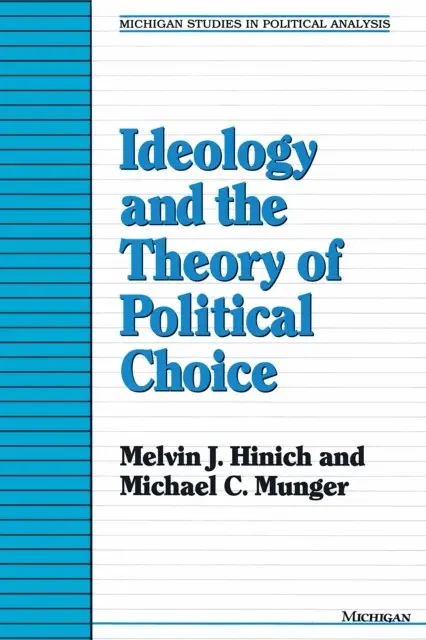
There is no unified theory that can explain both voter choice and where choices come from. Hinich and Munger fill that gap with their model of political communication based on ideology. Rather than beginning with voters and diffuse, atomistic preferences, Hinich and Munger explore why large groups of voters share preference profiles, why they consider themselves "liberals" or "conservatives." The reasons, they argue, lie in the twin problems of communication and commitment that politicians face. Voters, overloaded with information, ignore specific platform positions. Parties and candidates therefore communicate through simple statements of goals, analogies, and by invoking political symbols. But politicians must also commit to pursuing the actions implied by these analogies and symbols. Commitment requires that ideologies be used consistently, particularly when it is not in the party's short-run interest.The model Hinich and Munger develop accounts for the choices of voters, the goals of politicians, and the interests of contributors. It is an important addition to political science and essential reading for all in that discipline."Hinich and Munger's study of ideology and the theory of political choice is a pioneering effort to integrate ideology into formal political theory. It is a major step in directing attention toward the way in which ideology influences the nature of political choices." --Douglass C. North". . . represents a significant contribution to the literature on elections, voting behavior, and social choice." --Policy Currents Melvin Hinich is Professor of Government, University of Texas. Michael C. Munger is Associate Professor of Political Science, University of North Carolina.
441 kr
Skickas inom 7-10 vardagar
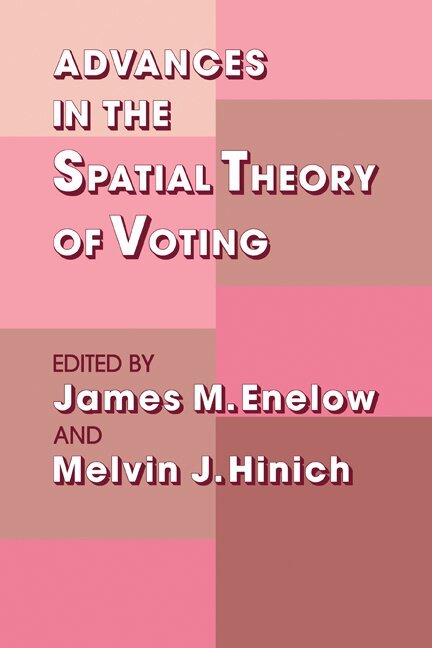
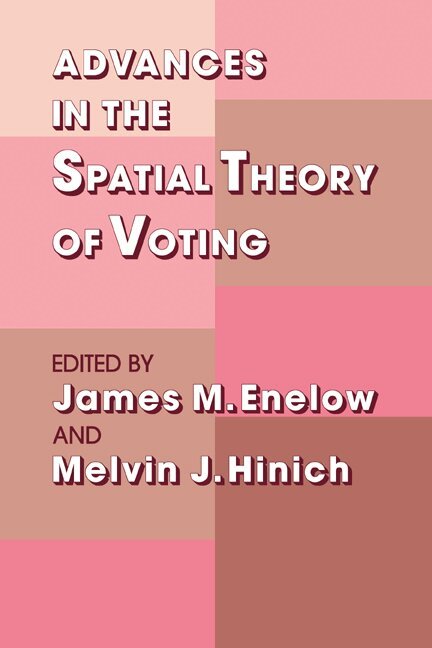
This volume brings together eight original essays selected to provide an overview of the developments in the spatial theory of voting. The spatial theory of self-interest and explores the consequences of this assumption for elite behaviour and for the choices voters make in representative and direct democracies. The book summarizes work in eight major areas: elections with possible entry by new candidates who have policy preferences, experimental testing of spatial models of committees and elections, elections with imperfect information about voting intentions, voting on alternatives that are linked to future decisions, elections with candidates who have policy preferences, experimental testing of spatial manoeuvres designed to alter voting outcomes, elections with experimental testing of spatial models of committees and elections, elections with imperfect information about voting intentions, voting on alternatives that are linked to future decisions, elections with more than two candidates under different election rules, and bureaucratic efforts to manipulate referendum voting. Recognized scholars in these areas summarize the major results of their own and others' work, providing self-contained discussions that will apprise readers of important recent advances.
428 kr
Skickas inom 7-10 vardagar
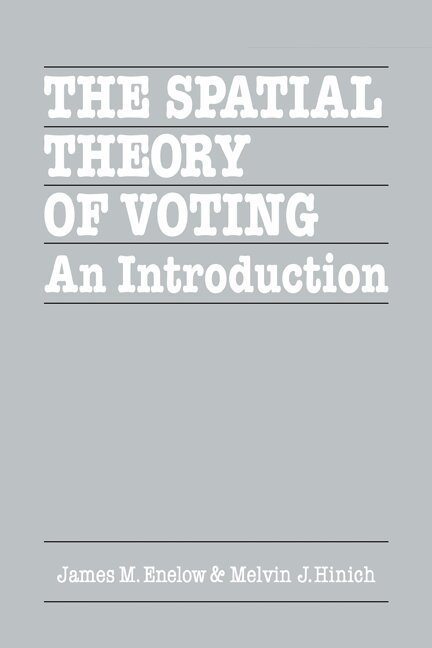
This book provides an introduction to an important approach to the study of voting and elections: the spatial theory of voting. In contrast to the social-psychological approach to studying voting behaviour, the spatial theory of voting is premised on the idea of self-interested choice. Voters cast votes on the basis of their evaluation of the candidates or policy alternatives competing for their vote. Candidates fashion their appeals to the voters in an effort to win votes. The spatial theory provides explicit definitions for these behavioural assumptions to determines the form that self-interested behaviour will take. The consequences of this behaviour for the type of candidate or policy that voters will select is the major focus of the theory. There is a twofold purpose to this work. The first is to provide an elementary but rigourous introduction to an important body of political science research. The second is to design and test a spatial theory of elections that provides insights into the nature of election contests. The book will appeal to a wide audience, since the mathematics is kept to an accessible level.
1 282 kr
Skickas inom 7-10 vardagar
This volume brings together eight original essays selected to provide an overview of the developments in the spatial theory of voting. The spatial theory of self-interest and explores the consequences of this assumption for elite behaviour and for the choices voters make in representative and direct democracies. The book summarizes work in eight major areas: elections with possible entry by new candidates who have policy preferences, experimental testing of spatial models of committees and elections, elections with imperfect information about voting intentions, voting on alternatives that are linked to future decisions, elections with candidates who have policy preferences, experimental testing of spatial manoeuvres designed to alter voting outcomes, elections with experimental testing of spatial models of committees and elections, elections with imperfect information about voting intentions, voting on alternatives that are linked to future decisions, elections with more than two candidates under different election rules, and bureaucratic efforts to manipulate referendum voting. Recognized scholars in these areas summarize the major results of their own and others' work, providing self-contained discussions that will apprise readers of important recent advances.
586 kr
Skickas inom 7-10 vardagar
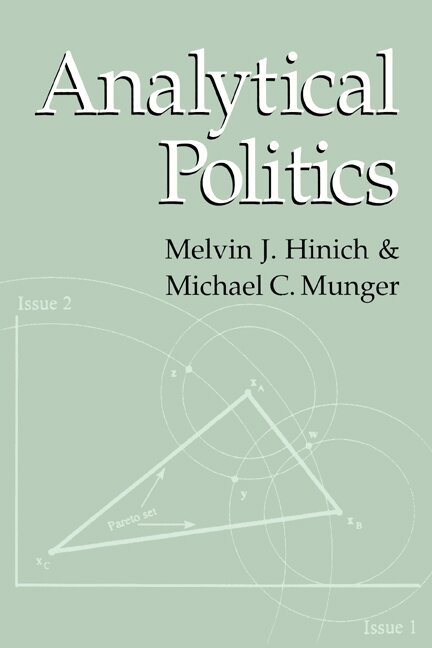
To 'analyse' means to break into components and understand. But new readers find modern mathematical theories of politics so inaccessible that analysis is difficult. Where does one start? Analytical Politics is an introduction to analytical theories of politics, explicitly designed both for the interested professional and students in political science. We cannot evaluate how well governments perform without some baseline for comparison: what should governments be doing? This book focuses on the role of the 'center' in politics, drawing from the classical political theories of Aristotle, Hobbes, Rousseau, and others. The main questions in Analytical Politics involve the existence and stability of the center; when does it exist? When should the center guide policy? How do alternative voting rules help in discovering the center? An understanding of the work reviewed here is essential for anyone who hopes to evaluate the performance or predict the actions of democratic governments.
347 kr
Skickas inom 7-10 vardagar
To 'analyse' means to break into components and understand. But new readers find modern mathematical theories of politics so inaccessible that analysis is difficult. Where does one start? Analytical Politics is an introduction to analytical theories of politics, explicitly designed both for the interested professional and students in political science. We cannot evaluate how well governments perform without some baseline for comparison: what should governments be doing? This book focuses on the role of the 'center' in politics, drawing from the classical political theories of Aristotle, Hobbes, Rousseau, and others. The main questions in Analytical Politics involve the existence and stability of the center; when does it exist? When should the center guide policy? How do alternative voting rules help in discovering the center? An understanding of the work reviewed here is essential for anyone who hopes to evaluate the performance or predict the actions of democratic governments.
1 578 kr
Skickas inom 10-15 vardagar
This volume presents a collection of papers analyzing the political systems of ten nations. It aims to provoke a conscious effort to compare, and investigate, the public choice of comparative politics. There have been many publications by public choice scholars, and many more by researchers who are at least sympathetic to the public choice perspective, yet little of this work has been integrated into the main stream of comparative political science literature. This work, however, presents an empirically oriented study of the politics, bureaucratic organization, and regulated economies of particular nations in the canon of the comparativist. It therefore provides a public choice view at the level of nations, not of systems. This compendium of work on comparative politics meets two criteria: a model of human behaviour or institutional impact is specified; and this model is confronted with data appropriate for evaluating whether it is useful for understanding politics in one or more nations.
1 578 kr
Skickas inom 10-15 vardagar
Empirical Studies in Comparative Politics presents a collection of papers analyzing the political systems of ten nations. It intends to provoke a conscious effort to compare, and investigate, the public choice of comparative politics. There have been many publications by public choice scholars, and many more by researchers who are at least sympathetic to the public choice perspective, yet little of this work has been integrated into the main stream of comparative political science literature. This work, however, presents an empirically oriented study of the politics, bureaucratic organization, and regulated economies of particular nations in the canon of the comparativist. It therefore provides a public choice view at the level of nations, not of systems. This compendium of work on comparative politics meets two criteria: In every case, a model of human behavior or institutional impact is specified; Also in every case, this model is confronted with data appropriate for evaluating whether this model is useful for understanding politics in one or more nations.