• Fri frakt över 249 kr
  • •
  • Snabba leveranser
  • •
  • Billiga böcker
Kundservice

Du är på sajten för privatpersoner.

Företag, bibliotek eller offentlig verksamhet?

Du handlar på classic.bokus.com, där alla dina funktioner finns intakta.
Till classic.bokus.com
Bokus logotyp. Gå till startsidan.
  • Erbjudanden
  • Nyheter
  • Student
  • Topplistor
  • Barn & ungdom
  • Bokus Play
  • E-böcker
  • Pocketböcker
  • Spel & pussel

Må bättre, för mindre! Upp till 50% rabatt på hälsoböcker

Sidfot

Mina sidor

    Hjälp

    • Kundservice
    • Vanliga frågor och svar
    • Frakt och leverans
    • Retur vid ångerrätt
    • Reklamera vara
    • Betalning
    • Köpvillkor
    • Allmänna villkor
    • Information om webbplatsens tillgänglighet

    Om Bokus

    • Om oss
    • Pressrum
    • För studenter
    • För företag
    • För bibliotek och offentlig verksamhet
    • För leverantörer
    • Hållbarhet

    Populärt

    • Aktuella erbjudanden
    • Presentkort
    • Studentlitteratur
    • Nya böcker
    • Topplistor
    • Signerade böcker
    • Engelska böcker

    Inspiration

    • Boktips
    • BookTok
    • Populära bokserier
    • Barnbokskaraktärer
    • Populära författare
    Logotyp för Bokus
    Följ oss på Facebook (extern länk)Följ oss på Instagram (extern länk)Följ oss på YouTube (extern länk)Följ oss på TikTok (extern länk)
    bokus @ CookiesAnpassa cookiesIntegritetspolicyKöpvillkor
    Till Citymail hemsida (extern länk)Till Budbee hemsida (extern länk)Till Postnord hemsida (extern länk)Till Schenker hemsida (extern länk)Till Early Bird hemsida (extern länk)Till Walleys hemsida (extern länk)
    1. Djur och Natur
    2. Naturböcker
    3. Växtböcker

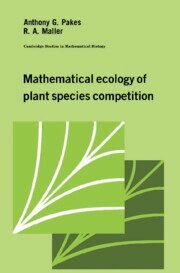
    Mathematical Ecology of Plant Species Competition

    AvAnthony G. Pakes,R. A. Maller

    Inbunden, Engelska, 1990

    Del 10 i serien Cambridge Studies in Mathematical Biology

    1 616 kr

    Beställningsvara. Skickas inom 10-15 vardagar. Fri frakt över 249 kr.

    Fler format och utgåvor

    Häftad

    572 kr

    Beskrivning

    Presented in this document is a class of deterministic models describing the dynamics of two plant species whose characteristics are common to the majority of annual plants that have a seedbank. Formulated in terms of elementary dynamical systems, these models were developed in response to four major questions on the long-term outcomes of binary mixtures of plant species: Is ultimate coexistence possible? If not, which strain will win? Does the mixture approach an equilibrium? If so, how long does the mixture take to attain it? The book gives a detailed account of model construction, analysis and application to field data obtained from long-term trials. In the particular case study modelled, the species involved are two pastural strains whose dynamics have critical agricultural and economic implications for the areas in which they are found, including North America, the Mediterranean region and Australia. This study will be valuable to researchers and students in mathematical biology and to agronomists and botanists interested in population dynamics.

    Produktinformation

    • Utgivningsdatum:1990-08-31
    • Mått:160 x 237 x 23 mm
    • Vikt:510 g
    • Format:Inbunden
    • Språk:Engelska
    • Serie:Cambridge Studies in Mathematical Biology
    • Antal sidor:208
    • Förlag:Cambridge University Press
    • ISBN:9780521373883

    Utforska kategorier

    • Växtböcker inom Djur och Natur
    • Botanik inom Naturvetenskap och teknik
    • Naturvetenskap:allmänt inom Naturvetenskap och teknik

    Recensioner i media

    "...presents an interesting application of higher-level mathematical modeling to solving real world biological problems. It should be read by both applied mathematicians and biologists interested in competition theory." N.C. Kenkel, SIAM Reviews

    Innehållsförteckning

    • Preface; Part I. Introduction; Part II. Mathematical formulation of the models; Part III. Analysis of Model G: Introduction; Part IV. Analysis of Model G: no interior equilibrium; Part V. Analysis of Model G: one interior equilibrium; Part VI. Analysis of Model 2; Part VII. Application of the models; Part VIII. A single strain model with cropping and tillage; Bibliography; Indexes.