• Fri frakt över 249 kr
  • •
  • Snabba leveranser
  • •
  • Billiga böcker
Kundservice

Du är på sajten för privatpersoner.

Företag, bibliotek eller offentlig verksamhet?

Du handlar på classic.bokus.com, där alla dina funktioner finns intakta.
Till classic.bokus.com
Bokus logotyp. Gå till startsidan.
  • Erbjudanden
  • Nyheter
  • Student
  • Topplistor
  • Barn & ungdom
  • Bokus Play
  • E-böcker
  • Pocketböcker
  • Spel & pussel

10% rabatt på allt med kod NYSTART10 →

Sidfot

Mina sidor

    Hjälp

    • Kundservice
    • Vanliga frågor och svar
    • Frakt och leverans
    • Retur vid ångerrätt
    • Reklamera vara
    • Betalning
    • Köpvillkor
    • Allmänna villkor
    • Information om webbplatsens tillgänglighet

    Om Bokus

    • Om oss
    • Pressrum
    • För studenter
    • För företag
    • För bibliotek och offentlig verksamhet
    • För leverantörer
    • Hållbarhet

    Populärt

    • Aktuella erbjudanden
    • Presentkort
    • Studentlitteratur
    • Nya böcker
    • Topplistor
    • Signerade böcker
    • Engelska böcker

    Inspiration

    • Boktips
    • BookTok
    • Populära bokserier
    • Barnbokskaraktärer
    • Populära författare
    Logotyp för Bokus
    Följ oss på Facebook (extern länk)Följ oss på Instagram (extern länk)Följ oss på YouTube (extern länk)Följ oss på TikTok (extern länk)
    bokus @ CookiesAnpassa cookiesIntegritetspolicyKöpvillkor
    Till Citymail hemsida (extern länk)Till Budbee hemsida (extern länk)Till Postnord hemsida (extern länk)Till Schenker hemsida (extern länk)Till Early Bird hemsida (extern länk)Till Walleys hemsida (extern länk)
    1. Skönlitteratur
    2. Litteraturvetenskap
    3. Litteraturvetenskap

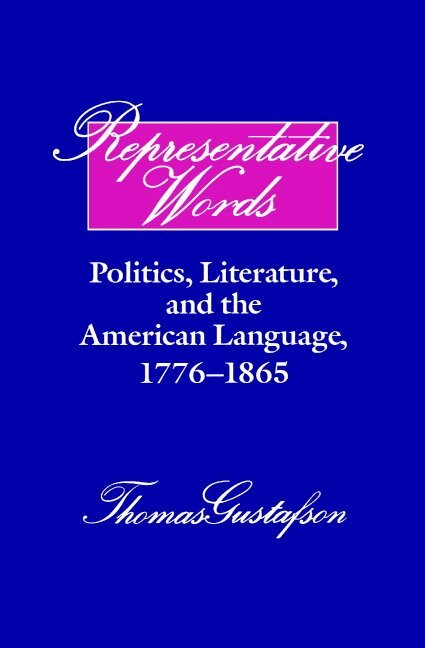
    Representative Words

    Politics, Literature, and the American Language, 1776-1865

    AvThomas Gustafson,Albert Gelpi

    Inbunden, Engelska, 1993

    Del 60 i serien Cambridge Studies in American Literature and Culture

    2 050 kr

    Beställningsvara. Skickas inom 10-15 vardagar. Fri frakt över 249 kr.

    Fler format och utgåvor

    Häftad

    735 kr

    Beskrivning

    Ralph Waldo Emerson's dictum - 'The corruption of man is followed by the corruption of language' - belongs to a long tradition of writing connecting political disorders and the corruption of language that stretches back in Western culture. Representative Words, which gives an account of the tradition from its classical and Christian origins through the Enlightenment, is primarily a study of how and why Americans renewed and developed it between the ages of the Revolutionary and the Civil Wars. It is the first comprehensive treatment of the background to and the appearance of the wealth of theories about language in the early era of American political and cultural discourse. Professor Gustafson's argument demonstrates the interconnectedness of the state of language and the state of society and turns on the question of representation and misrepresentation - whether and how words represent or misrepresent nature, social reality, truth, and value in the new American experiment in representative republican government.

    Produktinformation

    • Utgivningsdatum:1993-01-29
    • Mått:158 x 235 x 28 mm
    • Vikt:758 g
    • Format:Inbunden
    • Språk:Engelska
    • Serie:Cambridge Studies in American Literature and Culture
    • Antal sidor:488
    • Förlag:Cambridge University Press
    • ISBN:9780521395120

    Utforska kategorier

    • Litteraturvetenskap inom Skönlitteratur

    Recensioner i media

    "Thomas Gustafson's Representative Words is a sweeping summary of American writing about language between the Revolution and the Civil War. It is, among other things, a wonderful source....The book is a gold mine of information." Journal of American History

    Innehållsförteckning

    • Acknowledgments; Introduction; Part I. The American Logocracy: The Nexus of Word and Act: 1. Political and linguistic representation: confidence or distrust?; 2. Language and legal constitutions: the problem of change and who governs; Part II. Political and Linguistic Corruption: The Ideological Inheritance: 3. The classical pattern: from the order or Orpheus to the chaos of the Thucydidean moment; 4. The Christian typology: From Eden to Babel to Pentecost; 5. Eloquence, liberty, and power: civic humanism and the counter-renaissance; 6. The enlightenment project: language reform and political order; Part III. The American Language of Revolution and Constitutional Change: 7. The language of revolution: combating misrepresentation with the pen and tongue; 8. The grammar of politics: the constitution; Part IV. From Logomachy to Civil War: The Politics of Language in Post-Revolutionary America; 9. The unsettled language: schoolmasters vs. truants; 10. Corrupt language and a corrupt body politic, or the disunion of words and things; 11. Sovereign words vs. representative men; Afterword; Notes; Index.