• Fri frakt över 249 kr
  • •
  • Snabba leveranser
  • •
  • Billiga böcker
Kundservice

Du är på sajten för privatpersoner.

Företag, bibliotek eller offentlig verksamhet?

Du handlar på classic.bokus.com, där alla dina funktioner finns intakta.
Till classic.bokus.com
Bokus logotyp. Gå till startsidan.
  • Erbjudanden
  • Student
  • Topplistor
  • Barn & ungdom
  • Bokus Play
  • E-böcker
  • Ljudböcker
  • Pocketböcker
  • Spel och pussel

Pocketfynda! Hundratals böcker för 49 kr/st →

Sidfot

Mina sidor

    Hjälp

    • Kundservice
    • Vanliga frågor och svar
    • Frakt och leverans
    • Retur vid ångerrätt
    • Reklamera vara
    • Betalning
    • Köpvillkor
    • Allmänna villkor
    • Information om webbplatsens tillgänglighet

    Om Bokus

    • Om oss
    • Pressrum
    • För studenter
    • För företag
    • För bibliotek och offentlig verksamhet
    • För leverantörer
    • Hållbarhet

    Populärt

    • Aktuella erbjudanden
    • Presentkort
    • Studentlitteratur
    • Nya böcker
    • Topplistor
    • Signerade böcker
    • Engelska böcker

    Inspiration

    • Boktips
    • BookTok
    • Barnbokskaraktärer
    • Populära författare
    Logotyp för Bokus
    Följ oss på Facebook (extern länk)Följ oss på Instagram (extern länk)Följ oss på YouTube (extern länk)Följ oss på TikTok (extern länk)
    bokus @ CookiesAnpassa cookiesIntegritetspolicyKöpvillkor
    Till Citymail hemsida (extern länk)Till Budbee hemsida (extern länk)Till Postnord hemsida (extern länk)Till Schenker hemsida (extern länk)Till Early Bird hemsida (extern länk)Till Walleys hemsida (extern länk)
    1. Psykologi och pedagogik
    2. Psykologi
    3. Socialpsykologi och gruppsykologi

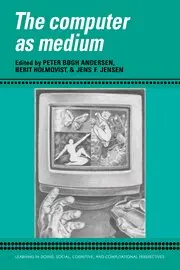
    The Computer as Medium

    AvPeter Bxgh Andersen,Berit Holmqvist

    Inbunden, Engelska, 1994

    Del i serien Learning in Doing: Social, Cognitive and Computational Perspectives

    1 727 kr

    Beställningsvara. Skickas inom 7-10 vardagar. Fri frakt över 249 kr.

    Beskrivning

    Computers are developing into a powerful medium integrating film, pictures, text and sound, and the use of computers for communication and information is rapidly expanding. The Computer as Medium brings insights from art, literature and theatre to bear on computers and discusses the communicative and organizational nature of computer networks within a historical perspective. The book consists of three parts. The first part characterizes the semiotic nature of computers and discusses semiotic approaches to programming and interface design. The second part discusses narrative and aesthetic issues of interactive fiction, information systems and hypertext. The final part contains papers on the cultural, organizational and historical impact of computers.The broad and rich coverage of this book will appeal to scholars in cognitive science, computer science, linguistics, semiotics, media studies and mass communications, cultural studies and education.

    Produktinformation

    • Utgivningsdatum:1994-03-25
    • Mått:161 x 236 x 33 mm
    • Vikt:879 g
    • Format:Inbunden
    • Språk:Engelska
    • Serie:Learning in Doing: Social, Cognitive and Computational Perspectives
    • Antal sidor:508
    • Förlag:Cambridge University Press
    • ISBN:9780521419956

    Utforska kategorier

    • Socialpsykologi och gruppsykologi inom Psykologi och pedagogik

    Innehållsförteckning

    • Series foreword; Preface; Contributors; Part I. Computer-Based Signs: Introduction Peter Bøgh Andersen; 1. A semiotic approach to programming Peter Bøgh Andersen; 2. Structuralism, computation and cognition: the contribution of glossematics David Piotrowski; 3. The shortest way between two points is a good idea: signs, Peirce and theorematic machines Keld Gall Jørgensen; 4. Logic grammar and the triadic sign relation Per Hasle; 5. Meaning and the machine: toward a semiotics of interaction Per Aage Brandt; Part II. The Rhetoric of Interactive Media: Introduction Berit Holmqvist; 6. Narrative computer systems: the dialectics of emotion and formalism Berit Holmqvist and Peter Bøgh Andersen; 7. Interactive fiction: artificial intelligence as a mode of sign production Peter Bøgh Andersen and Berit Holmqvist; 8. Plays, theatres and the art of acting in the eighteenth century: a formal analysis Jens Hougaard; 9. The meaning of plot and narrative Jørgen Bang; 10. Face to interface Berit Holmqvist; 11. Drawing and programming Bjørn Laursen and Peter Bøgh Andersen; 12. Hypermedia communication and academic discourse: some speculations on a future genre Gunnar Liestøl; Part III. Computers In Context: Introduction Jens F. Jensen; 13. Computer culture: the meaning of technology and the technology of meaning Jens F. Jensen; 14. One person, one computer: the social construction of the personal computer Klaus Bruhn Jensen; 15. Hi-tech network organizations as self-referential systems Lars Qvortrup; Comment: disturbing communication Peter Bøgh Andersen; 16. Dialogues in networks Elsebeth Korsgaard Sorensen; 17. Historical trends in computer and information technology Jens Christensen; Comment: the history of computer-based signs Peter Bøgh Andersen; 18. A historical perspective on work practices and technology Randi Markussen; 19. Hypertext: from modern utopia to post-modern dystopia? Bjørn Sørenssen; Index.