• Fri frakt över 249 kr
  • •
  • Snabba leveranser
  • •
  • Billiga böcker
Kundservice

Du är på sajten för privatpersoner.

Företag, bibliotek eller offentlig verksamhet?

Du handlar på classic.bokus.com, där alla dina funktioner finns intakta.
Till classic.bokus.com
Bokus logotyp. Gå till startsidan.
  • Erbjudanden
  • Nyheter
  • Student
  • Topplistor
  • Barn & ungdom
  • Bokus Play
  • E-böcker
  • Pocketböcker
  • Spel & pussel

10% rabatt på allt med kod NYSTART10 →

Sidfot

Mina sidor

    Hjälp

    • Kundservice
    • Vanliga frågor och svar
    • Frakt och leverans
    • Retur vid ångerrätt
    • Reklamera vara
    • Betalning
    • Köpvillkor
    • Allmänna villkor
    • Information om webbplatsens tillgänglighet

    Om Bokus

    • Om oss
    • Pressrum
    • För studenter
    • För företag
    • För bibliotek och offentlig verksamhet
    • För leverantörer
    • Hållbarhet

    Populärt

    • Aktuella erbjudanden
    • Presentkort
    • Studentlitteratur
    • Nya böcker
    • Topplistor
    • Signerade böcker
    • Engelska böcker

    Inspiration

    • Boktips
    • BookTok
    • Populära bokserier
    • Barnbokskaraktärer
    • Populära författare
    Logotyp för Bokus
    Följ oss på Facebook (extern länk)Följ oss på Instagram (extern länk)Följ oss på YouTube (extern länk)Följ oss på TikTok (extern länk)
    bokus @ CookiesAnpassa cookiesIntegritetspolicyKöpvillkor
    Till Citymail hemsida (extern länk)Till Budbee hemsida (extern länk)Till Postnord hemsida (extern länk)Till Schenker hemsida (extern länk)Till Early Bird hemsida (extern länk)Till Walleys hemsida (extern länk)
    1. Data och IT
    2. Systemvetenskap och AI

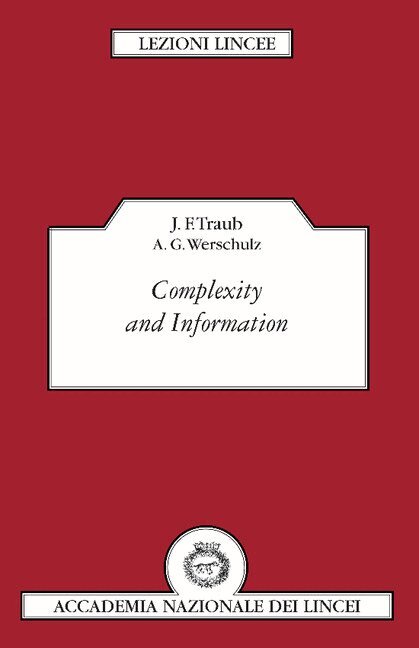
    Complexity and Information

    AvJ. F. Traub,A. G. Werschulz

    Häftad, Engelska, 1998

    Del i serien Lezioni Lincee

    635 kr

    Beställningsvara. Skickas inom 10-15 vardagar. Fri frakt över 249 kr.

    Beskrivning

    The twin themes of computational complexity and information pervade this 1998 book. It starts with an introduction to the computational complexity of continuous mathematical models, that is, information-based complexity. This is then used to illustrate a variety of topics, including breaking the curse of dimensionality, complexity of path integration, solvability of ill-posed problems, the value of information in computation, assigning values to mathematical hypotheses, and new, improved methods for mathematical finance. The style is informal, and the goals are exposition, insight and motivation. A comprehensive bibliography is provided, to which readers are referred for precise statements of results and their proofs. As the first introductory book on the subject it will be invaluable as a guide to the area for the many students and researchers whose disciplines, ranging from physics to finance, are influenced by the computational complexity of continuous problems.

    Produktinformation

    • Utgivningsdatum:1998-12-10
    • Mått:140 x 216 x 9 mm
    • Vikt:200 g
    • Format:Häftad
    • Språk:Engelska
    • Serie:Lezioni Lincee
    • Antal sidor:154
    • Förlag:Cambridge University Press
    • ISBN:9780521485067

    Utforska kategorier

    • Systemvetenskap och AI inom Data och IT
    • Matematisk statistik inom Naturvetenskap och teknik

    Recensioner i media

    'Clearly written, filled with interesting examples, important theorems and tantalising conjectures, this is destined to be a classic.' New Scientist

    Innehållsförteckning

    • Part I. Fundamentals: 1. Introduction; 2. Information-based complexity; 3. Breaking the curse of dimensionality; Part II. Some Interesting Topics: 4. Very high-dimensional integration and mathematical finance; 5. Complexity of path integration; 6. Are ill-posed problems solvable?; 7. Complexity of nonlinear problems; 8. What model of computation should be used by scientists?; 9. Do impossibility theorems from formal models limit scientific knowledge? 10. Complexity of linear programming; 11. Complexity of verification; 12. Complexity of implementation testing; 13. Noisy information; 14. Value of information in computation; 15. Assigning values to mathematical hypotheses; 16. Open problems; 17. A brief history of information-based complexity; Part III. References: 18. A guide to the literature; Bibliography; Subject index; Author index.