• Fri frakt över 249 kr
  • •
  • Snabba leveranser
  • •
  • Billiga böcker
Kundservice

Du är på sajten för privatpersoner.

Företag, bibliotek eller offentlig verksamhet?

Du handlar på classic.bokus.com, där alla dina funktioner finns intakta.
Till classic.bokus.com
Bokus logotyp. Gå till startsidan.
  • Erbjudanden
  • Student
  • Topplistor
  • Barn & ungdom
  • Bokus Play
  • E-böcker
  • Ljudböcker
  • Pocketböcker
  • Spel och pussel

Pocketfynda! Hundratals böcker för 49 kr/st →

Sidfot

Mina sidor

    Hjälp

    • Kundservice
    • Vanliga frågor och svar
    • Frakt och leverans
    • Retur vid ångerrätt
    • Reklamera vara
    • Betalning
    • Köpvillkor
    • Allmänna villkor
    • Information om webbplatsens tillgänglighet

    Om Bokus

    • Om oss
    • Pressrum
    • För studenter
    • För företag
    • För bibliotek och offentlig verksamhet
    • För leverantörer
    • Hållbarhet

    Populärt

    • Aktuella erbjudanden
    • Presentkort
    • Studentlitteratur
    • Nya böcker
    • Topplistor
    • Signerade böcker
    • Engelska böcker

    Inspiration

    • Boktips
    • BookTok
    • Barnbokskaraktärer
    • Populära författare
    Logotyp för Bokus
    Följ oss på Facebook (extern länk)Följ oss på Instagram (extern länk)Följ oss på YouTube (extern länk)Följ oss på TikTok (extern länk)
    bokus @ CookiesAnpassa cookiesIntegritetspolicyKöpvillkor
    Till Citymail hemsida (extern länk)Till Budbee hemsida (extern länk)Till Postnord hemsida (extern länk)Till Schenker hemsida (extern länk)Till Early Bird hemsida (extern länk)Till Walleys hemsida (extern länk)
    1. Naturvetenskap och teknik
    2. Geovetenskap
    3. Miljövetenskap och miljöpolitik

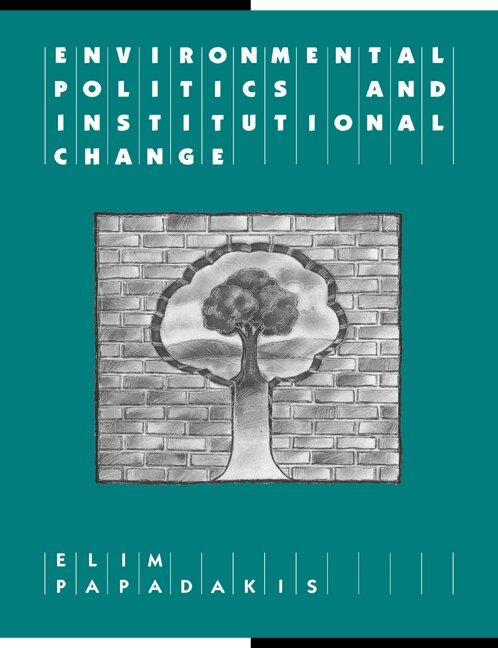
    Environmental Politics and Institutional Change

    AvElim Papadakis,Geoffrey Brennan

    Häftad, Engelska, 1996

    Del i serien Reshaping Australian Institutions

    503 kr

    Beställningsvara. Skickas inom 7-10 vardagar. Fri frakt över 249 kr.

    Beskrivning

    Environmentalism is one of the major issues of our time. A key question is how responsive are Australian institutions to the challenges posed by environmental issues? This book focuses on how effectively political institutions and organisations are able to address concerns about the deterioration of the environment. The book considers the key players in environmental debate and policy-making: social movements, interest groups, political parties, the media, the parliaments and the bureaucracy. It contains much rich empirical material. This stimulating and original book makes an important contribution not only to environmental politics, but to the ways in which institutions can become more effective and responsive to social forces. It will be of interest not only to political scientists and sociologists, but to environmental activists and policy-makers themselves.

    Produktinformation

    • Utgivningsdatum:1996-11-18
    • Mått:189 x 246 x 14 mm
    • Vikt:460 g
    • Format:Häftad
    • Språk:Engelska
    • Serie:Reshaping Australian Institutions
    • Antal sidor:256
    • Förlag:Cambridge University Press
    • ISBN:9780521556316

    Utforska kategorier

    • Miljövetenskap och miljöpolitik inom Naturvetenskap och teknik
    • Politik och statsskick inom Samhälle och politik

    Innehållsförteckning

    • Part I. Introduction: 1. Innovation and tradition; 2. Stimulus and response: the rise of environmentalism; 3. Framing the analysis; Part II. Political Institutions, Innovation and Social Change: 4. The 'centrality' of political institutions; 5. The circularity of political communication and dialogue; 6. Disrupting the circularity of political communication: the role of social movements; 7. Design, evolution and the environmental movement; Part III: Political Organisations and Adaptation: 8. Inertia and innovation; 9. Missed opportunities: the Liberal and National parties; 10. Leading the charge for the green vote: The Australian Labor Party; 11. Fundamentally green: the Australian Democrats; 12. Overcoming institutional inertia; Part IV. The Media, Agenda Setting and Public Opinion: 13. The articulation of environmental issues by the media; 14. Media stereotypes and adaptation; 15. Public opinion and survey research; 16. Mass opinion on environmental issues; Part V. Conclusion: 17. Possibilities for constructive dialogue.