• Fri frakt över 249 kr
  • •
  • Snabba leveranser
  • •
  • Billiga böcker
Kundservice

Du är på sajten för privatpersoner.

Företag, bibliotek eller offentlig verksamhet?

Du handlar på classic.bokus.com, där alla dina funktioner finns intakta.
Till classic.bokus.com
Bokus logotyp. Gå till startsidan.
  • Erbjudanden
  • Student
  • Topplistor
  • Barn & ungdom
  • Bokus Play
  • E-böcker
  • Ljudböcker
  • Pocketböcker
  • Spel & pussel

Upp till 25% på utvalda nyheter →

Sidfot

Mina sidor

    Hjälp

    • Kundservice
    • Vanliga frågor och svar
    • Frakt och leverans
    • Retur vid ångerrätt
    • Reklamera vara
    • Betalning
    • Köpvillkor
    • Allmänna villkor
    • Information om webbplatsens tillgänglighet

    Om Bokus

    • Om oss
    • Pressrum
    • För studenter
    • För företag
    • För bibliotek och offentlig verksamhet
    • För leverantörer
    • Hållbarhet

    Populärt

    • Aktuella erbjudanden
    • Presentkort
    • Studentlitteratur
    • Nya böcker
    • Topplistor
    • Signerade böcker
    • Engelska böcker

    Inspiration

    • Boktips
    • BookTok
    • Populära bokserier
    • Barnbokskaraktärer
    • Populära författare
    Logotyp för Bokus
    Följ oss på Facebook (extern länk)Följ oss på Instagram (extern länk)Följ oss på YouTube (extern länk)Följ oss på TikTok (extern länk)
    bokus @ CookiesAnpassa cookiesIntegritetspolicyKöpvillkor
    Till Citymail hemsida (extern länk)Till Budbee hemsida (extern länk)Till Postnord hemsida (extern länk)Till Schenker hemsida (extern länk)Till Early Bird hemsida (extern länk)Till Walleys hemsida (extern länk)
    1. Ekonomi och Ledarskap
    2. Nationalekonomi
    3. Ekonomisk politik

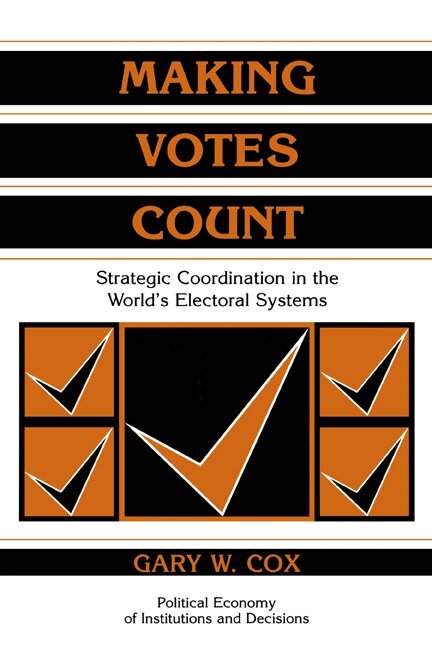
    Making Votes Count

    Strategic Coordination in the World's Electoral Systems

    AvGary W. Cox,Randall Calvert

    Häftad, Engelska, 1997

    Del i serien Political Economy of Institutions and Decisions

    394 kr

    Beställningsvara. Skickas inom 7-10 vardagar. Fri frakt över 249 kr.

    Fler format och utgåvor

    Inbunden

    1 469 kr

    Beskrivning

    Popular elections are at the heart of representative democracy. Thus, understanding the laws and practices that govern such elections is essential to understanding modern democracy. In this book, Cox views electoral laws as posing a variety of coordination problems that political forces must solve. Coordination problems - and with them the necessity of negotiating withdrawals, strategic voting, and other species of strategic coordination - arise in all electoral systems. This book employs a unified game-theoretic model to study strategic coordination worldwide and that relies primarily on constituency-level rather than national aggregate data in testing theoretical propositions about the effects of electoral laws. This book also considers not just what happens when political forces succeed in solving the coordination problems inherent in the electoral system they face but also what happens when they fail.

    Produktinformation

    • Utgivningsdatum:1997-03-28
    • Mått:152 x 229 x 23 mm
    • Vikt:540 g
    • Format:Häftad
    • Språk:Engelska
    • Serie:Political Economy of Institutions and Decisions
    • Antal sidor:360
    • Förlag:Cambridge University Press
    • ISBN:9780521585279

    Utforska kategorier

    • Ekonomisk politik inom Ekonomi och Ledarskap

    Recensioner i media

    "Every serious scholar of political systems should read this book....Cox is a master when it comes to explaining ideas generated by a logic-based theory....this book is a very important contribution to our knowledge about electoral systems. It will be the major book in this area for some time to come." Melvin Hinch, American Political Science Review

    Innehållsförteckning

    • List of tables and figures; Series editor's preface; Preface; PART I. INTRODUCTION: 1. Introduction; 2. Duverger's propositions; PART II. STRATEGIC VOTING: 3. On electoral systems; 4. Strategic voting in single-member single-ballot systems; 5. Strategic voting in multimember districts; 6. Strategic voting in single-member dual-ballot systems; 7. Some concluding comments on strategic voting, PART III. STRATEGIC ENTRY: 8. Strategic voting, party labels and entry; 9. Rational entry and the conservation of disproportionality: evidence from Japan; PART IV. ELECTORAL COORDINATION AT THe SYSTEM LEVEL: 10. Putting the constituencies together; 11. Electoral institutions, cleavage structures and the number of parties; PART V. COORDINATION FAILURES AND THE DEMOCRATIC PERFORMANCE: 12. Coordination failures and representation; 13. Coordination failures and dominant parties; 14. Coordination failures and realignments; PART VI. CONCLUSION; 15. Conclusion; Appendices; References; Subject index; Author index.