• Fri frakt över 249 kr
  • •
  • Snabba leveranser
  • •
  • Billiga böcker
Kundservice

Du är på sajten för privatpersoner.

Företag, bibliotek eller offentlig verksamhet?

Du handlar på classic.bokus.com, där alla dina funktioner finns intakta.
Till classic.bokus.com
Bokus logotyp. Gå till startsidan.
  • Erbjudanden
  • Nyheter
  • Student
  • Topplistor
  • Barn & ungdom
  • Bokus Play
  • E-böcker
  • Pocketböcker
  • Spel & pussel

10% rabatt på allt med kod NYSTART10 →

Sidfot

Mina sidor

    Hjälp

    • Kundservice
    • Vanliga frågor och svar
    • Frakt och leverans
    • Retur vid ångerrätt
    • Reklamera vara
    • Betalning
    • Köpvillkor
    • Allmänna villkor
    • Information om webbplatsens tillgänglighet

    Om Bokus

    • Om oss
    • Pressrum
    • För studenter
    • För företag
    • För bibliotek och offentlig verksamhet
    • För leverantörer
    • Hållbarhet

    Populärt

    • Aktuella erbjudanden
    • Presentkort
    • Studentlitteratur
    • Nya böcker
    • Topplistor
    • Signerade böcker
    • Engelska böcker

    Inspiration

    • Boktips
    • BookTok
    • Populära bokserier
    • Barnbokskaraktärer
    • Populära författare
    Logotyp för Bokus
    Följ oss på Facebook (extern länk)Följ oss på Instagram (extern länk)Följ oss på YouTube (extern länk)Följ oss på TikTok (extern länk)
    bokus @ CookiesAnpassa cookiesIntegritetspolicyKöpvillkor
    Till Citymail hemsida (extern länk)Till Budbee hemsida (extern länk)Till Postnord hemsida (extern länk)Till Schenker hemsida (extern länk)Till Early Bird hemsida (extern länk)Till Walleys hemsida (extern länk)
    1. Psykologi och pedagogik
    2. Psykologi
    3. Barnpsykologi och utvecklingspsykologi

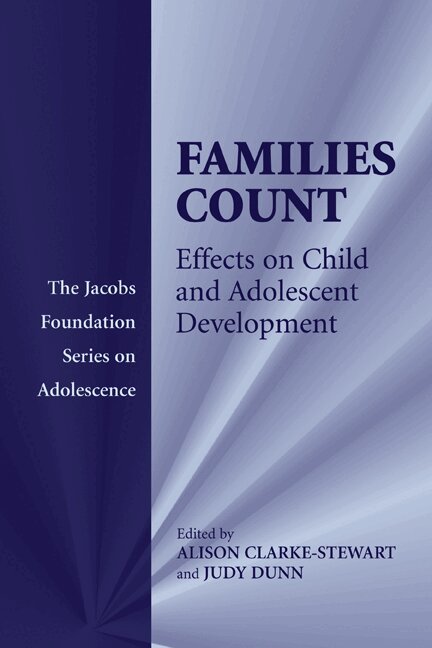
    Families Count

    Effects on Child and Adolescent Development

    AvAlison Clarke-Stewart,Judy Dunn

    Häftad, Engelska, 2006

    Del i serien The Jacobs Foundation Series on Adolescence

    505 kr

    Beställningsvara. Skickas inom 10-15 vardagar. Fri frakt över 249 kr.

    Beskrivning

    This book is concerned with the question of how families matter in young people's development - a question of obvious interest and importance to a wide range of readers, which has serious policy implication. A series of key current topics concerning families are examined by the top international scholars in the field, including the key risks affecting children, individual differences in their resilience, links between families and peers, the connections between parental work and children's family lives, the impact of childcare, divorce, and parental separation, grandparents, and new family forms such as lesbian and surrogate mother families. The latest research findings are brought together with discussion of policy issues raised.

    Produktinformation

    • Utgivningsdatum:2006-03-13
    • Mått:153 x 229 x 22 mm
    • Vikt:523 g
    • Format:Häftad
    • Språk:Engelska
    • Serie:The Jacobs Foundation Series on Adolescence
    • Antal sidor:400
    • Förlag:Cambridge University Press
    • ISBN:9780521612296

    Utforska kategorier

    • Barnpsykologi och utvecklingspsykologi inom Psykologi och pedagogik

    Mer om författaren

    Alison Clarke-Stewart is a psychologist whose work focuses on the effects of social environments on children's cognitive and emotional development. Since receiving her Ph.D. from Yale University in 1972, she has studied family interactions, child care, divorce and custody, and children's eyewitness testimony. She is currently a professor in the Department of Psychology and Social Behavior and Associate Dean for Research in the School of Social Ecology, University of California, Irvine. She is a fellow of the American Psychological Association and the American Psychological Society, a member of the Society for Research in Child Development, and a Principal Investigator in the NICHD Study of Early Child Care and Youth Development. She has been a visiting scholar at the Center for Advanced Study in the Behavioral Sciences and at Wolfson College, Oxford University. She has written more than 100 articles for scholarly journals such as Child Development and the American Psychologist and her recent books include What We Know about Childcare (Harvard Press, 2005) and 'Til Divorce Do Us Part (Yale Press, 2006). Judy Dunn is a psychologist whose research is focused on children's social, emotional and communicative development. She has studied children's family relationships (she pioneered research on siblings) and friendships, stepfamilies, and children's understanding of other people with a particular interest in longitudinal naturalistic observation approaches. She began her research in Cambridge University, spent 8 years in the US, and is currently a professor at the Institute of Psychiatry in London. She is a fellow of the British Academy and of the Academy of Medical Sciences. She has received the Society for Research in Child Development's Award for Distinuished Scientific Contribution and the American Psychological Association's G. Stanley Hall Award. She has been a visiting scholar at the Center for Advanced Study in the Behavioral Sciences at Stanford University, the Van Leer Foundation in Jerusalem, and universities in Italy. She has written scholarly articles and books, including most recently Children's Friendships: The Beginnings of Intimacy (Blackwell Publications 2004).

    Recensioner i media

    "...the breadth and clarity of its coverage is unique and edifying. ...with its incisive analyses and abundant references, Families Count is a must-have reference for all who are concerned with the factors in children's development. It would also be an excellent starting point for graduate, or upper division undergraduate, seminars in psychology or sociology courses concerned with children, families, or both. Certainly, the contents would provide an overview and multiple ideas for further investigations. Finally, the volume should be required reading for all those in academic considerations of public policy affecting children and families, as well as all those involved in the pragmatic development and implication of such policies." --Contemporary Psychology: APA Review of Books

    Innehållsförteckning

    • Introduction; Part I. Risk and Resilience: 1. How families matter in child development: reflections from research on risk and resilience Ann S. Masten and Anne Shaffer; 2. The promotion of resilience in the face of adversity Michael Rutter; 3. Identifying risk and protective factors for healthy child development Arnold Sameroff; Part II. Peer and Parents: 4. The influence of family and peer relationships in the development of competence during adolescence W. Andrew Collins and Glenn I. Roisman; 5. Toward a dynamic developmental model of the role of parents and peers in early onset substance use Kenneth A. Dodge, Patrick S. Malone, Jennifer E. Lansford, Shari Miller-Johnson, Gregory S. Pettit and John E. Bates; Part III. Work and Family: 6. Mothers and fathers at work: implications for families and children Ann C. Crouter; 7. The family-child care mesosystem Kathleen McCartney; Part IV. Discord and Divorce: 8. Marital discord, divorce, and children's well-being: results from a 20-year longitudinal study of two generations Paul R. Amato; 9. The influence of conflict, marital problem solving and parenting on children's adjustment in nondivorced, divorced, and remarried families E. Mavis Hetherington; 10. Adolescents' development in high-conflict and separated families: evidence from a German longitudinal study Sabine Walper and Katharina Beckh; Part V. New and Extended Family Forms: 11. New family forms Susan Golombok; 12. Grandparents, grandchildren, and family change in contemporary Britain Judy Dunn, Emma Fergusson and Barbara Maughan; Part VI. Conclusions and Commentaries: 13. What have we learned: proof that families matter, prospects for future research, and policies for families and children Alison Clarke-Stewart; 14. Research and policy: second looks at views of development, families, and communities and at translations into practice Jacqueline J. Goodnow; 15. Prognosis: policy and process Robert A. Hinde.