• Fri frakt över 249 kr
  • •
  • Snabba leveranser
  • •
  • Billiga böcker
Kundservice

Du är på sajten för privatpersoner.

Företag, bibliotek eller offentlig verksamhet?

Du handlar på classic.bokus.com, där alla dina funktioner finns intakta.
Till classic.bokus.com
Bokus logotyp. Gå till startsidan.
  • Erbjudanden
  • Nyheter
  • Student
  • Topplistor
  • Barn & ungdom
  • Bokus Play
  • E-böcker
  • Pocketböcker
  • Spel & pussel

10% studentrabatt med kod TERM26

Sidfot

Mina sidor

    Hjälp

    • Kundservice
    • Vanliga frågor och svar
    • Frakt och leverans
    • Retur vid ångerrätt
    • Reklamera vara
    • Betalning
    • Köpvillkor
    • Allmänna villkor
    • Information om webbplatsens tillgänglighet

    Om Bokus

    • Om oss
    • Pressrum
    • För studenter
    • För företag
    • För bibliotek och offentlig verksamhet
    • För leverantörer
    • Hållbarhet

    Populärt

    • Aktuella erbjudanden
    • Presentkort
    • Studentlitteratur
    • Nya böcker
    • Topplistor
    • Signerade böcker
    • Engelska böcker

    Inspiration

    • Boktips
    • BookTok
    • Populära bokserier
    • Barnbokskaraktärer
    • Populära författare
    Logotyp för Bokus
    Följ oss på Facebook (extern länk)Följ oss på Instagram (extern länk)Följ oss på YouTube (extern länk)Följ oss på TikTok (extern länk)
    bokus @ CookiesAnpassa cookiesIntegritetspolicyKöpvillkor
    Till Citymail hemsida (extern länk)Till Budbee hemsida (extern länk)Till Postnord hemsida (extern länk)Till Schenker hemsida (extern länk)Till Early Bird hemsida (extern länk)Till Walleys hemsida (extern länk)
    1. Historia och arkeologi
    2. Historia
    3. Asiens historia

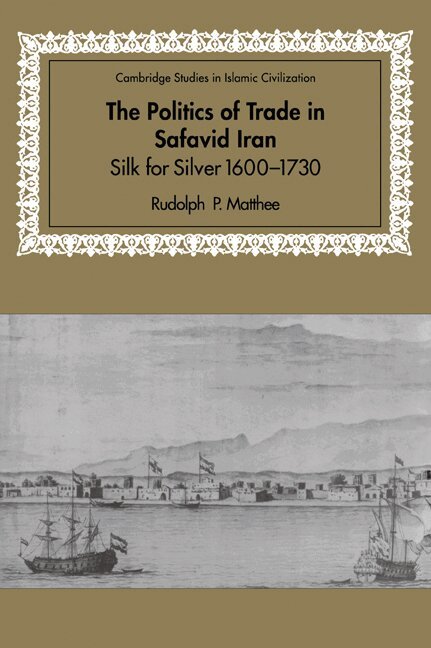
    The Politics of Trade in Safavid Iran

    Silk for Silver, 1600-1730

    AvRudolph P. Matthee,David Morgan

    Inbunden, Engelska, 1999

    Del i serien Cambridge Studies in Islamic Civilization

    1 665 kr

    Beställningsvara. Skickas inom 10-15 vardagar. Fri frakt över 249 kr.

    Fler format och utgåvor

    Häftad

    353 kr

    Beskrivning

    Using a wide range of archival and written sources, Rudi Matthee considers the economic, social and political networks established between Iran, its neighbours and the world at large, through the prism of the late Safavid silk trade. In so doing, he demonstrates how silk, a resource crucial to state revenue and the only commodity to span Iran's entire economic activity, was integral to aspects of late Safavid society, including its approach to commerce, export routes and, importantly, to the political and economic problems which contributed to its collapse in the early 1700s. In a challenge to traditional scholarship, the author argues that despite the introduction of a maritime, western-dominated channel, Iran's traditional land-based silk export continued to expand right up to the end of the seventeenth century. The book makes a major theoretical contribution to the debates on the social and economic history of the pre-modern world.

    Produktinformation

    • Utgivningsdatum:1999-12-09
    • Mått:155 x 235 x 23 mm
    • Vikt:571 g
    • Format:Inbunden
    • Språk:Engelska
    • Serie:Cambridge Studies in Islamic Civilization
    • Antal sidor:316
    • Förlag:Cambridge University Press
    • ISBN:9780521641319

    Utforska kategorier

    • Asiens historia inom Historia och arkeologi

    Recensioner i media

    '… this book represents a contribution of whose parameters and paradigm any future study of Safavid Iran which purports to offer a comprehensive analysis of the period will have to take account.' Journal of Semitic Studies

    Innehållsförteckning

    • Preface; Acknowledgements; Notes on transliteration; List of abbreviations; Maps; Introduction; 1. The Iranian silk trade: from the Silk Road to the Safavids; 2. Procedures, logistics, finances; 3. Shah 'Abbas I and the Safavid political economy: territorial expansion, anti-Ottoman diplomacy, and the politics of silk; 4. Government control and growing competition: the silk export monopoly and the advent of the European maritime companies; 5. The complications of privatization: from the abolition of the silk export monopoly to the peace of Zuhab, 1629–1639; 6. Conflict and reorientation: silk to silver, 1640–1667; 7. Renewed regulation and the rise of the Russian connection, 1660s–1690s; 8. Contraction and continuity, 1690–1730; Conclusion; Appendix; Glossary; Bibliography; Index.