• Fri frakt över 249 kr
  • •
  • Snabba leveranser
  • •
  • Billiga böcker
Kundservice

Du är på sajten för privatpersoner.

Företag, bibliotek eller offentlig verksamhet?

Du handlar på classic.bokus.com, där alla dina funktioner finns intakta.
Till classic.bokus.com
Bokus logotyp. Gå till startsidan.
  • Erbjudanden
  • Student
  • Topplistor
  • Barn & ungdom
  • Bokus Play
  • E-böcker
  • Ljudböcker
  • Pocketböcker
  • Spel & pussel

10% rabatt på allt med kod NYSTART10 →

Sidfot

Mina sidor

    Hjälp

    • Kundservice
    • Vanliga frågor och svar
    • Frakt och leverans
    • Retur vid ångerrätt
    • Reklamera vara
    • Betalning
    • Köpvillkor
    • Allmänna villkor
    • Information om webbplatsens tillgänglighet

    Om Bokus

    • Om oss
    • Pressrum
    • För studenter
    • För företag
    • För bibliotek och offentlig verksamhet
    • För leverantörer
    • Hållbarhet

    Populärt

    • Aktuella erbjudanden
    • Presentkort
    • Studentlitteratur
    • Nya böcker
    • Topplistor
    • Signerade böcker
    • Engelska böcker

    Inspiration

    • Boktips
    • BookTok
    • Populära bokserier
    • Barnbokskaraktärer
    • Populära författare
    Logotyp för Bokus
    Följ oss på Facebook (extern länk)Följ oss på Instagram (extern länk)Följ oss på YouTube (extern länk)Följ oss på TikTok (extern länk)
    bokus @ CookiesAnpassa cookiesIntegritetspolicyKöpvillkor
    Till Citymail hemsida (extern länk)Till Budbee hemsida (extern länk)Till Postnord hemsida (extern länk)Till Schenker hemsida (extern länk)Till Early Bird hemsida (extern länk)Till Walleys hemsida (extern länk)
    1. Språk och ordböcker
    2. Språkvetenskap och lingvistik

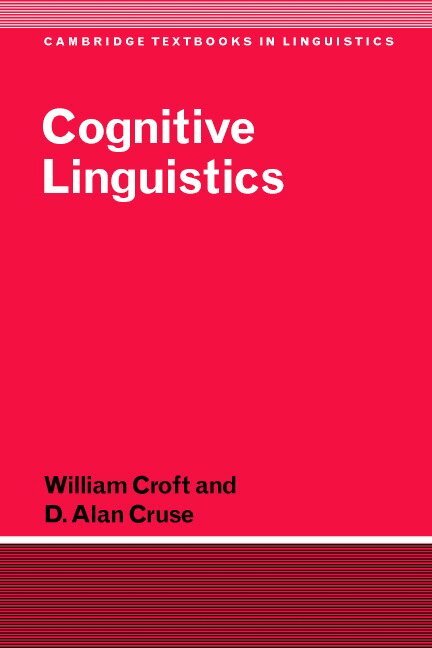
    Cognitive Linguistics

    AvWilliam Croft,D. Alan Cruse

    Häftad, Engelska, 2004

    Del i serien Cambridge Textbooks in Linguistics

    620 kr

    Beställningsvara. Skickas inom 10-15 vardagar. Fri frakt över 249 kr.

    Fler format och utgåvor

    Inbunden

    1 195 kr

    Beskrivning

    Cognitive Linguistics argues that language is governed by general cognitive principles, rather than by a special-purpose language module. This introductory textbook surveys the field of cognitive linguistics as a distinct area of study, presenting its theoretical foundations and the arguments supporting it. Clearly organised and accessibly written, it provides a useful introduction to the relationship between language and cognitive processing in the human brain. It covers the main topics likely to be encountered in a course or seminar, and provides a synthesis of study and research in this fast-growing field of linguistics. The authors begin by explaining the conceptual structures and cognitive processes governing linguistic representation and behaviour, and go on to explore cognitive approaches to lexical semantics, as well as syntactic representation and analysis, focusing on the closely related frameworks of cognitive grammar and construction grammar. This much-needed introduction will be welcomed by students in linguistics and cognitive science.

    Produktinformation

    • Utgivningsdatum:2004-01-22
    • Mått:152 x 225 x 24 mm
    • Vikt:622 g
    • Format:Häftad
    • Språk:Engelska
    • Serie:Cambridge Textbooks in Linguistics
    • Antal sidor:374
    • Förlag:Cambridge University Press
    • ISBN:9780521667708

    Utforska kategorier

    • Språkvetenskap och lingvistik inom Språk och ordböcker

    Mer om författaren

    D. Alan Cruse is Senior Lecturer in the School of English and Linguistics, University of Manchester. William Croft is Professor of Linguistics at the University of Manchester.

    Innehållsförteckning

    • 1. Introduction: what is cognitive linguistics?; Part I. A Conceptual Approach to Linguistic Analysis: 2. Frames, domains, spaces: the organisation of conceptual structure; 3. Conceptualization and construal operations; 4. Categories, concepts and meanings; Part II. Cognitive Approaches to Lexical Semantics: 5. Polysemy: the construal of sense boundaries; 6. A dynamic construal approach to sense relations I: hyponymy and metonymy; 7. A dynamic construal approach to sense relations II: antonymy and complementarity; 8. Metaphor; Part III. Cognitive Approaches to Grammatical Form: 9. From idioms to construction grammar; 10. An overview of construction grammars; 11. The usage-based model; 12. Conclusion: cognitive linguistics and beyond.