• Fri frakt över 249 kr
  • •
  • Snabba leveranser
  • •
  • Billiga böcker
Kundservice

Du är på sajten för privatpersoner.

Företag, bibliotek eller offentlig verksamhet?

Du handlar på classic.bokus.com, där alla dina funktioner finns intakta.
Till classic.bokus.com
Bokus logotyp. Gå till startsidan.
  • Erbjudanden
  • Nyheter
  • Student
  • Topplistor
  • Barn & ungdom
  • Bokus Play
  • E-böcker
  • Pocketböcker
  • Spel & pussel

10% rabatt på allt med kod NYSTART10 →

Sidfot

Mina sidor

    Hjälp

    • Kundservice
    • Vanliga frågor och svar
    • Frakt och leverans
    • Retur vid ångerrätt
    • Reklamera vara
    • Betalning
    • Köpvillkor
    • Allmänna villkor
    • Information om webbplatsens tillgänglighet

    Om Bokus

    • Om oss
    • Pressrum
    • För studenter
    • För företag
    • För bibliotek och offentlig verksamhet
    • För leverantörer
    • Hållbarhet

    Populärt

    • Aktuella erbjudanden
    • Presentkort
    • Studentlitteratur
    • Nya böcker
    • Topplistor
    • Signerade böcker
    • Engelska böcker

    Inspiration

    • Boktips
    • BookTok
    • Populära bokserier
    • Barnbokskaraktärer
    • Populära författare
    Logotyp för Bokus
    Följ oss på Facebook (extern länk)Följ oss på Instagram (extern länk)Följ oss på YouTube (extern länk)Följ oss på TikTok (extern länk)
    bokus @ CookiesAnpassa cookiesIntegritetspolicyKöpvillkor
    Till Citymail hemsida (extern länk)Till Budbee hemsida (extern länk)Till Postnord hemsida (extern länk)Till Schenker hemsida (extern länk)Till Early Bird hemsida (extern länk)Till Walleys hemsida (extern länk)
    1. Naturvetenskap och teknik
    2. Matematik och naturvetenskap
    3. Biologi
    4. Biovetenskap

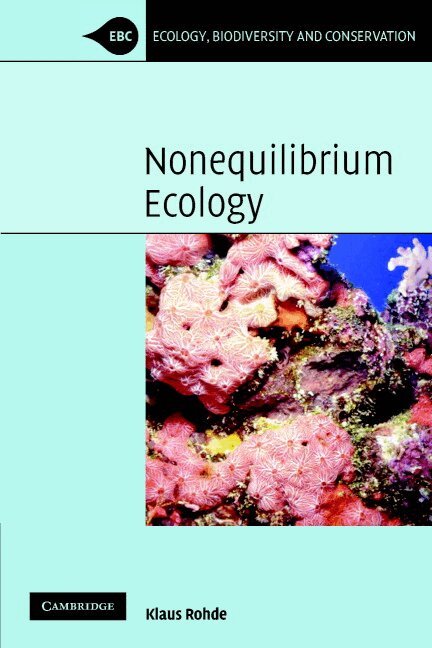
    Nonequilibrium Ecology

    AvKlaus Rohde

    Häftad, Engelska, 2006

    Del i serien Ecology, Biodiversity and Conservation

    825 kr

    Beställningsvara. Skickas inom 10-15 vardagar. Fri frakt över 249 kr.

    Fler format och utgåvor

    Inbunden

    1 791 kr

    Beskrivning

    Ecology has long been shaped by ideas that stress the sharing of resources and the competition for those resources, and by the assumption that populations and communities typically exist under equilibrium conditions in habitats saturated with both individuals and species. However, much evidence contradicts these assumptions and it is likely that nonequilibrium is much more widespread than might be expected. This book is unique in focusing on nonequilibrium aspects of ecology, providing evidence for nonequilibrium and equilibrium in populations (and metapopulations), in extant communities and in ecological systems over evolutionary time, including nonequilibrium due to recent and present mass extinctions. The assumption that competition is of overriding importance is central to equilibrium ecology, and much space is devoted to its discussion. As communities of some taxa appear to be shaped more by competition than others, an attempt is made to find an explanation for these differences.

    Produktinformation

    • Utgivningsdatum:2006-01-19
    • Mått:152 x 228 x 13 mm
    • Vikt:390 g
    • Format:Häftad
    • Språk:Engelska
    • Serie:Ecology, Biodiversity and Conservation
    • Antal sidor:236
    • Förlag:Cambridge University Press
    • ISBN:9780521674553

    Utforska kategorier

    • Biovetenskap inom Naturvetenskap och teknik
    • Djurböcker inom Djur och Natur
    • Zoologi inom Naturvetenskap och teknik

    Mer om författaren

    Klaus Rohde is Professor Emeritus at the University of New England, Australia.

    Recensioner i media

    Nonequilibrium Ecology is a useful compilation of facts, theories, and opinions related to the competition debate..." Franz J. Weissing, Ecology

    Innehållsförteckning

    • Introduction; 1. Concepts and problems; 2. Nonequilibrium in communities; 3. Interspecific competition: definition and effects on species; 4. Interspecific competition: effects in communities and conclusion; 5. Non-competitive mechanisms responsible for niche restriction and segregation; 6. Patterns over evolutionary time, present mass-extinctions; 7. Some detailed examples at the population/metapopulation level; 8. Some detailed examples at the community level; 9. Some detailed biogeographical/macroecological patterns; 10. An autecological comparison: the ecology of aspidogastrea; 11. What explains the differences found? A summary, and prospects for an ecology of the future; acknowledgments; References.