• Fri frakt över 249 kr
  • •
  • Snabba leveranser
  • •
  • Billiga böcker
Kundservice

Du är på sajten för privatpersoner.

Företag, bibliotek eller offentlig verksamhet?

Du handlar på classic.bokus.com, där alla dina funktioner finns intakta.
Till classic.bokus.com
Bokus logotyp. Gå till startsidan.
  • Erbjudanden
  • Nyheter
  • Student
  • Topplistor
  • Barn & ungdom
  • Bokus Play
  • E-böcker
  • Pocketböcker
  • Spel & pussel

10% studentrabatt med kod TERM26

Sidfot

Mina sidor

    Hjälp

    • Kundservice
    • Vanliga frågor och svar
    • Frakt och leverans
    • Retur vid ångerrätt
    • Reklamera vara
    • Betalning
    • Köpvillkor
    • Allmänna villkor
    • Information om webbplatsens tillgänglighet

    Om Bokus

    • Om oss
    • Pressrum
    • För studenter
    • För företag
    • För bibliotek och offentlig verksamhet
    • För leverantörer
    • Hållbarhet

    Populärt

    • Aktuella erbjudanden
    • Presentkort
    • Studentlitteratur
    • Nya böcker
    • Topplistor
    • Signerade böcker
    • Engelska böcker

    Inspiration

    • Boktips
    • BookTok
    • Populära bokserier
    • Barnbokskaraktärer
    • Populära författare
    Logotyp för Bokus
    Följ oss på Facebook (extern länk)Följ oss på Instagram (extern länk)Följ oss på YouTube (extern länk)Följ oss på TikTok (extern länk)
    bokus @ CookiesAnpassa cookiesIntegritetspolicyKöpvillkor
    Till Citymail hemsida (extern länk)Till Budbee hemsida (extern länk)Till Postnord hemsida (extern länk)Till Schenker hemsida (extern länk)Till Early Bird hemsida (extern länk)Till Walleys hemsida (extern länk)
    1. Naturvetenskap och teknik
    2. Matematik och naturvetenskap
    3. Matematik
    4. Tillämpad matematik

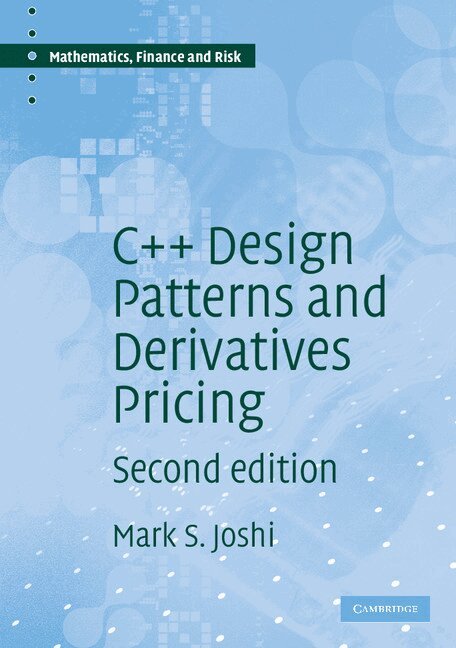
    C++ Design Patterns and Derivatives Pricing

    AvM. S. Joshi

    Häftad, Engelska, 2008

    Del 2 i serien Mathematics, Finance and Risk

    840 kr

    Beställningsvara. Skickas inom 10-15 vardagar. Fri frakt över 249 kr.

    Beskrivning

    Design patterns are the cutting-edge paradigm for programming in C++, and they are here discussed in depth using examples from financial mathematics. Assuming only a basic knowledge of C++ and mathematical finance, the reader learns how to produce well-designed, structured, reusable code via carefully-chosen examples. This new edition includes several new chapters covering topics of increasing robustness in the presence of exceptions, designing a generic factory, interfacing C++ with EXCEL, and improving code design using the idea of decoupling. Complete ANSI/ISO compatible C++ source code is hosted on an accompanying website for the reader to study in detail, and reuse as they see fit. Whether you are a student of financial mathematics, a working quantitative analyst or financial mathematician, you need this book. Offering practical steps for implementing pricing models for complex financial products, it will transform your understanding of how to use C++.

    Produktinformation

    • Utgivningsdatum:2008-05-22
    • Mått:174 x 247 x 16 mm
    • Vikt:640 g
    • Format:Häftad
    • Språk:Engelska
    • Serie:Mathematics, Finance and Risk
    • Antal sidor:306
    • Upplaga:2
    • Förlag:Cambridge University Press
    • ISBN:9780521721622

    Utforska kategorier

    • Tillämpad matematik inom Naturvetenskap och teknik

    Mer om författaren

    Mark S. Joshi is an Associate Professor in the Centre for Actuarial Studies at the University of Melbourne.

    Recensioner i media

    'This is a short book, but an elegant one. It would serve as an excellent course text for a course on the practical aspects of mathematical finance.' International Statistical Institute

    Innehållsförteckning

    • Preface; 1. A simple Monte Carlo model; 2. Encapsulation; 3. Inheritance and virtual functions; 4. Bridging with a virtual constructor; 5. Strategies, decoration and statistics; 6. A random numbers class; 7. An exotics engine and the template pattern; 8. Trees; 9. Solvers, templates and implied volatilities; 10. The factory; 11. Design patterns revisited; 12. The situation in 2007; 13. Exceptions; 14. Templatizing the factory; 15. Interfacing with EXCEL; 16. Decoupling; A. Black–Scholes formulas; B. Distribution functions; C. A simple array class; D. The code; Bibliography; Index.