• Fri frakt över 249 kr
  • •
  • Snabba leveranser
  • •
  • Billiga böcker
Kundservice

Du är på sajten för privatpersoner.

Företag, bibliotek eller offentlig verksamhet?

Du handlar på classic.bokus.com, där alla dina funktioner finns intakta.
Till classic.bokus.com
Bokus logotyp. Gå till startsidan.
  • Erbjudanden
  • Nyheter
  • Student
  • Topplistor
  • Barn & ungdom
  • Bokus Play
  • E-böcker
  • Pocketböcker
  • Spel & pussel

10% rabatt på allt med kod NYSTART10 →

Sidfot

Mina sidor

    Hjälp

    • Kundservice
    • Vanliga frågor och svar
    • Frakt och leverans
    • Retur vid ångerrätt
    • Reklamera vara
    • Betalning
    • Köpvillkor
    • Allmänna villkor
    • Information om webbplatsens tillgänglighet

    Om Bokus

    • Om oss
    • Pressrum
    • För studenter
    • För företag
    • För bibliotek och offentlig verksamhet
    • För leverantörer
    • Hållbarhet

    Populärt

    • Aktuella erbjudanden
    • Presentkort
    • Studentlitteratur
    • Nya böcker
    • Topplistor
    • Signerade böcker
    • Engelska böcker

    Inspiration

    • Boktips
    • BookTok
    • Populära bokserier
    • Barnbokskaraktärer
    • Populära författare
    Logotyp för Bokus
    Följ oss på Facebook (extern länk)Följ oss på Instagram (extern länk)Följ oss på YouTube (extern länk)Följ oss på TikTok (extern länk)
    bokus @ CookiesAnpassa cookiesIntegritetspolicyKöpvillkor
    Till Citymail hemsida (extern länk)Till Budbee hemsida (extern länk)Till Postnord hemsida (extern länk)Till Schenker hemsida (extern länk)Till Early Bird hemsida (extern länk)Till Walleys hemsida (extern länk)
    1. Ekonomi och Ledarskap
    2. Företagsekonomi
    3. Affärsetik

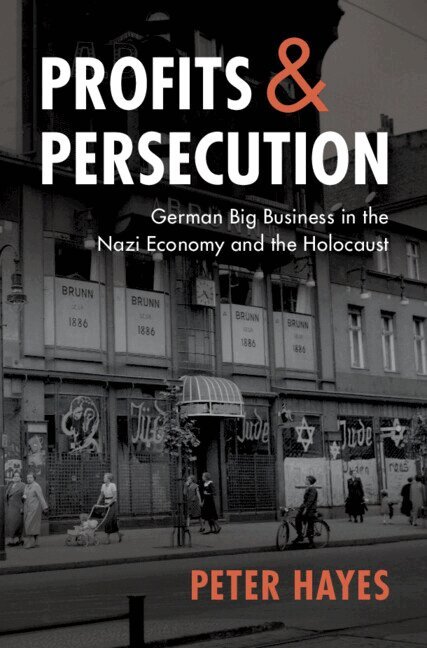
    Profits and Persecution

    German Big Business in the Nazi Economy and the Holocaust

    AvPeter Hayes

    Inbunden, Engelska, 2025

    337 kr

    Beställningsvara. Skickas inom 10-15 vardagar. Fri frakt över 249 kr.

    Fler format och utgåvor

    E-bok

    407 kr

    E-bok

    407 kr

    Beskrivning

    What role did German big business play in the persecution of European Jews during the Holocaust? What were its motivations? And how did it respond to changing social and economic circumstances after the war? Profits and Persecution examines how the leaders of Germany's largest industrial and financial enterprises played a key part in the catastrophes and crimes of their nation in the first half of the twentieth century. Drawing on evidence concerning the roughly one hundred most significant German firms of the Nazi era, Peter Hayes explores how large German corporations dealt with Jews, their property, and their labor. This study unites business history and the history of the Holocaust to consider both the economic and personal motivations that rendered German corporate leaders complicit in the actions of the Nazi Party. In doing so, it demonstrates how ordinary, familiar thought processes came to serve the ideological purposes of the Third Reich with lethal consequences.

    Produktinformation

    • Utgivningsdatum:2025-01-30
    • Mått:160 x 236 x 22 mm
    • Vikt:480 g
    • Format:Inbunden
    • Språk:Engelska
    • Antal sidor:224
    • Förlag:Cambridge University Press
    • ISBN:9780521772884

    Utforska kategorier

    • Affärsetik inom Ekonomi och Ledarskap
    • Europas historia inom Historia och arkeologi
    • Ekonomisk historia inom Ekonomi och Ledarskap

    Mer om författaren

    Peter Hayes is Theodore Zev Weiss Holocaust Educational Foundation Professor Emeritus at Northwestern University. He is the author of the best-selling Why? Explaining the Holocaust (2017), as well as thirteen other books and more than one hundred articles and chapters on the history of the Nazi era. Hayes served for twenty years on the Academic Committee of the United States Holocaust Memorial Museum and as its chair from 2014 to 2019.

    Recensioner i media

    'In a masterful synthesis of current scholarship, Peter Hayes shows how the German business community cooperated with the Nazi regime for multiple reasons: partially-overlapping political values; a near total absence of anti-antisemitic sentiments; but above all the perceived need not to be outdone by economic rivals in the race for profits, spoils, and government favor. Within the framework of Germany's directed economy, the business community became increasingly complicit in the atrocities of the Nazi regime, including ultimately the despoiling of Jews, the lethal exploitation of forced and slave labor, and genocide. As Hayes concludes, when the German business community faced Nazism's 'corrupting mix of compulsion and temptation, controls and opportunity,' then sadly 'rational calculation served Nazi criminality.'' Christopher R. Browning, author of Nazi Policy, Jewish Workers, German Killers

    Innehållsförteckning

    • Part I. Prologue, 1918–1933: 1. Path-dependence; 2. Ambivalence; Part II. Autarky and Armament, 1933–1939/41: 3. Compliance; 4. Monopsony; 5. Dejewification; Part III. Total War, 1939/41–1945: 6. Mobilization; 7. Exploitation; 8. Annihilation; Part IV. Aftermath, 1945–2024: 9. Outcomes; 10. Summary.