• Fri frakt över 249 kr
  • •
  • Snabba leveranser
  • •
  • Billiga böcker
Kundservice

Du är på sajten för privatpersoner.

Företag, bibliotek eller offentlig verksamhet?

Du handlar på classic.bokus.com, där alla dina funktioner finns intakta.
Till classic.bokus.com
Bokus logotyp. Gå till startsidan.
  • Erbjudanden
  • Nyheter
  • Student
  • Topplistor
  • Barn & ungdom
  • Bokus Play
  • E-böcker
  • Pocketböcker
  • Spel & pussel

10% studentrabatt med kod TERM26

Sidfot

Mina sidor

    Hjälp

    • Kundservice
    • Vanliga frågor och svar
    • Frakt och leverans
    • Retur vid ångerrätt
    • Reklamera vara
    • Betalning
    • Köpvillkor
    • Allmänna villkor
    • Information om webbplatsens tillgänglighet

    Om Bokus

    • Om oss
    • Pressrum
    • För studenter
    • För företag
    • För bibliotek och offentlig verksamhet
    • För leverantörer
    • Hållbarhet

    Populärt

    • Aktuella erbjudanden
    • Presentkort
    • Studentlitteratur
    • Nya böcker
    • Topplistor
    • Signerade böcker
    • Engelska böcker

    Inspiration

    • Boktips
    • BookTok
    • Populära bokserier
    • Barnbokskaraktärer
    • Populära författare
    Logotyp för Bokus
    Följ oss på Facebook (extern länk)Följ oss på Instagram (extern länk)Följ oss på YouTube (extern länk)Följ oss på TikTok (extern länk)
    bokus @ CookiesAnpassa cookiesIntegritetspolicyKöpvillkor
    Till Citymail hemsida (extern länk)Till Budbee hemsida (extern länk)Till Postnord hemsida (extern länk)Till Schenker hemsida (extern länk)Till Early Bird hemsida (extern länk)Till Walleys hemsida (extern länk)
    1. Skönlitteratur
    2. Litteraturvetenskap
    3. Litteraturteori

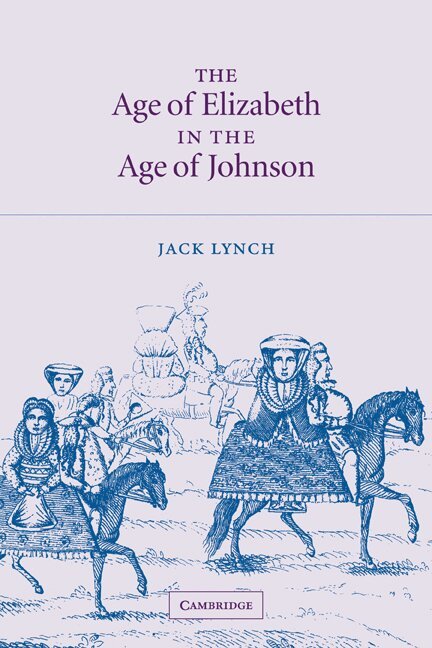
    The Age of Elizabeth in the Age of Johnson

    AvJack Lynch

    Inbunden, Engelska, 2002

    1 473 kr

    Beställningsvara. Skickas inom 10-15 vardagar. Fri frakt över 249 kr.

    Fler format och utgåvor

    Häftad

    533 kr

    Beskrivning

    In The Age of Elizabeth in the Age of Johnson, Jack Lynch explores eighteenth-century British conceptions of the Renaissance, and the historical, intellectual, and cultural uses to which the past was put during the period. Scholars, editors, historians, religious thinkers, linguists and literary critics of the period all defined themselves in relation to 'the last age' or 'the age of Elizabeth'. Seventeenth- and eighteenth-century thinkers reworked older historical schemes to suit their own needs, turning to the ages of Petrarch and Poliziano, Erasmus and Scaliger, Shakespeare, Spenser, and Queen Elizabeth to define their culture in contrast to the preceding age. They derived a powerful sense of modernity from the comparison, which proved essential to the constitution of a national character. This interdisciplinary study will be of interest to cultural as well as literary historians of the eighteenth century.

    Produktinformation

    • Utgivningsdatum:2002-12-12
    • Mått:160 x 236 x 21 mm
    • Vikt:515 g
    • Format:Inbunden
    • Språk:Engelska
    • Antal sidor:240
    • Förlag:Cambridge University Press
    • ISBN:9780521819077

    Utforska kategorier

    • Litteraturteori inom Skönlitteratur

    Mer om författaren

    Jack Lynch is assistant professor of English at Rutgers University. He is co-editor, with Paul J. Korshin, of The Age of Johnson: A Scholarly Annual. He is the author of A Bibliography of Johnsonian Studies, 1986-1998 (2000) and Samuel Johnson's Dictionary: Selections from the 1755 Work that Defined the English Language (2002).

    Recensioner i media

    Review of the hardback: 'An original and major contribution to the reader's understanding of eighteenth-century cultural identity.' The New Rambler

    Innehållsförteckning

    • Preface; Note on the texts and citation; List of abbreviations; Introduction; 1. Struggling to emerge from barbarity: historiography and the idea of the classic; 2. Learning's triumph: historicism and the spirit of the age; 3. Call Britannia's glories back to view: Tudor history and Hanoverian historians; 4. The rage of Reformation: religious controversy and political stability; 5. The ground-work of stile: language and national identity; 6. Studied barbarity: Jonson, Spenser, and the idea of progress; 7. The last age: Renaissance lost; Notes; Bibliography; Index.