• Fri frakt över 249 kr
  • •
  • Snabba leveranser
  • •
  • Billiga böcker
Kundservice

Du är på sajten för privatpersoner.

Företag, bibliotek eller offentlig verksamhet?

Du handlar på classic.bokus.com, där alla dina funktioner finns intakta.
Till classic.bokus.com
Bokus logotyp. Gå till startsidan.
  • Erbjudanden
  • Nyheter
  • Student
  • Topplistor
  • Barn & ungdom
  • Bokus Play
  • E-böcker
  • Pocketböcker
  • Spel & pussel

10% rabatt på allt med kod: NYSTART10 →

Sidfot

Mina sidor

    Hjälp

    • Kundservice
    • Vanliga frågor och svar
    • Frakt och leverans
    • Retur vid ångerrätt
    • Reklamera vara
    • Betalning
    • Köpvillkor
    • Allmänna villkor
    • Information om webbplatsens tillgänglighet

    Om Bokus

    • Om oss
    • Pressrum
    • För studenter
    • För företag
    • För bibliotek och offentlig verksamhet
    • För leverantörer
    • Hållbarhet

    Populärt

    • Aktuella erbjudanden
    • Presentkort
    • Studentlitteratur
    • Nya böcker
    • Topplistor
    • Signerade böcker
    • Engelska böcker

    Inspiration

    • Boktips
    • BookTok
    • Populära bokserier
    • Barnbokskaraktärer
    • Populära författare
    Logotyp för Bokus
    Följ oss på Facebook (extern länk)Följ oss på Instagram (extern länk)Följ oss på YouTube (extern länk)Följ oss på TikTok (extern länk)
    bokus @ CookiesAnpassa cookiesIntegritetspolicyKöpvillkor
    Till Citymail hemsida (extern länk)Till Budbee hemsida (extern länk)Till Postnord hemsida (extern länk)Till Schenker hemsida (extern länk)Till Early Bird hemsida (extern länk)Till Walleys hemsida (extern länk)
    1. Samhälle och politik
    2. Politik och statsskick

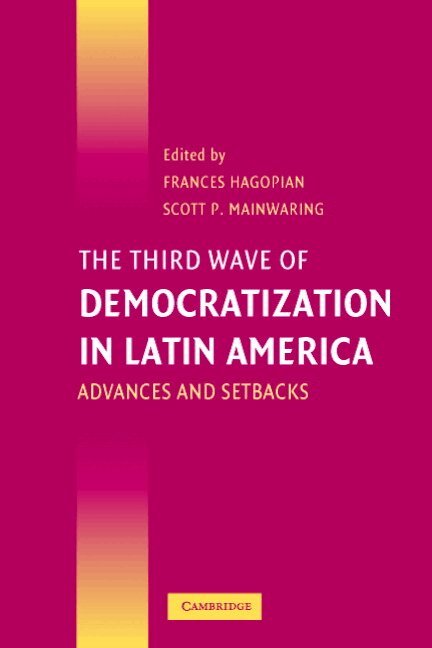
    The Third Wave of Democratization in Latin America

    Advances and Setbacks

    AvFrances Hagopian,Scott P. Mainwaring

    Inbunden, Engelska, 2005

    1 201 kr

    Beställningsvara. Skickas inom 10-15 vardagar. Fri frakt över 249 kr.

    Beskrivning

    The late twentieth century witnessed the birth of an impressive number of new democracies in Latin America. This wave of democratization since 1978 has been by far the broadest and most durable in the history of Latin America, but many of the resulting democratic regimes also suffer from profound deficiencies. What caused democratic regimes to emerge and survive? What are their main achievements and shortcomings? This volume offers an ambitious and comprehensive overview of the unprecedented advances as well as the setbacks in the post-1978 wave of democratization. It seeks to explain the sea change from a region dominated by authoritarian regimes to one in which openly authoritarian regimes are the rare exception, and it analyzes why some countries have achieved striking gains in democratization while others have experienced erosions. The book presents general theoretical arguments about what causes and sustains democracy and analyses of nine compelling country cases.

    Produktinformation

    • Utgivningsdatum:2005-06-06
    • Mått:156 x 234 x 24 mm
    • Vikt:780 g
    • Format:Inbunden
    • Språk:Engelska
    • Antal sidor:432
    • Förlag:Cambridge University Press
    • ISBN:9780521824613

    Utforska kategorier

    • Politik och statsskick inom Samhälle och politik

    Mer om författaren

    Frances Hagopian is the Michael P. Grace II Associate Professor of Latin American Studies in the Department of Political Science, and former Director of the Kellogg Institute for International Studies, at the University of Notre Dame. She is the author of Traditional Politics and Regime Change in Brazil (Cambridge University Press, 1996), which was named a Choice Outstanding Book in Comparative Politics, and several articles on democratization that have appeared in World Politics, Comparative Political Studies, and several other publications. Her current research focuses on economic liberalization and political representation in Brazil, Argentina, Chile, and Mexico. Hagopian previously taught at Harvard, Tufts, and MIT, and she has held fellowships from the Center for Latin American Studies and Howard Heinz Endowment of the University of Pittsburgh, the Social Science Research Council and the American Council of Learned Societies, and the U.S. Department of Education (the Fulbright-Hays program). She is a member of the Council of the American Political Science Association, and the editorial boards of PS: Political Science and Latin American Politics and Society. Scott P. Mainwaring is Eugene Conley Professor of Political Science at the University of Notre Dame and Director of the Kellogg Institute for International Studies. Among his books are Democratic Accountability in Latin America, Christian Democracy in Latin America, Rethinking Party Systems in the Third Wave of Democratization: the Case of Brazil, Presidentialism and Democracy in Latin America (Cambridge University Press, 1997) and Building Democratic Institutions: Party Systems in Latin America. He received a John Simon Guggenheim Memorial Foundation fellowship in 2000 for work on a project on authoritarianism and democracy in Latin America, 1945–2000.

    Recensioner i media

    '… excellent example of theorizing about Latin America's most pressing policy dilemmas … demonstrates a series of theoretical purpose that belies the lingering misperception that 'barefoot empiricists' dominate the field. Specialists, students and laypersons alike will have plenty to reflect upon.' Development and Change

    Innehållsförteckning

    • Introduction: the third wave of democratization in Latin America Scott Mainwaring and Frances Hagopian; 1. Latin American democratization since 1978: democratic transitions, breakdowns, and erosions Scott Mainwaring and Aníbal Pérez-Liñán; Part I. Three Democratic Giants with Authoritarian Pasts: Argentina, Brazil, and Mexico: 2. Argentina: democratic survival amidst economic failure Steven Levitsky; 3. The growing sustainability of Brazil's low-quality democracy Kurt Weyland; 4. The demise of Mexico's one-party dominant regime: elite choices and the masses in the establishment of democracy Beatriz Magaloni; Part II. Unexpected Democracies in Unlikely Countries: Bolivia, El Salvador, and Guatemala: 5. Bolivia's democracy at the crossroads René Antonio Mayorga; 6. Challenges to political democracy in El Salvador Elisabeth Jean Wood; 7. Democracy on ice: the multiple challenges of Guatemala's peace process Mitchell A. Seligson; Part III. Democratic Erosion in The Third Wave: Colombia, Peru, and Venezuela: 8. From 'restricted' to 'besieged': the changing nature of the limits to democracy in Colombia Ana María Bejarano and Eduardo Pizarro; 9. Peru 1980–2000: chronicle of a death foretold? determinism, political decisions, and open outcomes Martín Tanaka; 10. Explaining democratic deterioration in Venezuela through nested inference Michael Coppedge; Part IV. Conclusions: 11. Conclusions: Government performance, political representation, and public perceptions of contemporary democracy in Latin America Frances Hagopian.