• Fri frakt över 249 kr
  • •
  • Snabba leveranser
  • •
  • Billiga böcker
Kundservice

Du är på sajten för privatpersoner.

Företag, bibliotek eller offentlig verksamhet?

Du handlar på classic.bokus.com, där alla dina funktioner finns intakta.
Till classic.bokus.com
Bokus logotyp. Gå till startsidan.
  • Erbjudanden
  • Nyheter
  • Student
  • Topplistor
  • Barn & ungdom
  • Bokus Play
  • E-böcker
  • Pocketböcker
  • Spel & pussel

Må bättre, för mindre! Upp till 50% rabatt på hälsoböcker

Sidfot

Mina sidor

    Hjälp

    • Kundservice
    • Vanliga frågor och svar
    • Frakt och leverans
    • Retur vid ångerrätt
    • Reklamera vara
    • Betalning
    • Köpvillkor
    • Allmänna villkor
    • Information om webbplatsens tillgänglighet

    Om Bokus

    • Om oss
    • Pressrum
    • För studenter
    • För företag
    • För bibliotek och offentlig verksamhet
    • För leverantörer
    • Hållbarhet

    Populärt

    • Aktuella erbjudanden
    • Presentkort
    • Studentlitteratur
    • Nya böcker
    • Topplistor
    • Signerade böcker
    • Engelska böcker

    Inspiration

    • Boktips
    • BookTok
    • Populära bokserier
    • Barnbokskaraktärer
    • Populära författare
    Logotyp för Bokus
    Följ oss på Facebook (extern länk)Följ oss på Instagram (extern länk)Följ oss på YouTube (extern länk)Följ oss på TikTok (extern länk)
    bokus @ CookiesAnpassa cookiesIntegritetspolicyKöpvillkor
    Till Citymail hemsida (extern länk)Till Budbee hemsida (extern länk)Till Postnord hemsida (extern länk)Till Schenker hemsida (extern länk)Till Early Bird hemsida (extern länk)Till Walleys hemsida (extern länk)
    1. Ekonomi och Ledarskap
    2. Nationalekonomi

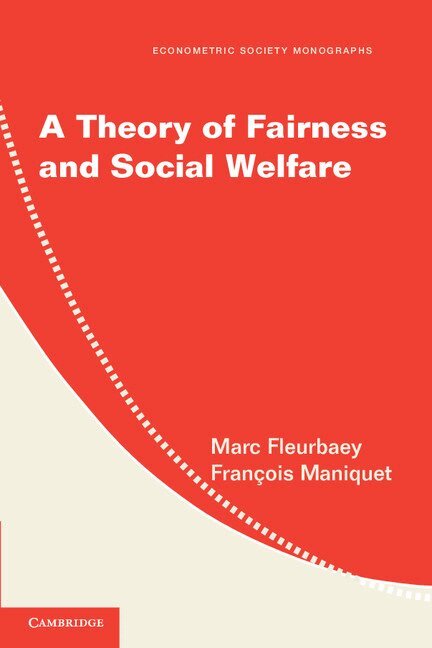
    A Theory of Fairness and Social Welfare

    AvMarc Fleurbaey,François Maniquet

    Inbunden, Engelska, 2011

    Del 48 i serien Econometric Society Monographs

    1 389 kr

    Beställningsvara. Skickas inom 10-15 vardagar. Fri frakt över 249 kr.

    Fler format och utgåvor

    Häftad

    535 kr

    Beskrivning

    The definition and measurement of social welfare have been a vexed issue for the past century. This book makes a constructive, easily applicable proposal and suggests how to evaluate the economic situation of a society in a way that gives priority to the worse-off and that respects each individual's preferences over his or her own consumption, work, leisure and so on. This approach resonates with the current concern to go 'beyond the GDP' in the measurement of social progress. Compared to technical studies in welfare economics, this book emphasizes constructive results rather than paradoxes and impossibilities, and shows how one can start from basic principles of efficiency and fairness and end up with concrete evaluations of policies. Compared to more philosophical treatments of social justice, this book is more precise about the definition of social welfare and reaches conclusions about concrete policies and institutions only after a rigorous derivation from clearly stated principles.

    Produktinformation

    • Utgivningsdatum:2011-06-13
    • Mått:152 x 229 x 22 mm
    • Vikt:640 g
    • Format:Inbunden
    • Språk:Engelska
    • Serie:Econometric Society Monographs
    • Antal sidor:316
    • Förlag:Cambridge University Press
    • ISBN:9780521887427

    Utforska kategorier

    • Nationalekonomi inom Ekonomi och Ledarskap

    Mer om författaren

    Marc Fleurbaey is a Research Director of the National Center for Scientific Research (CNRS) and serves on the staff of CERSES, the joint research entity of the CNRS and the Université Paris Descartes. He first worked at INSEE, taught subsequently at the Universities of Cergy-Pontoise and Pau, and as of 2011 is a professor at Princeton University. Professor Fleurbaey is a research associate at CORE at the Université Catholique de Louvain, at Sciences-Po in Paris, and at IDEP in Marseilles, and a visiting professor at the London School of Economics. He is a former editor of the journal Economics and Philosophy (Cambridge University Press) and is currently a managing editor of Social Choice and Welfare. He is the author, editor or coeditor of seven books, including Fairness, Responsibility, and Welfare (2008) and Justice, Political Liberalism, and Utilitarianism: Themes from Harsanyi and Rawls (with Maurice Salles and John Weymark, Cambridge University Press, 2008). His papers on normative and public economics have appeared in leading journals such as Econometrica the Journal of Political Economy and the Journal of Economic Theory. François Maniquet is Professor of Economics at CORE at the Université Catholique de Louvain, Belgium, and teaches part time at the University of Warwick, UK. He served as an FNRS research associate at the University of Namur, Belgium, until 2005. Professor Maniquet has been a visiting scholar at several research centers, including the Institute for Advanced Study in Princeton in 2001–2. He was awarded the Social Choice and Welfare Prize in 2004, and he received the Koç Prize for the best paper in the Review of Economic Design that same year. Professor Maniquet has published papers on welfare economics, public economics, game theory and political economics in eminent journals such as Econometrica, the Review of Economic Studies, the Journal of Economic Theory and the American Journal of Political Science. He is currently one of the editors of the Cambridge University Press journal Economics and Philosophy. Professor Maniquet was recently awarded the Francqui Prize, the highest scientific distinction in Belgium.

    Recensioner i media

    'Fleurbaey and Maniquet are among the outstanding scholars in the development of formal theories of social choice and justice today. Their many original contributions and synthesis, in the present volume, are masterly and go well beyond what can be said in the usual philosophical language. The concepts of fair and efficient resource allocations have been enriched by their work.' Kenneth J. Arrow, Stanford University and Nobel Laureate in Economics

    Innehållsförteckning

    • Preface; Introduction; Part I. Basics: 1. A contribution to welfare economics; 2. Efficiency versus equality; 3. Priority to the worst-off; 4. The informational basis of social orderings; Part II. Distribution: 5. Fair distribution of divisible goods: two approaches; 6. Specific domains; 7. Extensions; Part III. Production: 8. Public good; 9. Private good; 10. Unequal skills; 11. Income taxation; Conclusions; Proofs.