• Fri frakt över 249 kr
  • •
  • Snabba leveranser
  • •
  • Billiga böcker
Kundservice

Du är på sajten för privatpersoner.

Företag, bibliotek eller offentlig verksamhet?

Du handlar på classic.bokus.com, där alla dina funktioner finns intakta.
Till classic.bokus.com
Bokus logotyp. Gå till startsidan.
  • Erbjudanden
  • Nyheter
  • Student
  • Topplistor
  • Barn & ungdom
  • Bokus Play
  • E-böcker
  • Pocketböcker
  • Spel & pussel

10% rabatt på allt med kod: NYSTART10 →

Sidfot

Mina sidor

    Hjälp

    • Kundservice
    • Vanliga frågor och svar
    • Frakt och leverans
    • Retur vid ångerrätt
    • Reklamera vara
    • Betalning
    • Köpvillkor
    • Allmänna villkor
    • Information om webbplatsens tillgänglighet

    Om Bokus

    • Om oss
    • Pressrum
    • För studenter
    • För företag
    • För bibliotek och offentlig verksamhet
    • För leverantörer
    • Hållbarhet

    Populärt

    • Aktuella erbjudanden
    • Presentkort
    • Studentlitteratur
    • Nya böcker
    • Topplistor
    • Signerade böcker
    • Engelska böcker

    Inspiration

    • Boktips
    • BookTok
    • Populära bokserier
    • Barnbokskaraktärer
    • Populära författare
    Logotyp för Bokus
    Följ oss på Facebook (extern länk)Följ oss på Instagram (extern länk)Följ oss på YouTube (extern länk)Följ oss på TikTok (extern länk)
    bokus @ CookiesAnpassa cookiesIntegritetspolicyKöpvillkor
    Till Citymail hemsida (extern länk)Till Budbee hemsida (extern länk)Till Postnord hemsida (extern länk)Till Schenker hemsida (extern länk)Till Early Bird hemsida (extern länk)Till Walleys hemsida (extern länk)
    1. Ekonomi och Ledarskap
    2. Nationalekonomi
    3. Mikroekonomi

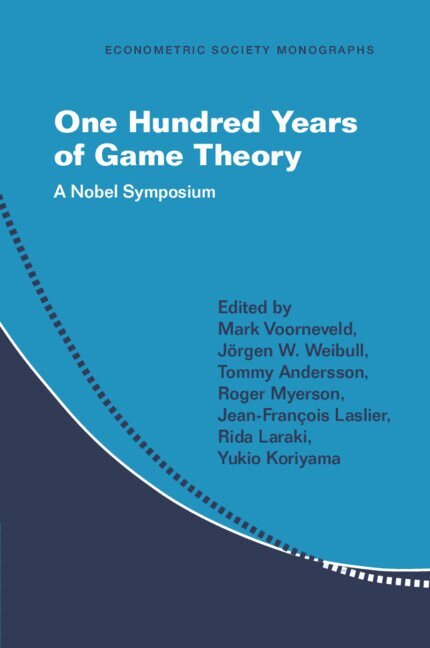
    One Hundred Years of Game Theory

    A Nobel Symposium

    AvMark Voorneveld,Jörgen W. Weibull

    Häftad, Engelska, 2026

    Del i serien Econometric Society Monographs

    494 kr

    Beställningsvara. Skickas inom 10-15 vardagar. Fri frakt över 249 kr.

    Beskrivning

    In the winter of 2021, the Swedish Nobel Foundation organized a Nobel symposium 'One Hundred Years of Game Theory' to commemorate the publication of famous mathematician Emile Borel's 'La théorie du jeu et les équations intégrales ... noyau symétrique'. The symposium gathered roughly forty of the world's most prominent scholars ranging from mathematical foundations to applications in economics, political science, computer science, biology, sociology, and other fields. One Hundred Years of Game Theory brings together their writings to summarize and put in perspective the main achievements of game theory in the last one hundred years. They address past achievements, taking stock of what has been accomplished and contemplating potential future developments and challenges. Offering cross-disciplinary discussions between eminent researchers including five Nobel laureates, one Fields medalist and two Gödel prize winners, the contributors provide a fascinating landscape of game theory and its wide range of applications.

    Produktinformation

    • Utgivningsdatum:2026-02-19
    • Mått:220 x 30 x 150 mm
    • Vikt:650 g
    • Format:Häftad
    • Språk:Engelska
    • Serie:Econometric Society Monographs
    • Antal sidor:438
    • Förlag:Cambridge University Press
    • ISBN:9781009686068

    Utforska kategorier

    • Mikroekonomi inom Ekonomi och Ledarskap
    • Systemvetenskap och AI inom Data och IT

    Mer om författaren

    Mark Voorneveld is a professor in the Department of Economics at the Stockholm School of Economics Jörgen W. Weibull is professor emeritus at the Stockholm School of Economics. He has taught game theory at many universities in the world. In his research he has made significant contributions to political economy, to the modelling of social norms and moral values, to evolutionary game theory, and to non-cooperative game theory. Tommy Andersson is a professor in the Department of Economics at Lund University. His research focuses on mechanism and market design. He is currently the President of the Society for Economic Design (2023-present) and a member of the Prize Committee for the Alfred Nobel Memorial Prize in Economic Sciences (2019 – present). Roger Myerson is a David L Pearson Professor of Global Conflict Studies in the Harris School of Public Policy at the University of Chicago. He has written about game theory, information economics, and comparative political institutions. In 2007, he was awarded the Nobel Memorial Prize in Economic Sciences for contributions to mechanism design theory, which analyzes rules for coordinating economic agents efficiently when they have different information and difficulty trusting each other. Jean-François Laslier is a Senior researcher at the CNRS and professor at the Paris School of Economics. His work interests include Games and Social Choice Theory, and Political Science. He does research on democracy, and in particular on voting rules and citizen's behavior. Rida Laraki is Director of the Moroccan Center for Game Theory at the University Mohammed VI Polytechnique (UM6P), Rabat, Morocco. He is a multi-disciplinary researcher whose work includes stochastic games, voting design, economic theory, optimization, and multi-agent learning. He is the co-author of Majority Judgment: Measuring, Ranking, and Electing (2011). Yukio Koriyama is Full Professor of Economics at the Ecole Polytechnique in France. His research interests include Game Theory and its application to Political Economy.

    Innehållsförteckning

    • One hundred years of game theory; a Nobel symposium Mark Voorneveld, Jorgen W. Weibull, Tommy Andersson, Roger Myerson, Jean-Francois Laslier, Rida Laraki, Yukio Koriyama; Part I. The Early History of Game Theory from Borel: 1. Introduction Francoise Forges; 2. The games of Borel and chance Laurent Mazliak; 3. Von Neumann, Morgenstern and their creation of game theory, 1900–1960 Robert Leonard; 4. Borel and the foundation of game theory Roger Myerson; Part II. Mathematics of Game Theory and Its Foundations: 5. Introduction Bernhard Von Stengel; 6. On mean field games Pierre-Louis Lions; 7. Value and equilibrium Sylvain Sorin; 8. Refinements of Nash equilibrium Robert Wilson; Part III. Population Dynamics, Learning, and Biology: 9. Introduction Lawrence Blume; 10. Adjustment dynamics for human players Michihiro Kandori; 11. Game theory in biology; ideas, successes, and challenges Olof Leimar; 12. The dynamics of evolutionary game theory Karl Sigmund; Part IV Computer Science: 13. Introduction Felix Brandt and Eva Tardos; 14. Non-concave games: a challenge for game theory's next 100 years Constantinos Daskalakis; 15. Fairness in approval-based multiwinner voting Edith Elkind; 16. Stochastic choice and dynamics based on pairwise comparisons Felix Brandt; 17. Truthful mechanism design for computationally hard resource allocation Paul Milgrom; 18. Impossibility in game dynamics Jason Milionis, Christos Papadimitriou, Georgios Piliouras and Kelly Spendlove; 19. The state of representing and solving games Tuomas Sandholm; Part V. Economics and Institutional Design: 20. Introduction Tommy Andersson; 21 Game theory and practical market design: how big, unobserved strategy sets brought cooperative and non-cooperative game theory together Alvin E. Roth; 22. Learning and equilibrium refinements Drew Fudenberg; Part VI. Individual Behavior in Strategic Interactions: 23. Introduction Mark Voorneveld; 24. Empirical evidence about individual behavior in games Colin F. Camerer; 25. From rationalistic to descriptive game theory Eric van Damme; 26. Social preferences and strategic interactions Ernst Fehr and Julien Senn; Part VII. Political Science: 27. Introduction Yukio Koriyama; 28. Game theory in political science: voting, elections and information aggregation David Austen-Smith; 29. Game theory and explanations for armed conflict James D. Fearon; 30. Applications of game theory in the political economy of trade policy Gene M. Grossman; Part VIII. Human Society: 31. Introduction Kaushik Basu; 32. Conflict, cooperation and innovation in the evolution of human societies Daron Acemoglu; 33. Laws and norms in games humans play Avinash Dixit; 34. Game theory in cultural evolution Joseph Henrich.