

François Maniquet - Böcker
Visar alla böcker från författaren François Maniquet. Handla med fri frakt och snabb leverans.
2 produkter
2 produkter
Del 48 - Econometric Society Monographs
A Theory of Fairness and Social Welfare
Häftad, Engelska, 2011
500 kr
Skickas inom 7-10 vardagar
The definition and measurement of social welfare have been a vexed issue for the past century. This book makes a constructive, easily applicable proposal and suggests how to evaluate the economic situation of a society in a way that gives priority to the worse-off and that respects each individual's preferences over his or her own consumption, work, leisure and so on. This approach resonates with the current concern to go 'beyond the GDP' in the measurement of social progress. Compared to technical studies in welfare economics, this book emphasizes constructive results rather than paradoxes and impossibilities, and shows how one can start from basic principles of efficiency and fairness and end up with concrete evaluations of policies. Compared to more philosophical treatments of social justice, this book is more precise about the definition of social welfare and reaches conclusions about concrete policies and institutions only after a rigorous derivation from clearly stated principles.
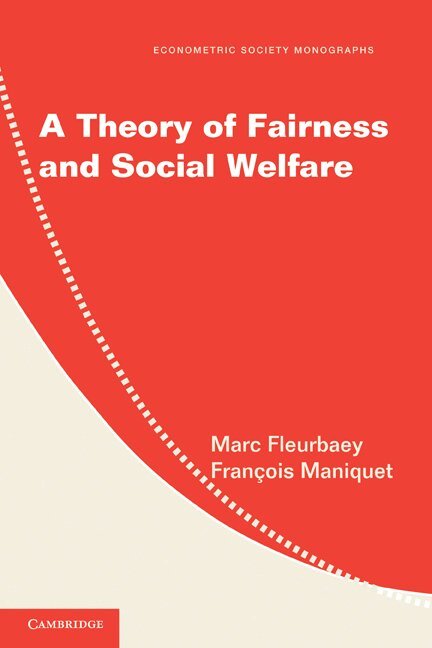
Del 48 - Econometric Society Monographs
A Theory of Fairness and Social Welfare
Inbunden, Engelska, 2011
1 295 kr
Skickas inom 7-10 vardagar
The definition and measurement of social welfare have been a vexed issue for the past century. This book makes a constructive, easily applicable proposal and suggests how to evaluate the economic situation of a society in a way that gives priority to the worse-off and that respects each individual's preferences over his or her own consumption, work, leisure and so on. This approach resonates with the current concern to go 'beyond the GDP' in the measurement of social progress. Compared to technical studies in welfare economics, this book emphasizes constructive results rather than paradoxes and impossibilities, and shows how one can start from basic principles of efficiency and fairness and end up with concrete evaluations of policies. Compared to more philosophical treatments of social justice, this book is more precise about the definition of social welfare and reaches conclusions about concrete policies and institutions only after a rigorous derivation from clearly stated principles.