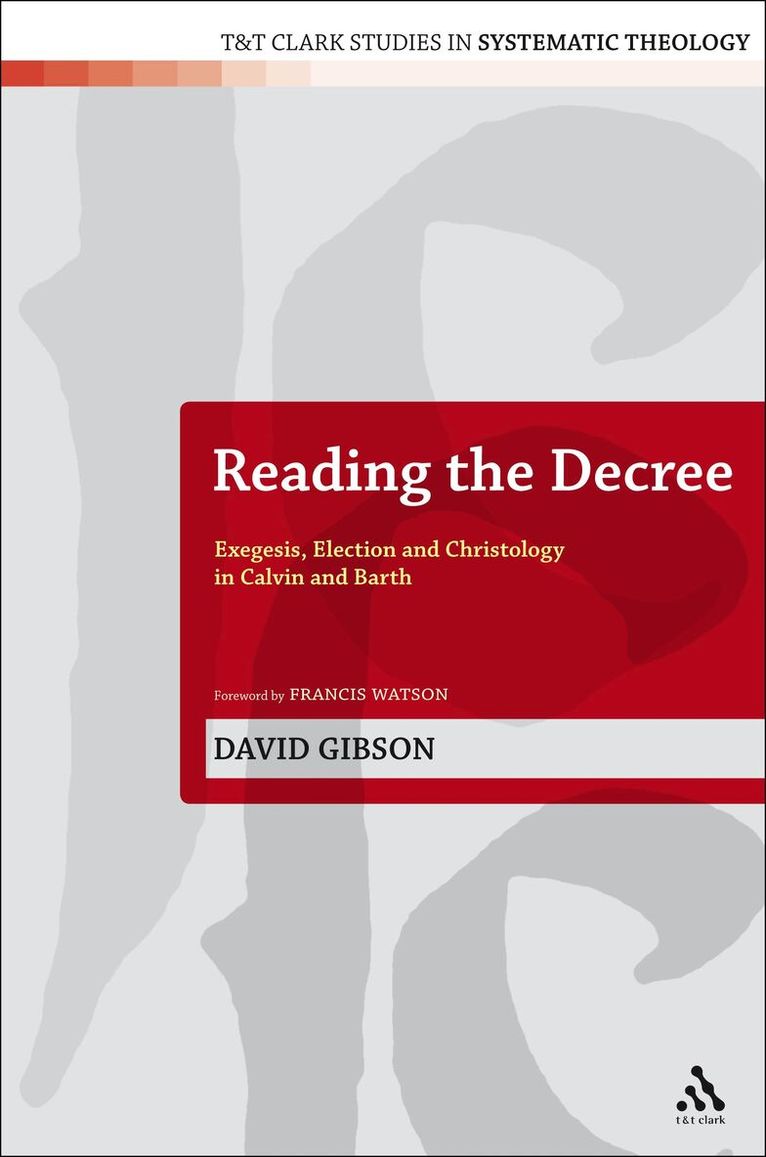
Häftad, Engelska, 2011
Reading the Decree
Exegesis, Election and Christology in Calvin and Barth
Av David Gibson, Ian a. McFarland
Del i serien T&T Clark Studies in Systematic Theology
553 kr
Beställningsvara. Skickas inom 10-15 vardagar. Fri frakt över 249 kr.
Beskrivning
Produktinformation
- Utgivningsdatum: 2011-11-03
- Mått: 152 x 232 x 16 mm
- Vikt: 352 g
- Format: Häftad
- Språk: Engelska
- Serie: T&T Clark Studies in Systematic Theology
- Antal sidor: 240
- Förlag: Bloomsbury Publishing PLC
- ISBN: 9780567129178
Utforska kategorier
Mer om författaren
Francis Watson is Professor in the Department of Theology and Religion, University of Durham and was formerly a holder of the Kirby Laing Chair of New Testament Exegesis in the University of Aberdeen (1999-2007), as well as a Reader in Biblical Theology, King's College London. Previous publications include: Paul, Judaism and the Gentiles, Text, Church and World, Text and Truth and Agape, Eros, Gender. David Gibson is Assistant Minister at High Church Hilton, Aberdeen. He studied theology at Nottingham University and King's College London, and completed a doctorate at the University of Aberdeen.
Recensioner i media
'Dr Gibson's exploration of the complex of issues that arises in the theological intersection of Christology, election and Scripture in Calvin and Barth is deft and dear, and painstaking and fair. The way in which he approaches his task, by fashioning illuminating methodological tools to interrogate the two theologians, is very well done. The result is a fascinating and valuable study.' - Paul Helm, Regents College, Vancouver, Canada 'Debates about the future of Reformed theology often tend to focus on the nature of the legacy of two men in particular: John Calvin and Karl Barth. Much ink has been spilled in examining the theological, social, intellectual, cultural, and even psychological backgrounds of these two men as a means of establishing their respective significance; but, in this work, David Gibson addresses these matters via a close study of their exegesis as a means of establishing just how faithful each was to their own stated scripture principle. Gibson's work represents a constructive and insightful development of contemporary discussion of the nature of Reformed theology.' -- Carl R. Trueman, Westminster Theological Seminary, Philadelphia, USA 'For those who deplore the "dumbing- down" of so much Christian publishing nowadays, this volume will offer a refreshing change' Churchman, Sept. 2010 'There is much to commend about Gibson's study. He offers the reader a clear, careful and fair reading of Calvin and Barth... He is refreshingly appreciative of the ways in which the connections and motifs internal to Barth's own thought are deeply indebted to the Reform tradition, and particularly to Calvin... this study deserves a wide reading, and will be of particular interest to Calvin and Barth scholars.' Journal of Theological Studies This rewarding study is a model of theology which is systematic in the best sense: it perceptively illumines the coherence of doctrine, and it does so through analysis of two towering figures in the Reformed tradition. Its most valuable contribution, however, is the care with which it examines the exegetical decisions which attend these doctrinal formulations. -Journal of Reformed Theology 4
Betyg & recensioner
0 recensioner
Inga recensioner tillgängliga.