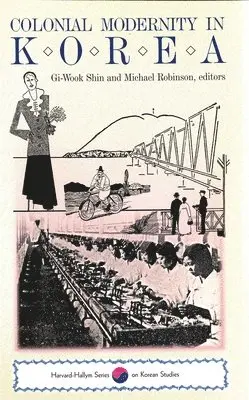
Häftad, Engelska, 2001
Colonial Modernity in Korea
Av Kyeong-Hee Choi, Henry H. Em, Gi-Wook Shin, Michael Robinson
Del 1 i serien Harvard-Hallym Series on Korea
253 kr
Beställningsvara. Skickas inom 10-15 vardagar. Fri frakt över 249 kr.
Beskrivning
Produktinformation
- Utgivningsdatum: 2001-08-01
- Mått: 152 x 229 x 30 mm
- Vikt: 726 g
- Format: Häftad
- Språk: Engelska
- Serie: Harvard-Hallym Series on Korea
- Antal sidor: 496
- Förlag: Harvard University, Asia Center
- ISBN: 9780674005945
Utforska kategorier
Mer om författaren
Gi-Wook Shin is Director of the Walter H. Shorenstein Asia-Pacific Research Center; founding director of the Korean Studies Program; Senior Fellow at the Freeman Spogli Institute for International Studies; and Associate Professor of Sociology at Stanford University. Michael Robinson is Associate Professor of Korean History at Indiana University. Soon Won Park is a lecturer in Korean studies at Keio University in Tokyo. Daqing Yang is Associate Professor of History and International Affairs, George Washington University.
Recensioner i media
Gi-Wook Shin and Michael Robinson have edited a book that brings together academics from a range of disciplines to present a comprehensive perspective of Korea’s colonial period from a more integrative and pluralist viewpoint… In taking on an alternative view of Korea’s colonial period, the book provides a valuable addition to the Korean historical literature. The rationale is well argued and avoids disparaging previous work. Nationalist biases (both Korean and Japanese) are avoided and editors and contributors project a richness of perspective that allows for a reassessment of the importance of the colonial period in the development of the modern Korean state.
Betyg & recensioner
0 recensioner
Inga recensioner tillgängliga.