• Fri frakt över 249 kr
  • •
  • Snabba leveranser
  • •
  • Billiga böcker
Kundservice

Du är på sajten för privatpersoner.

Företag, bibliotek eller offentlig verksamhet?

Du handlar på classic.bokus.com, där alla dina funktioner finns intakta.
Till classic.bokus.com
Bokus logotyp. Gå till startsidan.
  • Erbjudanden
  • Nyheter
  • Student
  • Topplistor
  • Barn & ungdom
  • Bokus Play
  • E-böcker
  • Pocketböcker
  • Spel & pussel

10% rabatt på allt med kod: NYSTART10 →

Sidfot

Mina sidor

    Hjälp

    • Kundservice
    • Vanliga frågor och svar
    • Frakt och leverans
    • Retur vid ångerrätt
    • Reklamera vara
    • Betalning
    • Köpvillkor
    • Allmänna villkor
    • Information om webbplatsens tillgänglighet

    Om Bokus

    • Om oss
    • Pressrum
    • För studenter
    • För företag
    • För bibliotek och offentlig verksamhet
    • För leverantörer
    • Hållbarhet

    Populärt

    • Aktuella erbjudanden
    • Presentkort
    • Studentlitteratur
    • Nya böcker
    • Topplistor
    • Signerade böcker
    • Engelska böcker

    Inspiration

    • Boktips
    • BookTok
    • Populära bokserier
    • Barnbokskaraktärer
    • Populära författare
    Logotyp för Bokus
    Följ oss på Facebook (extern länk)Följ oss på Instagram (extern länk)Följ oss på YouTube (extern länk)Följ oss på TikTok (extern länk)
    bokus @ CookiesAnpassa cookiesIntegritetspolicyKöpvillkor
    Till Citymail hemsida (extern länk)Till Budbee hemsida (extern länk)Till Postnord hemsida (extern länk)Till Schenker hemsida (extern länk)Till Early Bird hemsida (extern länk)Till Walleys hemsida (extern länk)
    1. Historia och arkeologi
    2. Historia
    3. Historia: särskilda händelser och ämnen
    4. Socialhistoria och kulturhistoria

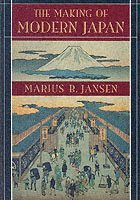
    Making of Modern Japan

    AvMarius B. Jansen

    Häftad, Engelska, 2002

    368 kr

    Beställningsvara. Skickas inom 5-8 vardagar. Fri frakt över 249 kr.

    Beskrivning

    Magisterial in vision, sweeping in scope, this monumental work presents a seamless account of Japanese society during the modern era, from 1600 to the present. A distillation of more than fifty years’ engagement with Japan and its history, it is the crowning work of our leading interpreter of the modern Japanese experience.Since 1600 Japan has undergone three periods of wrenching social and institutional change, following the imposition of hegemonic order on feudal society by the Tokugawa shogun; the opening of Japan’s ports by Commodore Perry; and defeat in World War II. The Making of Modern Japan charts these changes: the social engineering begun with the founding of the shogunate in 1600, the emergence of village and castle towns with consumer populations, and the diffusion of samurai values in the culture.Marius Jansen covers the making of the modern state, the adaptation of Western models, growing international trade, the broadening opportunity in Japanese society with industrialization, and the postwar occupation reforms imposed by General MacArthur. Throughout, the book gives voice to the individuals and views that have shaped the actions and beliefs of the Japanese, with writers, artists, and thinkers, as well as political leaders given their due.The story this book tells, though marked by profound changes, is also one of remarkable consistency, in which continuities outweigh upheavals in the development of society, and successive waves of outside influence have only served to strengthen a sense of what is unique and native to Japanese experience. The Making of Modern Japan takes us to the core of this experience as it illuminates one of the contemporary world’s most compelling transformations.

    Produktinformation

    • Utgivningsdatum:2002-10-15
    • Mått:160 x 235 x 45 mm
    • Vikt:1 257 g
    • Format:Häftad
    • Språk:Engelska
    • Antal sidor:936
    • Förlag:Harvard University Press
    • ISBN:9780674009912
    • Utmärkelser:Nominated for John K. Fairbank Prize in East Asian History 2001

    Utforska kategorier

    • Socialhistoria och kulturhistoria inom Historia och arkeologi
    • Asiens historia inom Historia och arkeologi

    Mer om författaren

    Marius B. Jansen was Professor Emeritus of Japanese History and East Asian Studies, Princeton University, and author of Sakamoto Ryoma and the Meiji Restoration.

    Recensioner i media

    An elegant, lucid, and magisterial book. A distillation of more than fifty years' engagement with Japan and its history, it presents the sweeping vision of our leading interpreter of the modern Japanese experience over the past half-millennium. Marius Jansen has integrated his own scholarship and that of many others in a lively account that has great potential as a text for survey courses in modern Japanese history; professionals in the field will benefit from its integrity and interpretive breadth. Moreover, Jansen's own enthusiasm and love for his subject come through every bit as clearly as his profound erudition; that sense of excitement carries the reader along smoothly and effortlessly. The book is a pleasure to read.

    Innehållsförteckning

    • Preface Acknowledgments Note on Names and Romanization 1. SEKIGAHARA 1. The Sengoku Background 2. The New Sengoku Daimyo 3. The Unifiers: Oda Nobunaga 4. Toyotomi Hideyoshi 5. Azuchi-Momoyama Culture 6. The Spoils of Sekigahara: Tokugawa Ieyasu 2. THE TOKUGAWA STATE 1. Taking Control 2. Ranking the Daimyo 3. The Structure of the Tokugawa Bakufu 4. The Domains (han) 5. Center and Periphery: Bakufu-Han Relations 6. The Tokugawa "State" 3. FOREIGN RELATIONS 1. The Setting 2. Relations with Korea 3. The Countries of the West 4. To the Seclusion Decrees 5. The Dutch at Nagasaki 6. Relations with China 7. The Question of the "Closed Country" 4. STATUS GROUPS 1. The Imperial Court 2. The Ruling Samurai Class 3. Village Life 4. Townsmen (chonin) 5. Subcaste Japanese 6. Status and Function 5. URBANIZATION AND COMMUNICATIONS 1. The sankin-kotai System 2. Communication Networks 3. Domain Castle Towns 4. Edo: The Central Magnet 6. THE DEVELOPMENT OF A MASS CULTURE 1. Civilizing the Ruling Class 2. Books and Literacy 3. Osaka and Kyoto 4. Genroku Culture 7. EDUCATION, THOUGHT, AND RELIGION 1. Education 2. The Diffusion of Confucianism 3. Scholars and Scholarship 4. The Problem of China 5. Ethnic Nativism 6. Dutch, or Western, Learning (rangaku) 7. Religion 8. Popular Preaching 8. CHANGE, PROTEST, AND REFORM 1. Population 2. Rulers and Ruled 3. Popular Protest 4. Bakufu Responses 9. THE OPENING TO THE WORLD 1. Russia 2. Western Europe 3. News from China 4. The Perry Mission 5. The War Within 6. Defense Intellectuals 10. THE TOKUGAWA FALL 1. The Narrative 2. The Open Ports 3. Experiencing the West 4. The Other Japanese 5. The Restoration Remembered 6. Why Did the Tokugawa Fall? 11. THE MEIJI REVOLUTION 1. Background 2. Steps toward Consensus 3. Toward Centralization 4. Failed Cultural Revolution 5. Wisdom throughout the World 6. The Breakup of the Restoration Coalition 7. Winners and Losers 12. BUILDING THE MEIJI STATE 1. Matsukata Economics 2. The Struggle for Political Participation 3. Ito Hirobumi and the Meiji Constitution 4. Yamagata Aritomo and the Imperial Army 5. Mori Arinori and Meiji Education 6. Summary: The Meiji Leaders 13. IMPERIAL JAPAN 1. The Election 2. Politics under the Meiji Constitution 3. Foreign Policy and Treaty Reform 4. War with China 5. The Diplomacy of Imperialism 6. The Annexation of Korea 7. State and Society 14. MEIJI CULTURE 1. Restore Antiquity! 2. Civilization and Enlightenment! Be a Success! 3. Christianity 4. Politics and Culture 5. The State and Culture 15. JAPAN BETWEEN THE WARS 1. Steps toward Party Government 2. Japan in World Affairs 3. Economic Change 16. TAISHO CULTURE AND SOCIETY 1. Education and Change 2. The Law Faculty of Tokyo Imperial University 3. Taisho Youth: From "Civilization" to "Culture" 4. Women 5. Labor 6. Changes in the Village 7. Urban Culture 8. The Interwar Years 17. THE CHINA WAR 1. Manchurian Beginnings: The Incident 2. Manchukuo: Eastward the Course of Empire 3. Soldiers and Politics 4. The Sacralization of Kokutai and the Return to Japan 5. The Economy: Recovery and Resources 6. Tenko: The Conversion of the Left 7. Planning for a Managed Economy 8. War with China and Konoe's "New Order in Asia" 18. THE PACIFIC WAR 1. Reading World Politics from Tokyo 2. Attempts to Reconfigure the Meiji Landscape 3. The Washington Talks 4. The Japanese People and the War 5. The Road to Hiroshima and Nagasaki 6. The Pacific War in the History of the Twentieth Century 7. Dismantling the Meiji State 19. THE YOSHIDA YEARS 1. The Social Context of Postsurrender Japan 2. Reform and Reconstruction 3. Planning for Recovery 4. Politics and the Road to San Francisco 5. The San Francisco System 6. Intellectuals and the Yoshida Structure 7. Postwar Culture 20. JAPAN SINCE INDEPENDENCE 1. Politics and the 1955 System 2. The Rise to Economic Superpower 3. Social Change 4. The Examined Life 5. Japan in World Affairs 6. Japan at Millennium's End Further Reading Notes Credits Index Illustrations follow pages 140, 364, and 588