• Fri frakt över 249 kr
  • •
  • Snabba leveranser
  • •
  • Billiga böcker
Kundservice

Du är på sajten för privatpersoner.

Företag, bibliotek eller offentlig verksamhet?

Du handlar på classic.bokus.com, där alla dina funktioner finns intakta.
Till classic.bokus.com
Bokus logotyp. Gå till startsidan.
  • Erbjudanden
  • Nyheter
  • Student
  • Topplistor
  • Barn & ungdom
  • Bokus Play
  • E-böcker
  • Pocketböcker
  • Spel & pussel

10% rabatt på allt med kod NYSTART10 →

Sidfot

Mina sidor

    Hjälp

    • Kundservice
    • Vanliga frågor och svar
    • Frakt och leverans
    • Retur vid ångerrätt
    • Reklamera vara
    • Betalning
    • Köpvillkor
    • Allmänna villkor
    • Information om webbplatsens tillgänglighet

    Om Bokus

    • Om oss
    • Pressrum
    • För studenter
    • För företag
    • För bibliotek och offentlig verksamhet
    • För leverantörer
    • Hållbarhet

    Populärt

    • Aktuella erbjudanden
    • Presentkort
    • Studentlitteratur
    • Nya böcker
    • Topplistor
    • Signerade böcker
    • Engelska böcker

    Inspiration

    • Boktips
    • BookTok
    • Populära bokserier
    • Barnbokskaraktärer
    • Populära författare
    Logotyp för Bokus
    Följ oss på Facebook (extern länk)Följ oss på Instagram (extern länk)Följ oss på YouTube (extern länk)Följ oss på TikTok (extern länk)
    bokus @ CookiesAnpassa cookiesIntegritetspolicyKöpvillkor
    Till Citymail hemsida (extern länk)Till Budbee hemsida (extern länk)Till Postnord hemsida (extern länk)Till Schenker hemsida (extern länk)Till Early Bird hemsida (extern länk)Till Walleys hemsida (extern länk)
    1. Naturvetenskap och teknik
    2. Teknik och industri
    3. Teknik: allmänt

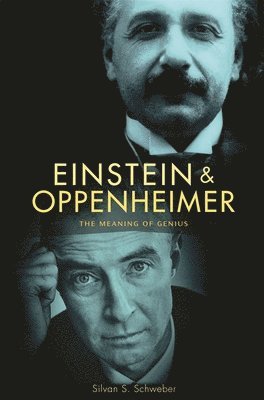
    Einstein and Oppenheimer

    The Meaning of Genius

    AvSilvan S. Schweber

    Häftad, Engelska, 2009

    284 kr

    Beställningsvara. Skickas inom 5-8 vardagar. Fri frakt över 249 kr.

    Beskrivning

    Albert Einstein and J. Robert Oppenheimer, two iconic scientists of the twentieth century, belonged to different generations, with the boundary marked by the advent of quantum mechanics. By exploring how these men differed—in their worldview, in their work, and in their day—this book provides powerful insights into the lives of two critical figures and into the scientific culture of their times. In Einstein’s and Oppenheimer’s philosophical and ethical positions, their views of nuclear weapons, their ethnic and cultural commitments, their opinions on the unification of physics, even the role of Buddhist detachment in their thinking, the book traces the broader issues that have shaped science and the world.Einstein is invariably seen as a lone and singular genius, while Oppenheimer is generally viewed in a particular scientific, political, and historical context. Silvan Schweber considers the circumstances behind this perception, in Einstein’s coherent and consistent self-image, and its relation to his singular vision of the world, and in Oppenheimer’s contrasting lack of certainty and related non-belief in a unitary, ultimate theory. Of greater importance, perhaps, is the role that timing and chance seem to have played in the two scientists’ contrasting characters and accomplishments—with Einstein’s having the advantage of maturing at a propitious time for theoretical physics, when the Newtonian framework was showing weaknesses.Bringing to light little-examined aspects of these lives, Schweber expands our understanding of two great figures of twentieth-century physics—but also our sense of what such greatness means, in personal, scientific, and cultural terms.

    Produktinformation

    • Utgivningsdatum:2009-10-01
    • Mått:156 x 235 x 28 mm
    • Vikt:612 g
    • Format:Häftad
    • Språk:Engelska
    • Antal sidor:432
    • Förlag:Harvard University Press
    • ISBN:9780674034525
    • Utmärkelser:Nominated for Rachel Carson Prize & Ludwik Fleck Prize 2009

    Utforska kategorier

    • Teknik: allmänt inom Naturvetenskap och teknik
    • Biografier inom Biografier
    • Fysik inom Naturvetenskap och teknik

    Mer om författaren

    Silvan S. Schweber was Associate, Department of the History of Science at Harvard University and Professor of Physics and Richard Koret Professor in the History of Ideas, Emeritus, at Brandeis University.

    Recensioner i media

    With sensitivity and masterful insight Schweber explores aspects of the lives, thought and personalities of Einstein and Oppenheimer—their philosophical and ethical positions, and their ethnic and cultural commitments—as well as their uneasy interaction with each other, their differing views on the unification of physics, and even the role of Buddhist detachment in their thinking. The end result is a book that offers new perspectives on how both scientists responded to the transformations in physics and its relationship with public and political developments brought about by the opening of the atomic age.

    Innehållsförteckning

    • *1. Einstein and Nuclear Weapons * Introduction * Einstein and the Atomic Bomb * After Hiroshima and Nagasaki * Einstein on World Government * Hydrogen Bombs * Individual versus Collective Stands * The Einstein--Russell Manifesto * Epilogue *2. Einstein and the Founding of Brandeis University * Introduction * Israel Goldstein * Rabbinic Connections * The Harold Laski Episode * Denouement * Epilogue *3. J. Robert Oppenheimer: Proteus Unbound * Introduction * The Early Years * Becoming a Physicist: Oppenheimer and His School * Los Alamos * The Postwar Years * Hydrogen Bombs * Epilogue *4. J. Robert Oppenheimer and American Pragmatism * The Director's Fund * Philosophy * Harvard Overseer * The William James Lectures *5. Einstein, Oppenheimer, and the Extension of Physics * Unification * Einstein and Unification * The MIT Centennial Celebration. * A Bird's-eye View of General Relativity, 1915--1960 *6. Einstein, Oppenheimer, and the Meaning of Community * The Einstein--Oppenheimer Interaction * Eulogies and Memorial Speeches * Roots and Tradition * Philosophy * Epilogue * Some Concluding Remarks * Appendix: The Russell--Einstein Manifesto * Notes * Bibliography * Acknowledgments * Index