• Fri frakt över 249 kr
  • •
  • Snabba leveranser
  • •
  • Billiga böcker
Kundservice

Du är på sajten för privatpersoner.

Företag, bibliotek eller offentlig verksamhet?

Du handlar på classic.bokus.com, där alla dina funktioner finns intakta.
Till classic.bokus.com
Bokus logotyp. Gå till startsidan.
  • Erbjudanden
  • Nyheter
  • Student
  • Topplistor
  • Barn & ungdom
  • Bokus Play
  • E-böcker
  • Pocketböcker
  • Spel & pussel

10% rabatt på allt med kod: NYSTART10 →

Sidfot

Mina sidor

    Hjälp

    • Kundservice
    • Vanliga frågor och svar
    • Frakt och leverans
    • Retur vid ångerrätt
    • Reklamera vara
    • Betalning
    • Köpvillkor
    • Allmänna villkor
    • Information om webbplatsens tillgänglighet

    Om Bokus

    • Om oss
    • Pressrum
    • För studenter
    • För företag
    • För bibliotek och offentlig verksamhet
    • För leverantörer
    • Hållbarhet

    Populärt

    • Aktuella erbjudanden
    • Presentkort
    • Studentlitteratur
    • Nya böcker
    • Topplistor
    • Signerade böcker
    • Engelska böcker

    Inspiration

    • Boktips
    • BookTok
    • Populära bokserier
    • Barnbokskaraktärer
    • Populära författare
    Logotyp för Bokus
    Följ oss på Facebook (extern länk)Följ oss på Instagram (extern länk)Följ oss på YouTube (extern länk)Följ oss på TikTok (extern länk)
    bokus @ CookiesAnpassa cookiesIntegritetspolicyKöpvillkor
    Till Citymail hemsida (extern länk)Till Budbee hemsida (extern länk)Till Postnord hemsida (extern länk)Till Schenker hemsida (extern länk)Till Early Bird hemsida (extern länk)Till Walleys hemsida (extern länk)
    1. Historia och arkeologi
    2. Historia
    3. Europas historia

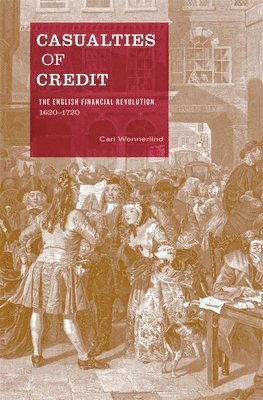
    Casualties of Credit

    The English Financial Revolution, 1620–1720

    AvCarl Wennerlind

    Inbunden, Engelska, 2011

    538 kr

    Beställningsvara. Skickas inom 10-15 vardagar. Fri frakt över 249 kr.

    Beskrivning

    Modern credit, developed during the financial revolution of 1620–1720, laid the foundation for England’s political, military, and economic dominance in the eighteenth century. Possessed of a generally circulating credit currency, a modern national debt, and sophisticated financial markets, England developed a fiscal–military state that instilled fear in its foes and facilitated the first industrial revolution. Yet a number of casualties followed in the wake of this new system of credit. Not only was it precarious and prone to accidents, but it depended on trust, public opinion, and ultimately violence.Carl Wennerlind reconstructs the intellectual context within which the financial revolution was conceived. He traces how the discourse on credit evolved and responded to the Glorious Revolution, the Scientific Revolution, the founding of the Bank of England, the Great Recoinage, armed conflicts with Louis XIV, the Whig–Tory party wars, the formation of the public sphere, and England’s expanded role in the slave trade. Debates about credit engaged some of London’s most prominent turn-of-the-century intellectuals, including Daniel Defoe, John Locke, Isaac Newton, Jonathan Swift and Christopher Wren. Wennerlind guides us through these conversations, toward an understanding of how contemporaries viewed the precariousness of credit and the role of violence—war, enslavement, and executions—in the safeguarding of trust.

    Produktinformation

    • Utgivningsdatum:2011-11-30
    • Mått:156 x 235 x 30 mm
    • Vikt:678 g
    • Format:Inbunden
    • Språk:Engelska
    • Antal sidor:360
    • Förlag:Harvard University Press
    • ISBN:9780674047389
    • Utmärkelser:Nominated for Morris D. Forkosch Prize 2012

    Utforska kategorier

    • Europas historia inom Historia och arkeologi
    • Ekonomisk historia inom Ekonomi och Ledarskap

    Mer om författaren

    Carl Wennerlind is Professor of History at Barnard College, Columbia University, where he specializes in intellectual history and political economy. He is the author of Casualties of Credit: The English Financial Revolution, 1620–1720 and, with Margaret Schabas, A Philosopher’s Economist: Hume and the Rise of Capitalism.

    Recensioner i media

    Recent history makes Wennerlind’s new intellectual history of England’s long ‘financial revolution’ of the seventeenth century of more than ordinary interest. The book describes the rise of credit as a concept that enabled financial innovation on a heretofore unprecedented scale in seventeenth-century England, criticizing some of the assumptions that lay behind this new orientation and thereby exposing the ‘casualties’ of credit that give the book its name. Wennerlind links the history of credit with such diverse phenomena as alchemy, capital punishment, and slavery that have rarely been associated with it by previous historians. Wennerlind’s book is both methodologically and chronologically innovative. He uses intellectual history to illuminate a topic more often explored by social and economic historians…Wennerlind does not simply use the work of financial historians to illuminate the idea of credit; he uses the intellectual history of credit to rethink the concept of the financial revolution itself. In so doing, he demonstrates that the expansion of credit, and the financial revolution engendered by that expansion, had a much more complicated history than previous accounts have realized… The book manages to offer insights into several key, and often unexplored, conceptual connections that can help us begin to understand the intellectual origins of the financial revolution.