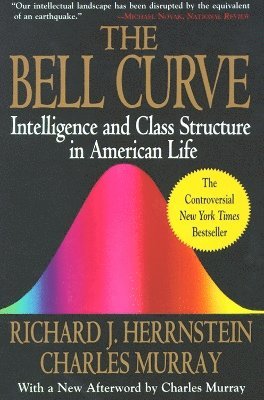
The controversial book linking intelligence to class and race in modern society, and what public policy can do to mitigate socioeconomic differences in IQ, birth rate, crime, fertility, welfare, and poverty.
Richard J. Herrnstein held the Edger Pierce Chair in Psychology at Harvard University until his death in 1994.
Recensioner i media
Michael Novak National Review Our intellectual landscape has been disrupted by the equivalent of an earthquake.
Innehållsförteckning
ContentsList of IllustrationsList of TablesA Note to the ReaderPrefaceAcknowledgmentsIntroductionPART I.THE EMERGENCE OF A COGNITIVE ELITE1 Cognitive Class and Education, 1900-19902 Cognitive Partitioning by Occupation3 The Economic Pressure to Partition4 Steeper Ladders, Narrower GatesPART II.COGNITIVE CLASSES AND SOCIAL BEHAVIOR5 Poverty6 Schooling7 Unemployment, Idleness, and Injury8 Family Matters9 Welfare Dependency10 Parenting11 Crime12 Civility and CitizenshipPART III.THE NATIONAL CONTEXT13 Ethnic Differences in Cognitive Ability14 Ethnic Inequalities in Relation to IQ15 The Demography of Intelligence16 Social Behavior and the Prevalence of Low Cognitive AbilityPART IV.LIVING TOGETHER17 Raising Cognitive Ability18 The Leveling of American Education19 Affirmative Action in Higher Education20 Affirmative Action in the Workplace21 The Way We Are Headed22 A Place for EveryoneAfterworldAPPENDIXES1 Statistics for People Who Are Sure They Can't Learn Statistics2 Technical Issues Regarding the National Longitudinal Survey of Youth3 Technical Issues Regarding the Armed Forces Qualification Test as a Measure of IQ4 Regression Analyses (rom Part II5 Supplemental Material for Chapter 136 Regression Analyses from Chapter 147 The Evolution of Affirmative Action in the WorkplaceNotesBibliographyIndex