• Fri frakt över 249 kr
  • •
  • Snabba leveranser
  • •
  • Billiga böcker
Kundservice

Du är på sajten för privatpersoner.

Företag, bibliotek eller offentlig verksamhet?

Du handlar på classic.bokus.com, där alla dina funktioner finns intakta.
Till classic.bokus.com
Bokus logotyp. Gå till startsidan.
  • Erbjudanden
  • Student
  • Topplistor
  • Barn & ungdom
  • Bokus Play
  • E-böcker
  • Ljudböcker
  • Pocketböcker
  • Spel & pussel

Upp till 25% på utvalda nyheter →

Sidfot

Mina sidor

    Hjälp

    • Kundservice
    • Vanliga frågor och svar
    • Frakt och leverans
    • Retur vid ångerrätt
    • Reklamera vara
    • Betalning
    • Köpvillkor
    • Allmänna villkor
    • Information om webbplatsens tillgänglighet

    Om Bokus

    • Om oss
    • Pressrum
    • För studenter
    • För företag
    • För bibliotek och offentlig verksamhet
    • För leverantörer
    • Hållbarhet

    Populärt

    • Aktuella erbjudanden
    • Presentkort
    • Studentlitteratur
    • Nya böcker
    • Topplistor
    • Signerade böcker
    • Engelska böcker

    Inspiration

    • Boktips
    • BookTok
    • Populära bokserier
    • Barnbokskaraktärer
    • Populära författare
    Logotyp för Bokus
    Följ oss på Facebook (extern länk)Följ oss på Instagram (extern länk)Följ oss på YouTube (extern länk)Följ oss på TikTok (extern länk)
    bokus @ CookiesAnpassa cookiesIntegritetspolicyKöpvillkor
    Till Citymail hemsida (extern länk)Till Budbee hemsida (extern länk)Till Postnord hemsida (extern länk)Till Schenker hemsida (extern länk)Till Early Bird hemsida (extern länk)Till Walleys hemsida (extern länk)
    1. Naturvetenskap och teknik
    2. Matematik och naturvetenskap
    3. Matematik
    4. Optimering

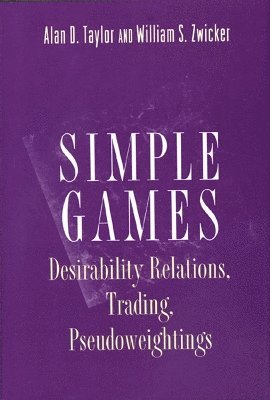
    Simple Games

    Desirability Relations, Trading, Pseudoweightings

    AvAlan D. Taylor,William S. Zwicker

    Inbunden, Engelska, 1999

    1 375 kr

    Beställningsvara. Skickas inom 5-8 vardagar. Fri frakt över 249 kr.

    Beskrivning

    Simple games are mathematical structures inspired by voting systems in which a single alternative, such as a bill, is pitted against the status quo. The first in-depth mathematical study of the subject as a coherent subfield of finite combinatorics--one with its own organized body of techniques and results--this book blends new theorems with some of the striking results from threshold logic, making all of it accessible to game theorists. Introductory material receives a fresh treatment, with an emphasis on Boolean subgames and the Rudin-Keisler order as unifying concepts. Advanced material focuses on the surprisingly wide variety of properties related to the weightedness of a game. A desirability relation orders the individuals or coalitions of a game according to their influence in the corresponding voting system. As Taylor and Zwicker show, acyclicity of such a relation approximates weightedness--the more sensitive the relation, the closer the approximation. A trade is an exchange of players among coalitions, and robustness under such trades is equivalent to weightedness of the game.Robustness under trades that fit some restrictive exchange pattern typically characterizes a wider class of simple games--for example, games for which some particular desirability order is acyclic. Finally, one can often describe these wider classes of simple games by weakening the total additivity of a weighting to obtain what is called a pseudoweighting. In providing such uniform explanations for many of the structural properties of simple games, this book showcases numerous new techniques and results.

    Produktinformation

    • Utgivningsdatum:1999-10-12
    • Mått:152 x 235 x 20 mm
    • Vikt:531 g
    • Format:Inbunden
    • Språk:Engelska
    • Antal sidor:264
    • Förlag:Princeton University Press
    • ISBN:9780691001203

    Utforska kategorier

    • Optimering inom Naturvetenskap och teknik

    Mer om författaren

    Alan D. Taylor is the Marie Louise Bailey Professor of Mathematics at Union College. William S. Zwicker is Professor of Mathematics at Union College. Both have taught at Union for twenty-four years; their research has been in the areas of combinatorial set theory and applications of mathematics to political science, including social choice theory, fair division, and game theory.

    Recensioner i media

    "The authors do a nice job of bringing material from game theory, voting theory, graph theory, and threshold logic together with new results of the authors and presenting it coherently in the context of simple games. As such, it is a useful text for anyone looking for an introduction to simple games that gives not only several perspectives from which to view them, but also some of the latest results in the field and still-open questions."—Deanna B. Haunsperger, Carleton College

    Innehållsförteckning

    • Prefaceix Acknowledgmentsxv Chapter 1 - Fundamentals 3 1.1 Introduction 3 1.2 Examples 8 1.3 The Dual Game 14 1.4 The Algebra of Simple Games 19 1.5 The Two-Point Constant-Sum Extension of a Game 26 1.6 Pregames and Weighted Graphs 29 1.7 Vector-Weighted Simple Games and Dimension Theory 34 1.8 The Voting Bloc and Bicameral Meet Characterization 39 1.9 The Game behind a Simple Game 40 Chapter 2 General Trading: Weighted Games 43 2.1 Introduction 43 2.2 Trading Transforms and Trading Matrices 45 2.3 Sequential Transfers 54 2.4 The Trading Characterization of Weighted Games 56 2.5 Pregraphs and Graphs 63 2.6 The Traditional Approaches: Systems of Linear Inequalities and Separating Hyperplanes 68 2.7 The Gabelman Examples 74 2.8 A General Framework 79 Chapter 3 Pairwise Trading: Linear Games and Winder Games 86 3.1 Introduction 86 3.2 The Desirability Relation on Individuals and Swap Robustness 87 3.3 Shift Minimal Winning Coalitions and the Ordinal Power Structure of a Simple Game 92 3.4 A Classification Theorem for Linear Games 97 3.5 Chvatal's Conjecture 103 3.6 The PSA Pseudoweighting Characterization of Linear Games 110 3.7 The Local Weighting Characterization of Linear Games 115 3.8 Two-Trade Robustness and Winder Games 120 3.9 A Weighting Characterization of Winder Games 122 3.10 The Hereditarily Dual-Comparable Characterization of Winder Games 123 Chapter 4 - Cycle Trading: Weakly Acyclic Games and Strongly Acyclic Games 125 4.1 Introduction 125 4.2 An Impossibility Result for Coalitional Desirability Relations 125 4.3 Possibilities, and More Impossibilities, from the Weight-Induced Order 134 4.4 Lapidot's Desirability Relation on Coalitions and Weakly Acyclic Games 139 4.5 The SSA Pseudoweighting Characterization of Weakly Acyclic Games, and a Generalization 142 4.6 An Inductive Construction of SSA Pseudoweightings for Weakly Acyclic Games 145 4.7 Winder's Desirability Relation on Coalition and Strongly Acyclic Games 150 4.8 A Pseudoweighting Characterization of Strongly Acyclic Games 156 4.9 Sequential Transfer Trading for L and W 157 4.10 Peleg's Question on the Weightedness of Constant-Sum Acyclic Games 165 Chapter 5 - Almost General Trading: Chow Games, Completely Acyclic Games, and Weighted Games 178 5.1 Introduction 178 5.2 Chow Games and Chow-Lapidot Parameters 179 5.3 A Gabelman-Style, Nonweighted Chow Game 183 5.4 The Trading Version of Lapidot's Desirability Relation 190 5.5 The Trading Version of Winder's Desirability Relation 196 5.6 Multiweightings 201 5.7 Weighted Games and the Weight-Induced Order 205 Appendix I: Systems of Linear Inequalities 215 Appendix II: Separating Hyperplanes 220 Appendix III: Duality and Transitivity for Binary Relations 223 References 229 Index 235