• Fri frakt över 249 kr
  • •
  • Snabba leveranser
  • •
  • Billiga böcker
Kundservice

Du är på sajten för privatpersoner.

Företag, bibliotek eller offentlig verksamhet?

Du handlar på classic.bokus.com, där alla dina funktioner finns intakta.
Till classic.bokus.com
Bokus logotyp. Gå till startsidan.
  • Erbjudanden
  • Nyheter
  • Student
  • Topplistor
  • Barn & ungdom
  • Bokus Play
  • E-böcker
  • Pocketböcker
  • Spel & pussel

10% rabatt på allt med kod: NYSTART10 →

Sidfot

Mina sidor

    Hjälp

    • Kundservice
    • Vanliga frågor och svar
    • Frakt och leverans
    • Retur vid ångerrätt
    • Reklamera vara
    • Betalning
    • Köpvillkor
    • Allmänna villkor
    • Information om webbplatsens tillgänglighet

    Om Bokus

    • Om oss
    • Pressrum
    • För studenter
    • För företag
    • För bibliotek och offentlig verksamhet
    • För leverantörer
    • Hållbarhet

    Populärt

    • Aktuella erbjudanden
    • Presentkort
    • Studentlitteratur
    • Nya böcker
    • Topplistor
    • Signerade böcker
    • Engelska böcker

    Inspiration

    • Boktips
    • BookTok
    • Populära bokserier
    • Barnbokskaraktärer
    • Populära författare
    Logotyp för Bokus
    Följ oss på Facebook (extern länk)Följ oss på Instagram (extern länk)Följ oss på YouTube (extern länk)Följ oss på TikTok (extern länk)
    bokus @ CookiesAnpassa cookiesIntegritetspolicyKöpvillkor
    Till Citymail hemsida (extern länk)Till Budbee hemsida (extern länk)Till Postnord hemsida (extern länk)Till Schenker hemsida (extern länk)Till Early Bird hemsida (extern länk)Till Walleys hemsida (extern länk)
    1. Naturvetenskap och teknik
    2. Matematik och naturvetenskap
    3. Biologi
    4. Zoologi

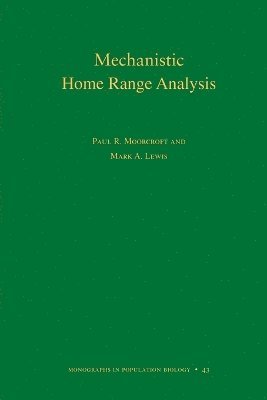
    Mechanistic Home Range Analysis

    AvPaul R. Moorcroft,Mark A. Lewis

    Häftad, Engelska, 2006

    Del i serien Monographs in Population Biology

    701 kr

    Beställningsvara. Skickas inom 5-8 vardagar. Fri frakt över 249 kr.

    Beskrivning

    Spatial patterns of movement are fundamental to the ecology of animal populations, influencing their social organization, mating systems, demography, and the spatial distribution of prey and competitors. However, our ability to understand the causes and consequences of animal home range patterns has been limited by the descriptive nature of the statistical models used to analyze them. In Mechanistic Home Range Analysis, Paul Moorcroft and Mark Lewis develop a radically new framework for studying animal home range patterns based on the analysis of correlated random work models for individual movement behavior. They use this framework to develop a series of mechanistic home range models for carnivore populations.The authors' analysis illustrates how, in contrast to traditional statistical home range models that merely describe pattern, mechanistic home range models can be used to discover the underlying ecological determinants of home range patterns observed in populations, make accurate predictions about how spatial distributions of home ranges will change following environmental or demographic disturbance, and analyze the functional significance of the movement strategies of individuals that give rise to observed patterns of space use. By providing researchers and graduate students of ecology and wildlife biology with a more illuminating way to analyze animal movement, Mechanistic Home Range Analysis will be an indispensable reference for years to come.

    Produktinformation

    • Utgivningsdatum:2006-08-20
    • Mått:152 x 235 x 17 mm
    • Vikt:363 g
    • Format:Häftad
    • Språk:Engelska
    • Serie:Monographs in Population Biology
    • Antal sidor:192
    • Förlag:Princeton University Press
    • ISBN:9780691009285

    Utforska kategorier

    • Zoologi inom Naturvetenskap och teknik
    • Djurböcker inom Djur och Natur

    Mer om författaren

    Paul R. Moorcroft is Associate Professor of Biology at Harvard University. Mark A. Lewis is Professor of Mathematics and Biology at the University of Alberta, where he holds a Senior Canada Research Chair in Mathematical Biology.

    Recensioner i media

    "Mechanistic Home Range Analysis will be the reference book for quantifying animal movement in general for some years to come. Moorcroft and Lewis extend the basic concepts and mathematical models of the mid-1990s for animal movement, group behavior, and group predator-prey survival in major ways to new and interesting situations. They also bring to their modeling and analyses more accurate data obtained from recently improved systems of tracking animals in the wild."—J. D. Murray, University of Oxford and University of Washington

    Innehållsförteckning

    • Preface ix CHAPTER 1: Introduction 1 1.1. Statistical Home Range Analysis 2 1.2. Mechanistic Home Range Analysis 4 CHAPTER 2: From Individual Behavior to Patterns of Space Use 7 2.1. Movement in One Dimension 8 2.2. Movement in Two Dimensions 12 2.3. Directed and Random Motion 13 2.4. Predicting Home Range Patterns 21 2.5. Summary 22 CHAPTER 3: A Simple Mechanistic Home Range Model 23 3.1. Model of Individual Movement Behavior 24 3.2. Characterizing the Movement Behavior of a Red Fox 27 3.3. Equations for Patterns of Space Use 30 3.4. Solving for Patterns of Space Use 31 3.5. Predicted Red Fox Home Range 33 3.6. Coyote Home Range Patterns 35 3.7. Summary 37 CHAPTER 4: A Model Based on Conspecific Avoidance 38 4.1. Model Formulation 39 4.2. Equations for Space Use 42 4.3. Empirical Evaluation of the Model 43 4.4. Summary 53 CHAPTER 5: Comparative Analysis of Home Range Patterns Predicted by the Conspecific Avoidance Model 55 5.1. Predicted Patterns of Space Use 55 5.2. Border versus Hinterland Scent Marking 60 5.3. The Distribution of Scent Marks along Boundaries 64 5.4. Summary 66 CHAPTER 6: Mathematical Analysis of the Conspecific Avoidance Model 67 6.1. Model Equations 67 6.2. Impact of the Scent-Marking Response 68 6.3. Existence of a Buffer Zone 72 6.4. Generalized Response Functions 74 6.5. Summary 78 ChAPTER 7: The Influence of Landscape and Resource Heterogeneity on Patterns of Space Use 79 7.1. Landscape Heterogeneity 79 7.2. Resource Heterogeneity and Foraging Behavior 82 7.3. Model Predictions 89 7.4. Summary 91 CHAPTER 8: Home Range Formation in the Absence of a Den Site 92 8.1. Model Formulation 92 8.2. Analysis 94 8.3. Summary 96 CHAPTER 9: Secondary Ecological Interactions 97 9.1. Wolf-Deer Interactions 97 9.2. Wolf-Coyote Interactions 100 9.3. Summary 103 10. Displacement Distances: Theory and Applications 104 10.1. The Minimum Convex Polygon Method 104 10.2. Mean-Absolute and Mean-Squared Displacement 110 10.3. Summary 114 CHAPTER 11: ESS Analysis of Movement Strategies: Analyzing the Functional Significance of Home Range Patterns 115 11.1. Evolutionarily Stable Movement Strategy for Interacting Wolf Packs 116 11.2. Analysis 119 11.3. Roles of Aggression and Signaling 126 11.4. Summary 128 CHAPTER 12: Future Directions and Synthesis 130 APPENDIXES A: Derivation of the Fokker-Planck Equation for Space Use 137 B: Alternative Derivation of the Space Use Equation 139 C: Autocorrelation in Movement Direction 140 D: Estimating the Parameters of the Localizing Tendency Model 142 E: Movement with Attraction toward a Den 144 F: Model Fitting 149 G: Numerical Methods for Solving Space Use Equations 151 H: Displacement Distances 152 I: ESS Analysis Model Parameters 157 References 158 Index 169