• Fri frakt över 249 kr
  • •
  • Snabba leveranser
  • •
  • Billiga böcker
Kundservice

Du är på sajten för privatpersoner.

Företag, bibliotek eller offentlig verksamhet?

Du handlar på classic.bokus.com, där alla dina funktioner finns intakta.
Till classic.bokus.com
Bokus logotyp. Gå till startsidan.
  • Erbjudanden
  • Nyheter
  • Student
  • Topplistor
  • Barn & ungdom
  • Bokus Play
  • E-böcker
  • Pocketböcker
  • Spel & pussel

Må bättre, för mindre! Upp till 50% rabatt på hälsoböcker

Sidfot

Mina sidor

    Hjälp

    • Kundservice
    • Vanliga frågor och svar
    • Frakt och leverans
    • Retur vid ångerrätt
    • Reklamera vara
    • Betalning
    • Köpvillkor
    • Allmänna villkor
    • Information om webbplatsens tillgänglighet

    Om Bokus

    • Om oss
    • Pressrum
    • För studenter
    • För företag
    • För bibliotek och offentlig verksamhet
    • För leverantörer
    • Hållbarhet

    Populärt

    • Aktuella erbjudanden
    • Presentkort
    • Studentlitteratur
    • Nya böcker
    • Topplistor
    • Signerade böcker
    • Engelska böcker

    Inspiration

    • Boktips
    • BookTok
    • Populära bokserier
    • Barnbokskaraktärer
    • Populära författare
    Logotyp för Bokus
    Följ oss på Facebook (extern länk)Följ oss på Instagram (extern länk)Följ oss på YouTube (extern länk)Följ oss på TikTok (extern länk)
    bokus @ CookiesAnpassa cookiesIntegritetspolicyKöpvillkor
    Till Citymail hemsida (extern länk)Till Budbee hemsida (extern länk)Till Postnord hemsida (extern länk)Till Schenker hemsida (extern länk)Till Early Bird hemsida (extern länk)Till Walleys hemsida (extern länk)
    1. Historia och arkeologi
    2. Historia
    3. Europas historia

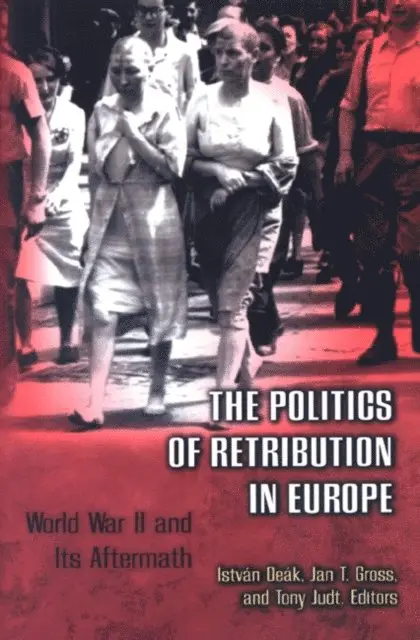
    Politics of Retribution in Europe

    World War II and Its Aftermath

    AvIstván Deák,Jan T. Gross

    Häftad, Engelska, 2000

    495 kr

    Beställningsvara. Skickas inom 5-8 vardagar. Fri frakt över 249 kr.

    Beskrivning

    The presentation of Europe's immediate historical past has quite dramatically changed. Conventional depictions of occupation and collaboration in World War II, of wartime resistance and post-war renewal, provided the familiar backdrop against which the chronicle of post-war Europe has mostly been told. Within these often ritualistic presentations, it was possible to conceal the fact that not only were the majority of people in Hitler's Europe not resistance fighters but millions actively co-operated with and many millions more rather easily accommodated to Nazi rule. Moreover, after the war, those who judged former collaborators were sometimes themselves former collaborators. Many people became innocent victims of retribution, while others--among them notorious war criminals--escaped punishment. Nonetheless, the process of retribution was not useless but rather a historically unique effort to purify the continent of the many sins Europeans had committed.This book sheds light on the collective amnesia that overtook European governments and peoples regarding their own responsibility for war crimes and crimes against humanity--an amnesia that has only recently begun to dissipate as a result of often painful searching across the continent. In inspiring essays, a group of internationally renowned scholars unravels the moral and political choices facing European governments in the war's aftermath: how to punish the guilty, how to decide who was guilty of what, how to convert often unspeakable and conflicted war experiences and memories into serviceable, even uplifting accounts of national history. In short, these scholars explore how the drama of the immediate past was (and was not) successfully "overcome." Through their comparative and transnational emphasis, they also illuminate the division between eastern and western Europe, locating its origins both in the war and in post-war domestic and international affairs. Here, as in their discussion of collaborators' trials, the authors lay bare the roots of the many unresolved and painful memories clouding present-day Europe.Contributors are Brad Abrams, Martin Conway, Sarah Farmer, Luc Huyse, Laszlo Karsai, Mark Mazower, and Peter Romijn, as well as the editors. Taken separately, their essays are significant contributions to the contemporary history of several European countries. Taken together, they represent an original and pathbreaking account of a formative moment in the shaping of Europe at the dawn of a new millennium.


    Produktinformation

    • Utgivningsdatum:2000-04-16
    • Mått:152 x 235 x 21 mm
    • Vikt:522 g
    • Format:Häftad
    • Språk:Engelska
    • Antal sidor:352
    • Förlag:Princeton University Press
    • ISBN:9780691009544

    Utforska kategorier

    • Europas historia inom Historia och arkeologi
    • Politik och statsskick inom Samhälle och politik

    Mer om författaren

    István Deák is Seth Low Professor of History at Columbia University and the author of, among other books, Beyond Nationalism: A Social and Political History of the Habsburg Officer Corps, l848-1918. Jan T. Gross is Professor of Politics and European Studies at New York University. He is the author of, among other books, Revolution from Abroad: Soviet Conquest of Poland's Western Ukraine and Western Belorussia (Princeton). Tony Judt is Erich Maria Remarque Professor of European Studies at New York University. His many books include The Burden of Responsibility: Blum, Camus, and the French Twentieth Century.

    Recensioner i media

    "This book makes a splendid contribution toward the rewriting of postwar European History... It is quite indispensable for college students and serious adult readers of recent European history... "--Trevor Burridge, History "The first question that leaps to mind is why the story of a massacre so monstrous, and of such historic significance, should surface only now, half a century after the fact. The answer to this question is both startling and complex ... A detailed account is provided by the sociologist and historian Jan T. Gross in his book."--Abraham Brumberg, Times Literary Supplement "Not surprisingly, Mr. Gross's book has sparked wails of outrage from many in Jedwabne and across Poland, where many feel he has greatly damaged the country's reputation. In time, however, it should become apparent that Mr. Gross has really done Poland an inestimable favor. His book has effectively thrown down the gauntlet, challenging Poles to live in truth."--Bruce I. Konviser, Wall Street Journal "A fine example of comparative history ... introduced and concluded by some of the most thought-provoking meditations on the general sculpting of post-war identity, the continental shift from 'war' to 'peace,' and the implications of the nascent cold war that this reviewer has encountered"--Donald Bloxham, History "This collective work is an essential source for anyone interested in the many complex and controversial questions associated with World War II and its aftermath."--Randolph L. Braham, Slavic Review "An] important volume ... [It is] successful because the editors themselves make important contributions to the analysis of retributive justice... The cases that are discussed ... Add a great deal to our understanding of the political determinants of postwar justice."--Norman M. Naimark, American Historical Review

    Innehållsförteckning

    • Tony Judt Preface vii PART I: PRELIMINARIES 1 Istvan Deik Introduction 3 Jan T. Gross Themes for a Social History of War Experience and Collaboration 15 PART II: THE EXPERIENCE OF WAR 37 Istvan Deik A Fatal Compromise? The Debate over Collaboration and Resistance in Hungary 39 Jan T. Gross A Tangled Web: Confronting Stereotypes Concerning Relations between Poles, Germans, Jews, and Communists 74 PART III: TRIALS AND POLITICAL EXPEDIENCY 131 Martin Conway Justice in Postwar Belgium: Popular Passions and Political Realities 133 Luc Huyse The Criminal justice System As a Political Actor in Regime Transitions: The Case of Belgium, 1944-50 157 Peter Romijn "Restoration of Confidence": The Purge of Local Government in the Netherlands As a Problem of Postwar Reconstruction 173 Sarah Farmer Postwar Justice in France: Bordeaux 1953 194 Mark Mazower The Cold War and the Appropriation of Memory: Greece after Liberation 212 Laszlo Karsai The People's Courts and Revolutionary justice in Hungary, 1945-46 233 Bradley Abrams The Politics of Retribution: The Trial of Jozef Tiso in the Czechoslovak Environment 252 PART IV: EPILOGUE 291 Tony Judt The Past Is Another Country: Myth and Memory in Postwar Europe 293 List of Contributors 325 Index 327