• Fri frakt över 249 kr
  • •
  • Snabba leveranser
  • •
  • Billiga böcker
Kundservice

Du är på sajten för privatpersoner.

Företag, bibliotek eller offentlig verksamhet?

Du handlar på classic.bokus.com, där alla dina funktioner finns intakta.
Till classic.bokus.com
Bokus logotyp. Gå till startsidan.
  • Erbjudanden
  • Nyheter
  • Student
  • Topplistor
  • Barn & ungdom
  • Bokus Play
  • E-böcker
  • Pocketböcker
  • Spel & pussel

10% rabatt på allt med kod NYSTART10 →

Sidfot

Mina sidor

    Hjälp

    • Kundservice
    • Vanliga frågor och svar
    • Frakt och leverans
    • Retur vid ångerrätt
    • Reklamera vara
    • Betalning
    • Köpvillkor
    • Allmänna villkor
    • Information om webbplatsens tillgänglighet

    Om Bokus

    • Om oss
    • Pressrum
    • För studenter
    • För företag
    • För bibliotek och offentlig verksamhet
    • För leverantörer
    • Hållbarhet

    Populärt

    • Aktuella erbjudanden
    • Presentkort
    • Studentlitteratur
    • Nya böcker
    • Topplistor
    • Signerade böcker
    • Engelska böcker

    Inspiration

    • Boktips
    • BookTok
    • Populära bokserier
    • Barnbokskaraktärer
    • Populära författare
    Logotyp för Bokus
    Följ oss på Facebook (extern länk)Följ oss på Instagram (extern länk)Följ oss på YouTube (extern länk)Följ oss på TikTok (extern länk)
    bokus @ CookiesAnpassa cookiesIntegritetspolicyKöpvillkor
    Till Citymail hemsida (extern länk)Till Budbee hemsida (extern länk)Till Postnord hemsida (extern länk)Till Schenker hemsida (extern länk)Till Early Bird hemsida (extern länk)Till Walleys hemsida (extern länk)
    1. Filosofi och religion
    2. Filosofi
    3. Filosofiska discipliner

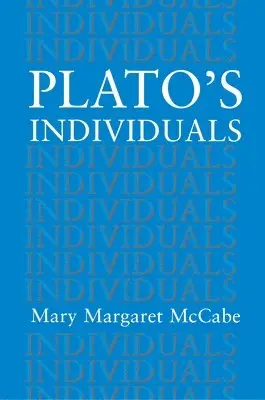
    Plato's Individuals

    AvMary Margaret McCabe

    Häftad, Engelska, 1999

    650 kr

    Beställningsvara. Skickas inom 5-8 vardagar. Fri frakt över 249 kr.

    Fler format och utgåvor

    E-bok

    898 kr

    Beskrivning

    Contradicting the long-held belief that Aristotle was the first to discuss individuation systematically, Mary Margaret McCabe argues that Plato was concerned with what makes something a something and that he solved the problem in a radically different way than did Aristotle. McCabe explores the centrality of individuation to Plato's thinking, from the Parmenides to the Politicus, illuminating Plato's later metaphysics in an exciting new way. Tradition associates Plato with the contrast between the particulars of the sensible world and transcendent forms, and supposes that therein lies the center of Plato's metaphysical universe. McCabe rebuts this view, arguing that Plato's thinking about individuals--which informs all his thought--comes to focus on the tension between "generous" or complex individuals and "austere" or simple individuals. In dialogues such as the Theaetetus and the Timaeus Plato repeatedly poses the question of individuation but cannot provide an answer. Later, in the Sophist, the Philebus, and the Politicus, Plato devises what McCabe calls the "mesh of identity," an account of how individuals may be identified relative to each other.The mesh of identity, however, fails to explain satisfactorily how individuals are unified or made coherent. McCabe asserts that individuation may be absolute--and she questions philosophy's longtime reliance on Aristotle's solution.

    Produktinformation

    • Utgivningsdatum:1999-10-31
    • Mått:197 x 254 x 21 mm
    • Vikt:503 g
    • Format:Häftad
    • Språk:Engelska
    • Antal sidor:360
    • Förlag:Princeton University Press
    • ISBN:9780691029399

    Utforska kategorier

    • Filosofiska discipliner inom Filosofi och religion

    Mer om författaren

    Mary Margaret McCabe is Professor of Ancient Philosophy at King's College, London. She is the author of Plato on Punishment (California) and co-editor (with Christopher Gill) of Form and Argument in Late Plato (Oxford).

    Recensioner i media

    "This bold new interpretation of Plato's ontology should be studied carefully by all students and scholars of Plato."--Choice "An interesting and well-argued thesis."--From Greece to Rome "This is a challenging book with a bold thesis."--Lloyd P. Gerson, Review of Metaphysics "McCabe's exposition and defense of Plato's henology is reason enough to praise the book and recommend it to scholars of ancient philosophy and philosophers of language."--George Rudebush, Philosophy in Review

    Innehållsförteckning

    • ACKNOWLEDGMENTS xi LIST OF ABBREVIATIONS xiii ONE The Problem of Individuation 3 1. The Argument of This Book 3 2. Nothing from Nothing: Vehicles of Change 5 3. The Grammatical Prejudice 9 4. Counting the World, Sorting the World 11 5. Units and Unities 12 6. The Problems of Individuation 16 7. Reading Plato 18 PART ONE: PRELIMINARY: PLATO'S MIDDLE PERIOD METAPHYSICS TWO Particulars 25 1. Socratic Definitions 26 2. Natural Inherence 29 3. The Compresence of Opposites 37 4. Complex Individuals 47 THREE Forms 53 1. Knowledge and the Separation of Forms 53 2. Simple Forms and Explanation 60 3. Understanding and Teleology 67 4. The Theory of Forms 75 5. Forms as Separate Substances 81 6. Counting Forms 83 7. Forms as the Objects of Knowledge 90 PART TWO: THE PROBLEM EMERGES FOUR The One and the Others 97 1. Ones and Manies 97 2. Dialectic and Gymnastic 99 3. Ones and Parts 107 4. Sameness and Difference 114 5. The One in Time 121 6. The Unity of the First Stage 124 7. The Other Stages 127 8. The Verb "to Be" 130 FIVE Bundles and Lumps 133 1. Knowledge and Perception 133 2. Protagorean Things 137 3. Platonic Bundles 141 4. Flux Attacked 145 5. Perception Attacked 149 6. The Objects of Thought 152 7. Socrates' Dream 158 SIX Slices and Stuffs 162 1. Reading the Timaeus 162 2. The Universe Is One and Whole 163 3. Slices 167 4. The Work of Necessity 175 5. Something Basic 176 6. Rereading the Timaeus 184 SEVEN Being and Talking 192 1. Not-Being 193 2. Being 199 3. "To Be" or "Not"? 205 4. Identity and Unity 208 5. Talking about Something or Other 212 6. The Unanswered Questions 216 PART THREE: TWO ANSWERS EIGHT Resolving Relations 221 1. Communing Kinds 221 2. The Mesh of Identity 224 3. Somethings Are Such 234 4. Opposites and Difference 238 5. What Kinds? 240 6. Limit and Unlimited 243 7. A Divine Cosmology 249 8. Numbers or What? 253 9. Collection and Division and the Mesh of Identity 257 NINE The Unity of Persons 263 1. Immortal Souls 264 2. Complex Souls 267 3. Sophistic Somebodies 270 4. Persistence: Memory and Continuity 274 5. Consistency and the Arguing Subject 276 6. Syllogizing Souls and the Unity of Consciousness 280 7. Common Properties 287 8. Active Minds 290 9. The Understanding Mind 297 TEN Conclusion 301 1. Plato's Changing Metaphysics 301 2. Plato's Account of Individuation 302 3. Plato and Aristotle 307 APPENDIX A On the Order of the Dialogues 309 APPENDIX B Arguments from First Principles 311 SELECT BIBLIOGRAPHY 315 INDEX LOCORUM 325 INDEX OF PERSONS 334 GENERAL INDEX 336