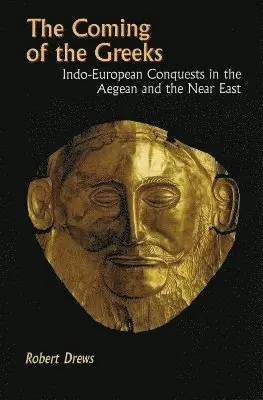
Coming of the Greeks
Indo-European Conquests in the Aegean and the Near East
415 kr
Beställningsvara. Skickas inom 5-8 vardagar. Fri frakt över 249 kr.
Du är på sajten för privatpersoner.
415 kr
Beställningsvara. Skickas inom 5-8 vardagar. Fri frakt över 249 kr.
Robert Drews is Professor of Classics and History at Vanderbilt University. He is the author of The End of the Bronze Age: Changes in Warfare and the Catastrophe ca. 1200 b.c. (Princeton), The Greek Accounts of Eastern History, and Basileus: The Evidence for Kingship in Geometric Greece.
"Into the ever-tangled and speculative debate on Indo-European origins comes this excellent book: lucid, critical, and refreshingly sober."--D. F. Easton, The Classical Review "The fact that [a] pattern of localized Near Eastern takeovers coincides with the inception of chariot warfare, coupled with his carefully documented hypothesis that Proto-Indo-European-speaking (PIE) peoples in Armenia were responsible for the development and spread of chariot warfare, serves as the backdrop to Drews's innovative scenario for the arrival of the Greeks... Such complete Near Eastern analogies involving archaeology, mythology, and linguistics, for example, have been rarely applied to support theories of PIE dispersal... His research serves the critical function of provoking new views of a long-standing problem."--Susan N. Skomal, American Journal of Archaeology
Du är på sajten för privatpersoner.
415 kr
Beställningsvara. Skickas inom 5-8 vardagar. Fri frakt över 249 kr.
Robert Drews is Professor of Classics and History at Vanderbilt University. He is the author of The End of the Bronze Age: Changes in Warfare and the Catastrophe ca. 1200 b.c. (Princeton), The Greek Accounts of Eastern History, and Basileus: The Evidence for Kingship in Geometric Greece.
"Into the ever-tangled and speculative debate on Indo-European origins comes this excellent book: lucid, critical, and refreshingly sober."--D. F. Easton, The Classical Review "The fact that [a] pattern of localized Near Eastern takeovers coincides with the inception of chariot warfare, coupled with his carefully documented hypothesis that Proto-Indo-European-speaking (PIE) peoples in Armenia were responsible for the development and spread of chariot warfare, serves as the backdrop to Drews's innovative scenario for the arrival of the Greeks... Such complete Near Eastern analogies involving archaeology, mythology, and linguistics, for example, have been rarely applied to support theories of PIE dispersal... His research serves the critical function of provoking new views of a long-standing problem."--Susan N. Skomal, American Journal of Archaeology