• Fri frakt över 249 kr
  • •
  • Snabba leveranser
  • •
  • Billiga böcker
Kundservice

Du är på sajten för privatpersoner.

Företag, bibliotek eller offentlig verksamhet?

Du handlar på classic.bokus.com, där alla dina funktioner finns intakta.
Till classic.bokus.com
Bokus logotyp. Gå till startsidan.
  • Erbjudanden
  • Nyheter
  • Student
  • Topplistor
  • Barn & ungdom
  • Bokus Play
  • E-böcker
  • Pocketböcker
  • Spel & pussel

10% rabatt på allt med kod NYSTART10 →

Sidfot

Mina sidor

    Hjälp

    • Kundservice
    • Vanliga frågor och svar
    • Frakt och leverans
    • Retur vid ångerrätt
    • Reklamera vara
    • Betalning
    • Köpvillkor
    • Allmänna villkor
    • Information om webbplatsens tillgänglighet

    Om Bokus

    • Om oss
    • Pressrum
    • För studenter
    • För företag
    • För bibliotek och offentlig verksamhet
    • För leverantörer
    • Hållbarhet

    Populärt

    • Aktuella erbjudanden
    • Presentkort
    • Studentlitteratur
    • Nya böcker
    • Topplistor
    • Signerade böcker
    • Engelska böcker

    Inspiration

    • Boktips
    • BookTok
    • Populära bokserier
    • Barnbokskaraktärer
    • Populära författare
    Logotyp för Bokus
    Följ oss på Facebook (extern länk)Följ oss på Instagram (extern länk)Följ oss på YouTube (extern länk)Följ oss på TikTok (extern länk)
    bokus @ CookiesAnpassa cookiesIntegritetspolicyKöpvillkor
    Till Citymail hemsida (extern länk)Till Budbee hemsida (extern länk)Till Postnord hemsida (extern länk)Till Schenker hemsida (extern länk)Till Early Bird hemsida (extern länk)Till Walleys hemsida (extern länk)
    1. Samhälle och politik
    2. Samhälle och kultur
    3. Kultur och medier
    4. Referensverk och tvärvetenskap

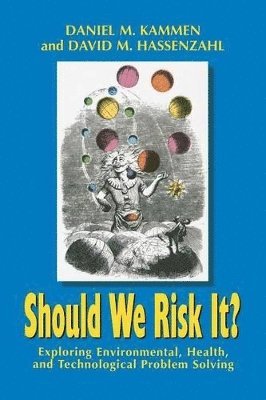
    Should We Risk It?

    Exploring Environmental, Health, and Technological Problem Solving

    AvDaniel M. Kammen,David M. Hassenzahl

    Häftad, Engelska, 2001

    593 kr

    Beställningsvara. Skickas inom 5-8 vardagar. Fri frakt över 249 kr.

    Beskrivning

    How dangerous is smoking? What are the risks of nuclear power or of climate change? What are the chances of dying on an airplane? More importantly, how do we use this information once we have it? The demand for risk analysts who are able to answer such questions has grown exponentially in recent years. Yet programs to train these analysts have not kept pace. In this book, Daniel Kammen and David Hassenzahl address that problem. They draw together, organize, and seek to unify previously disparate theories and methodologies connected with risk analysis for health, environmental, and technological problems. They also provide a rich variety of case studies and worked problems, meeting the growing need for an up-to-date book suitable for teaching and individual learning. The specific problems addressed in the book include order-of-magnitude estimation, dose-response calculations, exposure assessment, extrapolations and forecasts based on experimental or natural data, modeling and the problems of complexity in models, fault-tree analysis, managing and estimating uncertainty, and social theories of risk and risk communication.The authors cover basic and intermediate statistics, as well as Monte Carlo methods, Bayesian analysis, and various techniques of uncertainty and forecast evaluation. The volume's unique approach will appeal to a wide range of people in environmental science and studies, health care, and engineering, as well as to policy makers confronted by the increasing number of decisions requiring risk and cost/benefit analysis. Should We Risk It? will become a standard text in courses involving risk and decision analysis and in courses of applied statistics with a focus on environmental and technological issues.

    Produktinformation

    • Utgivningsdatum:2001-04-15
    • Mått:152 x 235 x 30 mm
    • Vikt:594 g
    • Format:Häftad
    • Språk:Engelska
    • Antal sidor:424
    • Förlag:Princeton University Press
    • ISBN:9780691074573

    Utforska kategorier

    • Referensverk och tvärvetenskap inom Samhälle och politik
    • Miljövetenskap och miljöpolitik inom Naturvetenskap och teknik
    • Sociala och etiska frågor inom Samhälle och politik

    Mer om författaren

    Daniel M. Kammen is Associate Professor of Energy and Society and director of the Renewable and Appropriate Energy Laboratory at the University of California, Berkeley. He has received international awards for his work on renewable energy and development and for his work on risk analysis and forecasting. David M. Hassenzahl is Assistant Professor of Environmental Studies at the University of Nevada, Las Vegas. He has been an environmental risk professional in both the public and private sectors.School of Public and International Affairs, Princeton University, where his research is focused on the role of risk analysis in policy making. He has been an environmental risk professional in both the public and private sectors.

    Recensioner i media

    "Daniel M. Kammen and David M. Hassenzahl have written a book that is essentially a well-annotated, comprehensive problem set for coursework or other training in risk assessment... [The authors] note that 'many people who ... must informally make decisions about risk ... learn the tools of the trade on the fly.' Should We Risk lt? goes a long way to provide training in problem solving for risk assessment."--Rebecca A. Efroymson, Endeavour "This book is highly recommended for those who practice risk analysis, and perhaps even more so, for those who earn their living making decisions based on risk analysis. It is especially recommended for anyone who wants to be provoked into thinking about the real world of the environment, health, and technology."--Jay Turim, Risk Analysis "Should We Risk It?, an exciting new text, explores the nature and the methods of risk analysis through a set of carefully selected, critically analyzed and clearly explained problems... [A] fascinating tour of the field."--John S. Evans, Science "This is a truly innovative and timely book that addresses the concepts of risk and its management from a problem-solving perspective... It leads the reader step-by-step through many of the dimensions of risk management."--Simon Gerrard, Environment

    Innehållsförteckning

    • PrefaceAcknowledgments1Introduction32Basic Models and Risk Problems313Review of Statistics for Risk Analysis834Uncertainty, Monte Carlo Methods, and Bayesian Analysis1225Toxicology1536Epidemiology1997Exposure Assessment2318Technological Risk2669Decision Making30410Risk Perception and Communication353App. AZ-Scores393App. BStudent's T-test395App. CChi-Squared Distribution398Index401