• Fri frakt över 249 kr
  • •
  • Snabba leveranser
  • •
  • Billiga böcker
Kundservice

Du är på sajten för privatpersoner.

Företag, bibliotek eller offentlig verksamhet?

Du handlar på classic.bokus.com, där alla dina funktioner finns intakta.
Till classic.bokus.com
Bokus logotyp. Gå till startsidan.
  • Erbjudanden
  • Nyheter
  • Student
  • Topplistor
  • Barn & ungdom
  • Bokus Play
  • E-böcker
  • Pocketböcker
  • Spel & pussel

10% rabatt på allt med kod: NYSTART10 →

Sidfot

Mina sidor

    Hjälp

    • Kundservice
    • Vanliga frågor och svar
    • Frakt och leverans
    • Retur vid ångerrätt
    • Reklamera vara
    • Betalning
    • Köpvillkor
    • Allmänna villkor
    • Information om webbplatsens tillgänglighet

    Om Bokus

    • Om oss
    • Pressrum
    • För studenter
    • För företag
    • För bibliotek och offentlig verksamhet
    • För leverantörer
    • Hållbarhet

    Populärt

    • Aktuella erbjudanden
    • Presentkort
    • Studentlitteratur
    • Nya böcker
    • Topplistor
    • Signerade böcker
    • Engelska böcker

    Inspiration

    • Boktips
    • BookTok
    • Populära bokserier
    • Barnbokskaraktärer
    • Populära författare
    Logotyp för Bokus
    Följ oss på Facebook (extern länk)Följ oss på Instagram (extern länk)Följ oss på YouTube (extern länk)Följ oss på TikTok (extern länk)
    bokus @ CookiesAnpassa cookiesIntegritetspolicyKöpvillkor
    Till Citymail hemsida (extern länk)Till Budbee hemsida (extern länk)Till Postnord hemsida (extern länk)Till Schenker hemsida (extern länk)Till Early Bird hemsida (extern länk)Till Walleys hemsida (extern länk)
    1. Ekonomi och Ledarskap
    2. Företagsekonomi
    3. Organisationsteori

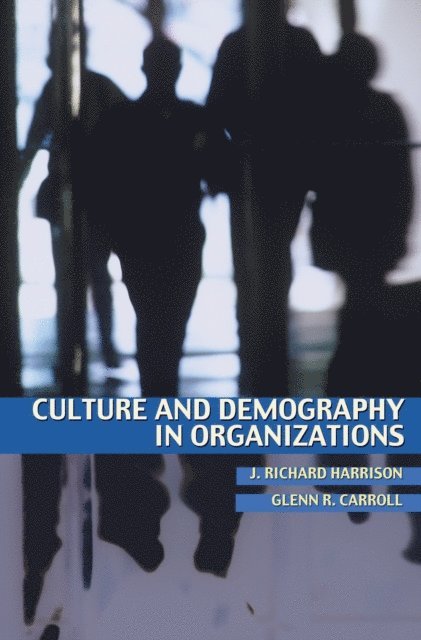
    Culture and Demography in Organizations

    AvJ. Richard Harrison,Glenn R. Carroll

    Häftad, Engelska, 2006

    612 kr

    Beställningsvara. Skickas inom 5-8 vardagar. Fri frakt över 249 kr.

    Beskrivning

    How do corporations and other organizations maintain and transmit their cultures over time? Culture and Demography in Organizations offers the most reliable and comprehensive answer to this complex question to date. The first book on the subject to ground its analysis in mathematical tools and computer simulation, it goes beyond standard approaches, which focus on socialization within organizations, by explicitly considering the effects of demographic processes of entry, exit, and organizational growth. J. Richard Harrison and Glenn R. Carroll base their analysis on a formal model with three components: hiring, socialization, and employee turnover. In exploring the model's implications through computer simulation methods, the authors cover topics such as organizational growth and decline, top management teams, organizational influence networks, terrorist organizations, cultural integration following mergers, and organizational failure. For each topic, they identify the conditions influencing cultural transmission.In general, they find that demographic processes play a central role in influencing organizational culture and that studying these processes leads to some surprising insights unavailable when considering socialization alone. This book, which also serves as an ideal introduction to the increasingly popular use of computer simulation, will be an indispensable resource for scholars and students of organization theory and behavior, cultural studies, strategic management, sociology, economics, and social simulation.

    Produktinformation

    • Utgivningsdatum:2006-01-08
    • Mått:156 x 235 x 17 mm
    • Vikt:413 g
    • Format:Häftad
    • Språk:Engelska
    • Antal sidor:290
    • Förlag:Princeton University Press
    • ISBN:9780691124827

    Utforska kategorier

    • Organisationsteori inom Ekonomi och Ledarskap

    Mer om författaren

    J. Richard Harrison Associate Professor of Organizations, Strategy, and International Management at the University of Texas, Dallas. Glenn R. Carroll is Laurence W. Lane Professor of Organizations at the Graduate School of Business, and (by courtesy) Professor of Sociology at Stanford University. He is also Professor in the Management Division of the Graduate School of Business, and (by courtesy) Professor of Sociology at Columbia University. He is coauthor of "The Demography of Corporations and Industries" (Princeton).

    Recensioner i media

    "Harrison and Carroll have written an invaluable book on organizational culture. They inform us about organizational culture and demography through a synthesis that gives us new insights on what culture is and how it can be managed... In short, Harrison and Carroll have contributed greatly to our understanding of culture and demography and to the methodology of our science."--Richard M. Burton, Administrative Science Quarterly

    Innehållsförteckning

    • List of Figures xi List of Tables xiii Preface xv Acknowledgments xix Part I: Cultural Analysis 1 CHAPTER 1: Culture in Organizations 3 1.1 Introduction 3 1.2 Culture in Social Science 4 1.3 Culture in Organization Theory 5 1.4 The Content Approach to Culture 7 1.5 The Distributive Approach to Culture 16 1.6 A Limited Synthetic Approach to Organizational Culture 21 1.7 Reader's Guide 25 CHAPTER 2: Modeling Culture with Simulation 27 2.1 Introduction 27 2.2 Forms of Scientific Inquiry 28 2.3 What Is a Computer Simulation? 30 2.4 Why Use Simulation? 35 2.5 Simulation Modeling 38 2.6 Challenges of Simulation 41 Part II Model of Cultural Transmission 47 CHAPTER 3: Representing Culture 49 3.1 Introduction 49 3.2 Enculturation 50 3.3 Content Dimensions of Culture 56 3.4 Enculturation and Cultural Dimensions 58 3.5 Summary 68 CHAPTER 4: Cultural Transmission 69 4.1 Introduction 69 4.2 Modeling Framework 70 4.3 Model Specification 71 4.4 Summary 82 CHAPTER 5: Organizational Types 84 5.1 Introduction 84 5.2 Stylized Organizational Types 85 5.3 Simulation Methods 90 5.4 Findings by Type 92 5.5 Conclusion 101 CHAPTER 6: Growth and Decline 102 6.1 Introduction 102 6.2 Cultural Management and Growth 104 6.3 Organizational Decline 110 6.4 Decomposing Transmission 111 6.5 Managerial Implications 118 6.6 Conclusion 119 Part III: Applications and Extensions of the Model 121 CHAPTER 7: Heterogeneity in Tenure 123 7.1 Introduction 123 7.2 LOS Distributions in Organizations 124 7.3 The Implicit Link 126 7.4 Modeling Top Management Teams 130 7.5 Design of Experiments 132 7.6 Findings 134 7.7 Decomposing LOS Heterogeneity 137 7.8 Summary 143 CHAPTER 8: Cultural Influence Networks 147 8.1 Introduction 147 8.2 Networks of Influence 149 8.3 Modeling Framework 149 8.4 Dynamic Influence 151 8.5 Demography and Network Structure 155 8.6 Design of Experiments 159 8.7 Findings 159 8.8 Discussion 166 CHAPTER 9: Terrorist Networks 169 9.1 Introduction 169 9.2 Background on Terrorist Organizations 170 9.3 Underground Network-Based Organizations 171 9.4 Adapting the Network Model 175 9.5 Effects of Counterterrorism Strategies 176 9.6 Simulation Design 178 9.7 Findings 179 9.8 Conclusion 182 CHAPTER 10: Merging Cultures 185 10.1 Introduction 185 10.2 Post-Merger Cultural Integration 187 10.3 Modeling Framework 191 10.4 Experimental Design 192 10.5 System Dynamics 196 10.6 Findings 198 10.7 Discussion 206 CHAPTER 11: Culture, Aging, and Failure 208 11.1 Introduction 208 11.2 Macro Model Framework 209 11.3 Demography of the System 214 11.4 The Cultural System 215 11.5 Design of Experiments 216 11.6 Findings 218 11.7 Implications 220 CHAPTER 12: Concluding Remarks 221 12.1 Introduction 221 12.2 Model Overview 221 12.3 Review of Findings 223 12.4 Implications 229 12.5 Extensions of the Model 233 12.6 Conclusion 234 Appendix A Notation 237 Appendix B Simulation Parameter Settings 241 References 251 Index 265