Glenn R. Carroll - Böcker
Visar alla böcker från författaren Glenn R. Carroll. Handla med fri frakt och snabb leverans.
8 produkter
8 produkter
1 548 kr
Skickas inom 5-8 vardagar
This book seeks to deepen and broaden the understanding of change in organization populations by examining the dynamics of numbers of organizations in populations. The authors have studied various kinds of organizations, including national labour unions, newspapers and newspaper publishers, brewing firms, life insurance companies, and banks.
2 149 kr
Skickas inom 5-8 vardagar
This book presents a stock-taking of the work that has been done since the appearance of Oliver Williamson's seminal book Markets and Hierarchies (Free Press 1975), that gave new life to the concept of transaction cost analysis (introduced by Ronald Coase in the 1930s). It derives from an issue of the OUP journal, Industrial and Corporate Change (1996), that published articles derived from a conference in 1995, the twentieth anniversary of the publication of the Williamson book.
250 kr
Skickas inom 7-10 vardagar
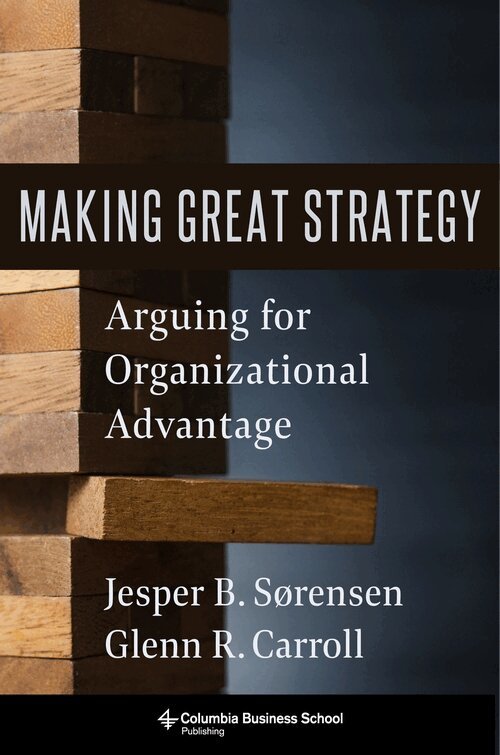
Making strategy requires undertaking major—often irreversible—decisions aimed at long-term success in an uncertain future. All leaders must formulate a clear course of action, yet many lack confidence in their ability to think systematically about their strategy. They struggle to apply the abstract lessons offered by conventional approaches to strategic analysis to their unique contexts.Making Great Strategy resolves these challenges with a straightforward, readily applicable framework. Jesper B. Sørensen and Glenn R. Carroll show that one factor underlies all sustainably successful strategies: a logically coherent argument that connects resources, capabilities, and environmental conditions to desired outcomes. They introduce a system for formulating and managing strategy through a set of three core activities: visualization, formalization and logic, and constructive argumentation. These activities can be implemented in any organization and are illustrated through examples and case studies from well-known companies such as Apple, Walmart, and The Economist.This book shows that while great strategic thinking is hard, it is not a mystery. Widely applicable and relevant for managers and leaders at all levels, especially executive teams charged with setting the course of their organizations, it is essential reading for anyone faced with practical problems of strategic management.
209 kr
Skickas inom 7-10 vardagar
Leaders remain skeptical about the power of organizational culture even though extensive research shows that it is crucial to business success. Can a manager really influence an organization’s culture, or do executives just try to impose a culture on their employees? Is the concept of culture too vague to measure objectively and improve? What happens to valuable employees who feel left out by the prevailing culture? Even if a “good” culture makes team members happy, does it actually affect the bottom line?This essential book answers the biggest questions about organizational culture, offering research-backed insights for leaders on shaping and managing an environment that spurs achievement. The management experts Jennifer A. Chatman and Glenn R. Carroll—a psychologist and a sociologist—draw on social-scientific findings to evaluate and debunk common misconceptions. They show how research on culture empowers managers to identify what really matters and deploy it productively. Chatman and Carroll also provide actionable levers to build and maintain organizational culture, from crafting a culture that supports strategic objectives to ensuring that it can adapt as conditions change.Making Organizational Culture Great features compelling examples from companies and nonprofits including Apple, Genentech, Disney, Ford, Netflix, Maersk, Google, Cisco, Southwest Airlines, and many others. A practical guide for current and aspiring leaders, this book reveals how to manage culture consistently, comprehensively, and coherently.
817 kr
Skickas inom 7-10 vardagar
Leaders remain skeptical about the power of organizational culture even though extensive research shows that it is crucial to business success. Can a manager really influence an organization’s culture, or do executives just try to impose a culture on their employees? Is the concept of culture too vague to measure objectively and improve? What happens to valuable employees who feel left out by the prevailing culture? Even if a “good” culture makes team members happy, does it actually affect the bottom line?This essential book answers the biggest questions about organizational culture, offering research-backed insights for leaders on shaping and managing an environment that spurs achievement. The management experts Jennifer A. Chatman and Glenn R. Carroll—a psychologist and a sociologist—draw on social-scientific findings to evaluate and debunk common misconceptions. They show how research on culture empowers managers to identify what really matters and deploy it productively. Chatman and Carroll also provide actionable levers to build and maintain organizational culture, from crafting a culture that supports strategic objectives to ensuring that it can adapt as conditions change.Making Organizational Culture Great features compelling examples from companies and nonprofits including Apple, Genentech, Disney, Ford, Netflix, Maersk, Google, Cisco, Southwest Airlines, and many others. A practical guide for current and aspiring leaders, this book reveals how to manage culture consistently, comprehensively, and coherently.
664 kr
Skickas inom 7-10 vardagar
Most analysts of corporations and industries adopt the focal perspective of a single prototypical organization. Many analysts also study corporations primarily in terms of their internal organizational structures or as complex systems of financial contracts. Glenn Carroll and Michael Hannan bring fresh insight to our understanding of corporations and the industries they comprise by looking beyond prototypical structures to focus on the range and diversity of organizations in their social and economic setting. The result is a rich rendering of analysis that portrays whole populations and communities of corporations. The Demography of Corporations and Industries is the first book to present the demographic approach to organizational studies in its entirety. It examines the theory, models, methods, and data used in corporate demographic research. Carroll and Hannan explore the processes by which corporate populations change over time, including organizational founding, growth, decline, structural transformation, and mortality.They review and synthesize the major theoretical mechanisms of corporate demography, ranging from aging and size dependence to population segregation and density dependence. The book also explores some selected implications of corporate demography for public policy, including employment and regulation. In this path-breaking book, Carroll and Hannan demonstrate why demographic research on corporations is important; describe how to conduct demographic research; specify fruitful areas of future research; and suggest how the demographic perspective can enrich the public discussion of issues surrounding the corporation in our constantly evolving industrial society. All researchers and analysts with an interest in this topic will find The Demography of Corporations and Industries an invaluable resource.
558 kr
Skickas inom 7-10 vardagar
How do corporations and other organizations maintain and transmit their cultures over time? Culture and Demography in Organizations offers the most reliable and comprehensive answer to this complex question to date. The first book on the subject to ground its analysis in mathematical tools and computer simulation, it goes beyond standard approaches, which focus on socialization within organizations, by explicitly considering the effects of demographic processes of entry, exit, and organizational growth. J. Richard Harrison and Glenn R. Carroll base their analysis on a formal model with three components: hiring, socialization, and employee turnover. In exploring the model's implications through computer simulation methods, the authors cover topics such as organizational growth and decline, top management teams, organizational influence networks, terrorist organizations, cultural integration following mergers, and organizational failure. For each topic, they identify the conditions influencing cultural transmission.In general, they find that demographic processes play a central role in influencing organizational culture and that studying these processes leads to some surprising insights unavailable when considering socialization alone. This book, which also serves as an ideal introduction to the increasingly popular use of computer simulation, will be an indispensable resource for scholars and students of organization theory and behavior, cultural studies, strategic management, sociology, economics, and social simulation.
518 kr
Skickas inom 7-10 vardagar
Building theories of organizations is challenging: theories are partial and "folk" categories are fuzzy. The commonly used tools--first-order logic and its foundational set theory--are ill-suited for handling these complications. Here, three leading authorities rethink organization theory. Logics of Organization Theory sets forth and applies a new language for theory building based on a nonmonotonic logic and fuzzy set theory. In doing so, not only does it mark a major advance in organizational theory, but it also draws lessons for theory building elsewhere in the social sciences. Organizational research typically analyzes organizations in categories such as "bank," "hospital," or "university." These categories have been treated as crisp analytical constructs designed by researchers. But sociologists increasingly view categories as constructed by audiences. This book builds on cognitive psychology and anthropology to develop an audience-based theory of organizational categories. It applies this framework and the new language of theory building to organizational ecology.It reconstructs and integrates four central theory fragments, and in so doing reveals unexpected connections and new insights.