• Fri frakt över 249 kr
  • •
  • Snabba leveranser
  • •
  • Billiga böcker
Kundservice

Du är på sajten för privatpersoner.

Företag, bibliotek eller offentlig verksamhet?

Du handlar på classic.bokus.com, där alla dina funktioner finns intakta.
Till classic.bokus.com
Bokus logotyp. Gå till startsidan.
  • Erbjudanden
  • Nyheter
  • Student
  • Topplistor
  • Barn & ungdom
  • Bokus Play
  • E-böcker
  • Pocketböcker
  • Spel & pussel

10% rabatt på allt med kod NYSTART10 →

Sidfot

Mina sidor

    Hjälp

    • Kundservice
    • Vanliga frågor och svar
    • Frakt och leverans
    • Retur vid ångerrätt
    • Reklamera vara
    • Betalning
    • Köpvillkor
    • Allmänna villkor
    • Information om webbplatsens tillgänglighet

    Om Bokus

    • Om oss
    • Pressrum
    • För studenter
    • För företag
    • För bibliotek och offentlig verksamhet
    • För leverantörer
    • Hållbarhet

    Populärt

    • Aktuella erbjudanden
    • Presentkort
    • Studentlitteratur
    • Nya böcker
    • Topplistor
    • Signerade böcker
    • Engelska böcker

    Inspiration

    • Boktips
    • BookTok
    • Populära bokserier
    • Barnbokskaraktärer
    • Populära författare
    Logotyp för Bokus
    Följ oss på Facebook (extern länk)Följ oss på Instagram (extern länk)Följ oss på YouTube (extern länk)Följ oss på TikTok (extern länk)
    bokus @ CookiesAnpassa cookiesIntegritetspolicyKöpvillkor
    Till Citymail hemsida (extern länk)Till Budbee hemsida (extern länk)Till Postnord hemsida (extern länk)Till Schenker hemsida (extern länk)Till Early Bird hemsida (extern länk)Till Walleys hemsida (extern länk)
    1. Samhälle och politik
    2. Samhälle och kultur
    3. Sociala grupper och identitet

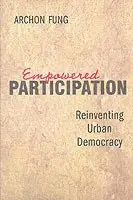
    Empowered Participation

    Reinventing Urban Democracy

    AvArchon Fung

    Häftad, Engelska, 2006

    414 kr

    Beställningsvara. Skickas inom 5-8 vardagar. Fri frakt över 249 kr.

    Fler format och utgåvor

    E-bok

    580 kr

    Beskrivning

    Every month in every neighborhood in Chicago, residents, teachers, school principals, and police officers gather to deliberate about how to improve their schools and make their streets safer. Residents of poor neighborhoods participate as much or more as those from wealthy ones. All voices are heard. Since the meetings began more than a dozen years ago, they have led not only to safer streets but also to surprising improvements in the city's schools. Chicago's police department and school system have become democratic urban institutions unlike any others in America. Empowered Participation is the compelling chronicle of this unprecedented transformation. It is the first comprehensive empirical analysis of the ways in which participatory democracy can be used to effect social change. Using city-wide data and six neighborhood case studies, the book explores how determined Chicago residents, police officers, teachers, and community groups worked to banish crime and transform a failing city school system into a model for educational reform.The author's conclusion: Properly designed and implemented institutions of participatory democratic governance can spark citizen involvement that in turn generates innovative problem-solving and public action. Their participation makes organizations more fair and effective. Though the book focuses on Chicago's municipal agencies, its lessons are applicable to many American cities. Its findings will prove useful not only in the fields of education and law enforcement, but also to sectors as diverse as environmental regulation, social service provision, and workforce development.

    Produktinformation

    • Utgivningsdatum:2006-03-13
    • Mått:152 x 235 x 18 mm
    • Vikt:431 g
    • Format:Häftad
    • Språk:Engelska
    • Antal sidor:304
    • Förlag:Princeton University Press
    • ISBN:9780691126081

    Utforska kategorier

    • Sociala grupper och identitet inom Samhälle och politik
    • Offentlig förvaltning inom Samhälle och politik
    • Regionalt styre och förvaltning inom Samhälle och politik

    Mer om författaren

    Archon Fung is Associate Professor of Public Policy at the John F. Kennedy School of Government at Harvard University. He is the author, with Erik Olin Wright, of "Deepening Democracy: Institutional Innovations in Empowered Participatory Governance".

    Recensioner i media

    "A wonderful book: theoretically compelling, analytically insightful, empirically careful. It is a highly-skilled merger of arguments in democratic theory and applications in real world situations. It is well-written, clean, (almost) jargon-free and compelling."--Mark Carl Rom, Democracy & Society "A judicious, thorough, and multifaceted study of important questions in democratic theory. It is well worth reading."--William Nelson, Ethics "[This] book masterfully dissects terms and rebuts claims of the unfeasibility or inadequacy of public participation in policy."--Richard A. Couto, Perspectives on Politics "Empowered Participation provides some much-needed empirical endeavor to a field that is mostly theoretical... [It is] an important work which anyone interested in community organization, civic engagement, community policing, and democratic theory should read."--Patrick J. Carr, American Journal of Sociology "Archon Fung makes an indispensable contribution to deliberative democratic theory."--Michael Rabinder James, Political Theory

    Innehållsförteckning

    • List of Figures and Tables vii Preface ix Abbreviations xi 1. Democracy as a Reform Strategy 1 1.1. Empowered Participation as an Administrative Reform Strategy 2 1.2. Accountable Autonomy: An Institutional Design for Empowered Participation 5 1.3. Paths More Traveled: Markets and Public Hierarchies 8 1.4. Origins: Civic Engagement, Pragmatism, and Deliberative Democracy 14 1.5. Mechanisms of Effectiveness 18 1.6. Sources of Fairness 23 1.7. Exploring Accountable Autonomy, in Theory and Practice 26 2. Down to the Neighborhoods 31 2.1. Perils of Patronage: School Governance in the Machine Era 31 2.2. Progressive Reform and Bureaucratic Administration, 1947-980 37 2.3. Legitimation Crisis to Accountable Autonomy, 1980-1988 39 2.4. Progressive Reformers and Machine Policing 44 2.5. Building the Modern Police Bureaucracy in Chicago 47 2.6. Legitimation Crisis in Policing 51 2.7. Toward Community-Centered Policing 53 2.8. Administration as Pragmatic and Participatory Neighborhood Deliberation 56 2.9. Deliberative Problem-Solving in Chicago LCSs 61 2.10.Communities of Inquiry in Chicago Policing 63 2.11.Conclusion 68 3. Building Capacity and Accountability 69 3.1. Dilemmas of Devolution 70 3.2. Training: Schools of Democracy in the Chicago Reforms 73 3.3. Mobilization 74 3.4. Cognitive Templates for Deliberative Governance and Problem-Solving 76 3.5. Bottom-Up, Top-Down Accountability 79 3.6. Enhancing Institutional Background Conditions for Problem-Solving 83 3.7. Networking Inquiry 86 3.8. Redistribution to the Least Capable 89 3.9. Conflicts between Community and the Local State 91 4. Challenges to Participation 99 4.1. Three Stages of Empirical Investigation 99 4.2. The Strong Rational-Choice Perspective 101 4.3. Strong Egalitarianism 108 4.4. Social Capital 119 4.5. Unity and the Politics of Difference 122 4.6. Expertise 128 5. Deliberation and Poverty 132 5.1. Deliberation in Contexts of Poverty and Social Conflict 132 5.2. Initial Conditions: Six Cases in Three Neighborhoods 135 5.3. Southtown Elementary Becomes Harambee Academy 142 5.4. Central Beat: Nonsystematic Problem-Solving 151 5.5. Traxton School: Wealth and Embedded Agreement 159 5.6. Poverty and the Character of Pragmatic Deliberation 170 6. Deliberation in Social Conflict 173 6.1. Bridges across Race and Class in Traxton Beat 173 6.2. Translation and Trust in Southtown Beat 197 6.3. The Discipline of Self-Reflection: Central Elementary under Probation 210 6.4. Beyond Decentralization: Structured Deliberation and Intervention 217 7. The Chicago Experience and Beyond 220 7.1. Lessons from the Street 221 7.2. System-wide Democratic and Administrative Accomplishments 225 7.3. Incomplete Politics and Institutional Instability 228 7.4. Bringing Practice Back into Participatory and Deliberative Democratic Theory 231 7.5. Beyond Chicago 233 7.6. The Promise of Participatory-Deliberative Democracy 241 Notes 243 Selected Bibliography 253 Index 271