• Fri frakt över 249 kr
  • •
  • Snabba leveranser
  • •
  • Billiga böcker
Kundservice

Du är på sajten för privatpersoner.

Företag, bibliotek eller offentlig verksamhet?

Du handlar på classic.bokus.com, där alla dina funktioner finns intakta.
Till classic.bokus.com
Bokus logotyp. Gå till startsidan.
  • Erbjudanden
  • Student
  • Topplistor
  • Barn & ungdom
  • Bokus Play
  • E-böcker
  • Ljudböcker
  • Pocketböcker
  • Spel & pussel

Upp till 25% på utvalda nyheter →

Sidfot

Mina sidor

    Hjälp

    • Kundservice
    • Vanliga frågor och svar
    • Frakt och leverans
    • Retur vid ångerrätt
    • Reklamera vara
    • Betalning
    • Köpvillkor
    • Allmänna villkor
    • Information om webbplatsens tillgänglighet

    Om Bokus

    • Om oss
    • Pressrum
    • För studenter
    • För företag
    • För bibliotek och offentlig verksamhet
    • För leverantörer
    • Hållbarhet

    Populärt

    • Aktuella erbjudanden
    • Presentkort
    • Studentlitteratur
    • Nya böcker
    • Topplistor
    • Signerade böcker
    • Engelska böcker

    Inspiration

    • Boktips
    • BookTok
    • Populära bokserier
    • Barnbokskaraktärer
    • Populära författare
    Logotyp för Bokus
    Följ oss på Facebook (extern länk)Följ oss på Instagram (extern länk)Följ oss på YouTube (extern länk)Följ oss på TikTok (extern länk)
    bokus @ CookiesAnpassa cookiesIntegritetspolicyKöpvillkor
    Till Citymail hemsida (extern länk)Till Budbee hemsida (extern länk)Till Postnord hemsida (extern länk)Till Schenker hemsida (extern länk)Till Early Bird hemsida (extern länk)Till Walleys hemsida (extern länk)
    1. Naturvetenskap och teknik
    2. Geovetenskap
    3. Miljövetenskap och miljöpolitik

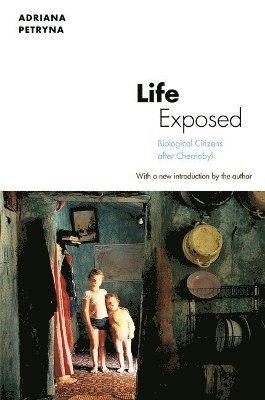
    Life Exposed

    Biological Citizens after Chernobyl

    AvAdriana Petryna

    Häftad, Engelska, 2013

    300 kr

    Beställningsvara. Skickas inom 5-8 vardagar. Fri frakt över 249 kr.

    Fler format och utgåvor

    E-bok

    415 kr

    Beskrivning

    On April 26, 1986, Unit Four of the Chernobyl nuclear reactor exploded in then Soviet Ukraine. More than 3.5 million people in Ukraine alone, not to mention many citizens of surrounding countries, are still suffering the effects. Life Exposed is the first book to comprehensively examine the vexed political, scientific, and social circumstances that followed the disaster. Tracing the story from an initial lack of disclosure to post-Soviet democratizing attempts to compensate sufferers, Adriana Petryna uses anthropological tools to take us into a world whose social realities are far more immediate and stark than those described by policymakers and scientists. She asks: What happens to politics when state officials fail to inform their fellow citizens of real threats to life? What are the moral and political consequences of remedies available in the wake of technological disasters? Through extensive research in state institutions, clinics, laboratories, and with affected families and workers of the so-called Zone, Petryna illustrates how the event and its aftermath have not only shaped the course of an independent nation but have made health a negotiated realm of entitlement.She tracks the emergence of a "biological citizenship" in which assaults on health become the coinage through which sufferers stake claims for biomedical resources, social equity, and human rights. Life Exposed provides an anthropological framework for understanding the politics of emergent democracies, the nature of citizenship claims, and everyday forms of survival as they are interwoven with the profound changes that accompanied the collapse of the Soviet Union.

    Produktinformation

    • Utgivningsdatum:2013-02-24
    • Mått:152 x 235 x 19 mm
    • Vikt:408 g
    • Format:Häftad
    • Språk:Engelska
    • Antal sidor:304
    • Förlag:Princeton University Press
    • ISBN:9780691151663
    • Utmärkelser:Joint winner of Sharon Stevens First Book Prize 2003

    Utforska kategorier

    • Miljövetenskap och miljöpolitik inom Naturvetenskap och teknik
    • Sociala och etiska frågor inom Samhälle och politik

    Mer om författaren

    Adriana Petryna is the Edmund J. and Louise W. Kahn Term Professor in Anthropology at the University of Pennsylvania. She is the author of When Experiments Travel: Clinical Trials and the Global Search for Human Subjects and the coeditor of When People Come First: Critical Studies in Global Health (both Princeton).

    Recensioner i media

    Winner of the 2006 New Millenium Award, Society of Medical Anthropology Co-Winner of the 2003 Sharon Stephens First Book Prize, American Ethnological Society "Petryna's ethnographic approach consciously shapes her account and illuminates it with detail that historians of the future will treasure."--Jeanne Guillemin, Medical Humanities Review "The book presents exceptionally rich anthropological material generated through observations and interviews... The true scope of the human tragedy caused by this man-made catastrophe comes to the fore via biological stories of Petryna's informants."--Larissa Remennick, Journal of the American Medical Association "There is nothing comparable. Very well written, it will be of major interest to readers in risk analysis and risk sociology, science studies, and political science, as well as to anyone interested in the consequences of megatechnologies."--Ulrich Beck, author of World at Risk "[Chernobyl] is a dramatic and important story, and Life Exposed is a compelling book... [A]n important study that will interest a wide anthropological audience."--Jonathan P. Parry, Journal of the Royal Anthropological Institute

    Innehållsförteckning

    • List of Figures and Tables xi Introduction to the 2013 Edition xiii Acknowledgments xxxiii Note on Transliteration xxxvii Chapter 1 Life Politics after Chernobyl 1 * Time Lapse 1 * A Technogenic Catastrophe 9 * Nation Building 20 * Experimental Systems 25 * Docta Ignorantia 27 * The Unstoppable Course of Radiation Illness 32 Chapter 2 Technical Error: Measures of Life and Risk 34 * A Foreign Burden 34 * Saturated Grid 36 * Institute of Biophysics, Moscow 39 * Soviet-American Cooperation 41 * Safe Living Politics 49 * Life Sciences 55 * Risk In Vivo 59 Chapter 3 Chernobyl in Historical Light 63 * How to Remember Then 64 * New City of Bila-Skala 66 * Vitalii 67 * Contracts of Truth 69 * Oksana 70 * Anna 72 * Requiem for Storytelling 76 Chapter 4 Illness as Work: Human Market Transition 82* City of Sufferers 82 * Capitalist Transition 92 * Nothing to Buy and Nothing to Sell 94 * Medical-Labor Committees 102 * Disability Claims 107 * Illness for Life 113 Chapter 5 Biological Citizenship 115 * Remediation Models 115 * Normalizing Catastrophe 119 * Suffering and Medical Signs 121 * Domestic Neurology 126 * Disability Groups 130 * Law, Medicine, and Corruption 138 * Material Basis of Health 143 Chapter 6 Local Science and Organic Processes 149 * Social Rebuilding 149 * Radiation Research 151 * Between the Lesional and the Psychosocial 156 * New Sociality 165 * Doctor-Patient Relations 174 * No One Is Hiding Anything Anymore 176 * In the Middle of the Experiment 181 Chapter 7 Self and Social Identity in Transition 191 * Anton and Halia 191 * Beyond the Family: Kvartyra and Public Voice 194 * Medicalized Selves 201 * Everyday Violence 206 * Lifetime 212 Chapter 8 Conclusion 215 Notes 221 Bibliography 239 Index 253