• Fri frakt över 249 kr
  • •
  • Snabba leveranser
  • •
  • Billiga böcker
Kundservice

Du är på sajten för privatpersoner.

Företag, bibliotek eller offentlig verksamhet?

Du handlar på classic.bokus.com, där alla dina funktioner finns intakta.
Till classic.bokus.com
Bokus logotyp. Gå till startsidan.
  • Erbjudanden
  • Student
  • Topplistor
  • Barn & ungdom
  • Bokus Play
  • E-böcker
  • Ljudböcker
  • Pocketböcker
  • Spel & pussel

Upp till 25% på utvalda nyheter →

Sidfot

Mina sidor

    Hjälp

    • Kundservice
    • Vanliga frågor och svar
    • Frakt och leverans
    • Retur vid ångerrätt
    • Reklamera vara
    • Betalning
    • Köpvillkor
    • Allmänna villkor
    • Information om webbplatsens tillgänglighet

    Om Bokus

    • Om oss
    • Pressrum
    • För studenter
    • För företag
    • För bibliotek och offentlig verksamhet
    • För leverantörer
    • Hållbarhet

    Populärt

    • Aktuella erbjudanden
    • Presentkort
    • Studentlitteratur
    • Nya böcker
    • Topplistor
    • Signerade böcker
    • Engelska böcker

    Inspiration

    • Boktips
    • BookTok
    • Populära bokserier
    • Barnbokskaraktärer
    • Populära författare
    Logotyp för Bokus
    Följ oss på Facebook (extern länk)Följ oss på Instagram (extern länk)Följ oss på YouTube (extern länk)Följ oss på TikTok (extern länk)
    bokus @ CookiesAnpassa cookiesIntegritetspolicyKöpvillkor
    Till Citymail hemsida (extern länk)Till Budbee hemsida (extern länk)Till Postnord hemsida (extern länk)Till Schenker hemsida (extern länk)Till Early Bird hemsida (extern länk)Till Walleys hemsida (extern länk)
    1. Samhälle och politik
    2. Sociologi och antropologi
    3. Sociologi

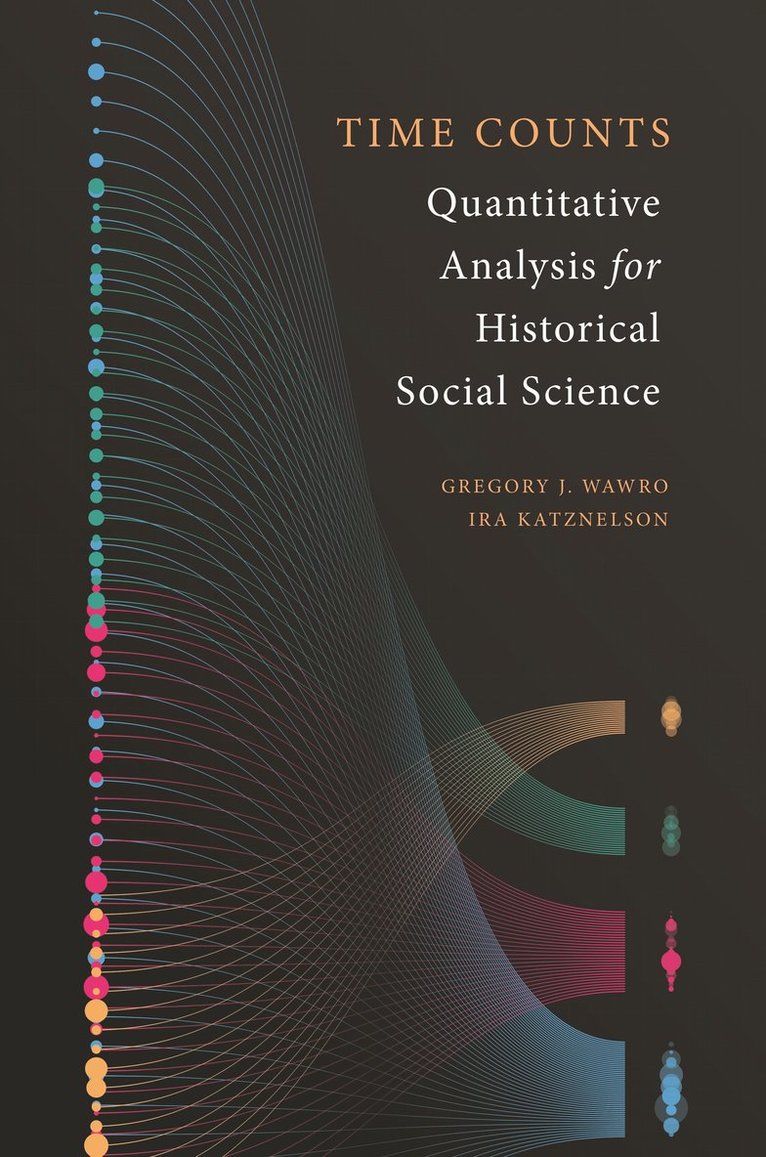
    Time Counts

    Quantitative Analysis for Historical Social Science

    AvGregory Wawro,Ira Katznelson

    Häftad, Engelska, 2022

    342 kr

    Beställningsvara. Skickas inom 5-8 vardagar. Fri frakt över 249 kr.

    Fler format och utgåvor

    Inbunden

    971 kr

    Beskrivning

    How to study the past using dataQuantitative Analysis for Historical Social Science advances historical research in the social sciences by bridging the divide between qualitative and quantitative analysis. Gregory Wawro and Ira Katznelson argue for an expansion of the standard quantitative methodological toolkit with a set of innovative approaches that better capture nuances missed by more commonly used statistical methods. Demonstrating how to employ such promising tools, Wawro and Katznelson address the criticisms made by prominent historians and historically oriented social scientists regarding the shortcomings of mainstream quantitative approaches for studying the past.Traditional statistical methods have been inadequate in addressing temporality, periodicity, specificity, and context—features central to good historical analysis. To address these shortcomings, Wawro and Katznelson argue for the application of alternative approaches that are particularly well-suited to incorporating these features in empirical investigations. The authors demonstrate the advantages of these techniques with replications of research that locate structural breaks and uncover temporal evolution. They develop new practices for testing claims about path dependence in time-series data, and they discuss the promise and perils of using historical approaches to enhance causal inference.Opening a dialogue among traditional qualitative scholars and applied quantitative social scientists focusing on history, Quantitative Analysis for Historical Social Science illustrates powerful ways to move historical social science research forward.

    Produktinformation

    • Utgivningsdatum:2022-05-03
    • Mått:155 x 235 x 17 mm
    • Vikt:363 g
    • Format:Häftad
    • Språk:Engelska
    • Antal sidor:264
    • Förlag:Princeton University Press
    • ISBN:9780691155050

    Utforska kategorier

    • Sociologi inom Samhälle och politik
    • Statsvetenskap och politisk teori inom Samhälle och politik
    • Historia inom Historia och arkeologi

    Mer om författaren

    Gregory J. Wawro is professor of political science at Columbia University. His books include Filibuster: Obstruction and Lawmaking in the U.S. Senate. Ira Katznelson is the Ruggles Professor of Political Science and History at Columbia University. His books include Fear Itself: The New Deal and the Origins of Our Time.

    Innehållsförteckning

    • List of FiguresList of TablesPreface and AcknowledgmentsList of Abbreviations1 Designing Historical Inquiry1.1 Conundrums1.2 History and Political Science: A Century of Divergence1.3 Post-War Divisions between History, Economics, Political Science, and Sociology1.4 Possibilities1.5 Ways Ahead2 Quantitative Pathways for Qualitative Purposes2.1 Orientations2.2 Analytical History: Two Modes2.3 Identifying a Middle Range3 Methods3.1 Methodological Issues3.2 Semiparametric Methods3.3 Change Point Models3.4 Important Concerns3.4.1 Adjudicating between simple and more complex models3.4.2 Imposing less structure is not atheoretical3.5 Conclusion4 Congressional Demonstrations4.1 Coalition Sizes, Agenda Change, and Supermajority Rules in the U.S. Senate4.2 Party Power in the U.S. House of Representatives4.3 Realignment, the 17th Amendment, and Split Party Delegations in the Senate4.4 The 17th Amendment and Representation4.5 Sectionalism and Labor Policy in the New Deal and Fair Deal Periods4.6 Conclusion5 Path Dependence5.1 Path Dependence in Economics5.2 Contingency and Deterministic Patterns5.3 Positive Feedbacks5.4 Stability through Change5.5 Sequence, Externalities, and Path Dependence5.6 Empirical Modeling of Path Dependence5.7 Alternative Approaches to Modeling Path Dependence5.8 Critical Junctures and Initial Conditions5.9 Markov Switching Models with Time-Varying Transition Probabilities5.9.1 A representative MSM-TVTP model5.9.2 Stylized examples of MSM-TVTP indicating path dependence5.10 Replication of Path Dependence and Macropartisanship5.11 Path Dependence and Partisan Polarization5.12 Conclusion6 Natural Experiments, Causality, and Historical Analysis6.1 Randomness, Counterfactuals, and Comparisons for Causal Inference6.2 Opportunities and Challenges6.3 Historical Events and Causal Leverage6.3.1 Extreme weather events and economic development6.4 Discontinuities6.5 Instrumental Variables6.6 Persistence6.6.1 Potential problems with standard errors6.6.2 Multilevel concerns6.6.3 Path dependence and causal analysis6.6.4 A closer look at two studies featuring historical IV estimation6.7 Discussion7 ConclusionNotesBibliographyIndex