• Fri frakt över 249 kr
  • •
  • Snabba leveranser
  • •
  • Billiga böcker
Kundservice

Du är på sajten för privatpersoner.

Företag, bibliotek eller offentlig verksamhet?

Du handlar på classic.bokus.com, där alla dina funktioner finns intakta.
Till classic.bokus.com
Bokus logotyp. Gå till startsidan.
  • Erbjudanden
  • Nyheter
  • Student
  • Topplistor
  • Barn & ungdom
  • Bokus Play
  • E-böcker
  • Pocketböcker
  • Spel & pussel

10% rabatt på allt med kod: NYSTART10 →

Sidfot

Mina sidor

    Hjälp

    • Kundservice
    • Vanliga frågor och svar
    • Frakt och leverans
    • Retur vid ångerrätt
    • Reklamera vara
    • Betalning
    • Köpvillkor
    • Allmänna villkor
    • Information om webbplatsens tillgänglighet

    Om Bokus

    • Om oss
    • Pressrum
    • För studenter
    • För företag
    • För bibliotek och offentlig verksamhet
    • För leverantörer
    • Hållbarhet

    Populärt

    • Aktuella erbjudanden
    • Presentkort
    • Studentlitteratur
    • Nya böcker
    • Topplistor
    • Signerade böcker
    • Engelska böcker

    Inspiration

    • Boktips
    • BookTok
    • Populära bokserier
    • Barnbokskaraktärer
    • Populära författare
    Logotyp för Bokus
    Följ oss på Facebook (extern länk)Följ oss på Instagram (extern länk)Följ oss på YouTube (extern länk)Följ oss på TikTok (extern länk)
    bokus @ CookiesAnpassa cookiesIntegritetspolicyKöpvillkor
    Till Citymail hemsida (extern länk)Till Budbee hemsida (extern länk)Till Postnord hemsida (extern länk)Till Schenker hemsida (extern länk)Till Early Bird hemsida (extern länk)Till Walleys hemsida (extern länk)
    1. Filosofi och religion
    2. Filosofi
    3. Filosofiska discipliner

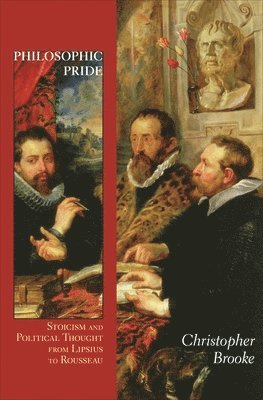
    Philosophic Pride

    Stoicism and Political Thought from Lipsius to Rousseau

    AvChristopher Brooke

    Häftad, Engelska, 2022

    374 kr

    Beställningsvara. Skickas inom 5-8 vardagar. Fri frakt över 249 kr.

    Fler format och utgåvor

    Inbunden

    521 kr

    E-bok

    718 kr

    Beskrivning

    Philosophic Pride is the first full-scale look at the essential place of Stoicism in the foundations of modern political thought. Spanning the period from Justus Lipsius's Politics in 1589 to Jean-Jacques Rousseau's Emile in 1762, and concentrating on arguments originating from England, France, and the Netherlands, the book considers how political writers of the period engaged with the ideas of the Roman and Greek Stoics that they found in works by Cicero, Seneca, Epictetus, and Marcus Aurelius. Christopher Brooke examines key texts in their historical context, paying special attention to the history of classical scholarship and the historiography of philosophy.Brooke delves into the persisting tension between Stoicism and the tradition of Augustinian anti-Stoic criticism, which held Stoicism to be a philosophy for the proud who denied their fallen condition. Concentrating on arguments in moral psychology surrounding the foundations of human sociability and self-love, Philosophic Pride details how the engagement with Roman Stoicism shaped early modern political philosophy and offers significant new interpretations of Lipsius and Rousseau together with fresh perspectives on the political thought of Hugo Grotius and Thomas Hobbes.Philosophic Pride shows how the legacy of the Stoics played a vital role in European intellectual life in the early modern era.

    Produktinformation

    • Utgivningsdatum:2022-11-29
    • Mått:156 x 235 x 19 mm
    • Vikt:440 g
    • Format:Häftad
    • Språk:Engelska
    • Antal sidor:304
    • Förlag:Princeton University Press
    • ISBN:9780691242156

    Utforska kategorier

    • Filosofiska discipliner inom Filosofi och religion

    Mer om författaren

    Christopher Brooke is lecturer in political theory and the history of political thought in the Department of Politics and International Studies at the University of Cambridge, where he is a fellow of King's College.

    Recensioner i media

    "It is one of the strengths of Christopher Brooke's fascinating new study, Philosophic Pride, that he is aware of the multifarious nature of his subject; he knows that he is dealing with a fluid cluster of ideas and themes, not a unitary philosophical movement. Not that he has set out, in any case, to write a history of (Neo-)Stoicism; his task is both narrower and harder than that. The subject of this book is the relationship between Stoicism and early modern political thought; since there was scarcely such a thing as a worked-out body of Stoic political theory (unless we count Seneca's fanciful portrayal of the monarchical ruler--Nero, of all people--extending the empire of reason), this means that an already elusive subject is considered here from a variety of oblique angles."---Noel Malcolm, Times Literary Supplement