• Fri frakt över 249 kr
  • •
  • Snabba leveranser
  • •
  • Billiga böcker
Kundservice

Du är på sajten för privatpersoner.

Företag, bibliotek eller offentlig verksamhet?

Du handlar på classic.bokus.com, där alla dina funktioner finns intakta.
Till classic.bokus.com
Bokus logotyp. Gå till startsidan.
  • Erbjudanden
  • Nyheter
  • Student
  • Topplistor
  • Barn & ungdom
  • Bokus Play
  • E-böcker
  • Pocketböcker
  • Spel & pussel

10% rabatt på allt med kod NYSTART10 →

Sidfot

Mina sidor

    Hjälp

    • Kundservice
    • Vanliga frågor och svar
    • Frakt och leverans
    • Retur vid ångerrätt
    • Reklamera vara
    • Betalning
    • Köpvillkor
    • Allmänna villkor
    • Information om webbplatsens tillgänglighet

    Om Bokus

    • Om oss
    • Pressrum
    • För studenter
    • För företag
    • För bibliotek och offentlig verksamhet
    • För leverantörer
    • Hållbarhet

    Populärt

    • Aktuella erbjudanden
    • Presentkort
    • Studentlitteratur
    • Nya böcker
    • Topplistor
    • Signerade böcker
    • Engelska böcker

    Inspiration

    • Boktips
    • BookTok
    • Populära bokserier
    • Barnbokskaraktärer
    • Populära författare
    Logotyp för Bokus
    Följ oss på Facebook (extern länk)Följ oss på Instagram (extern länk)Följ oss på YouTube (extern länk)Följ oss på TikTok (extern länk)
    bokus @ CookiesAnpassa cookiesIntegritetspolicyKöpvillkor
    Till Citymail hemsida (extern länk)Till Budbee hemsida (extern länk)Till Postnord hemsida (extern länk)Till Schenker hemsida (extern länk)Till Early Bird hemsida (extern länk)Till Walleys hemsida (extern länk)
    1. Historia och arkeologi
    2. Historia
    3. Europas historia

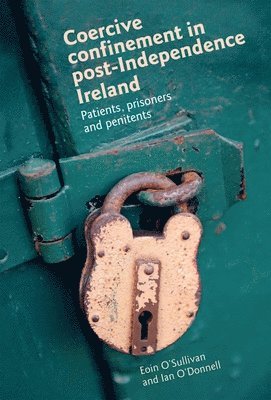
    Coercive Confinement in Ireland

    Patients, Prisoners and Penitents

    AvEoin Sullivan,Ian O'Donnell

    Inbunden, Engelska, 2012

    1 185 kr

    Beställningsvara. Skickas inom 5-8 vardagar. Fri frakt över 249 kr.

    Fler format och utgåvor

    Häftad

    372 kr

    Beskrivning

    This book provides an overview of the incarceration of tens of thousands of men, women and children during the first fifty years of Irish independence. Psychiatric hospitals, mother and baby homes, Magdalen homes, Reformatory and Industrial schools, prisons and Borstal formed a network of institutions of coercive confinement that was integral to the emerging state. The book provides a wealth of contemporaneous accounts of what life was like within these austere and forbidding places as well as offering a compelling explanation for the longevity of the system and the reasons for its ultimate decline. While many accounts exist of individual institutions and the factors associated with their operation, this is the first attempt to provide a holistic account of the interlocking range of institutions that dominated the physical landscape and, in many ways, underpinned the rural economy. Highlighting the overlapping roles of church, state and family in the maintenance of these forms of social control, this book will appeal to those interested in understanding twentieth-century Ireland: in particular, historians, legal scholars, criminologists, sociologists and other social scientists. These arguments take on special importance as Irish society continues to grapple with the legacy of its extensive use of institutionalisation.

    Produktinformation

    • Utgivningsdatum:2012-06-30
    • Mått:156 x 234 x 29 mm
    • Vikt:658 g
    • Format:Inbunden
    • Språk:Engelska
    • Antal sidor:320
    • Förlag:Manchester University Press
    • ISBN:9780719086489

    Utforska kategorier

    • Europas historia inom Historia och arkeologi
    • Politiska ideologier och rörelser inom Samhälle och politik

    Mer om författaren

    Eoin O’Sullivan is Head of the School of Social Work and Social Policy and Fellow of Trinity College, Dublin|Ian O’Donnell is Professor of Criminology at University College Dublin and Adjunct Fellow of Linacre College, Oxford

    Recensioner i media

    Most of these people were simply locked up in state institutions, creating a shameful legacy that is only now being dragged into the light. Coercive Confinement in Ireland is a valuable contribution to that process., Andrew Lynch, Sunday Business Post|Some of the documents reproduced here give a powerful insight into the social mores of the time., Andrew Lynch, Sunday Business Post|"Coercive Confinement in Ireland deserves a readership well beyond its jurisdiction of interest.", Mark Finnane, Griffith University, Australia, Punishment & Society, 28 March 2013|"Coercive Confinement raises important questions about levels of awareness among the general population and challenges the notion that Irish Society was ignorant of the existence of Magdalene convents and industrial schools until the late twentieth century.", Cliona Rattigan, History Ireland, June 2013|This book provides an invaluable contribution to criminology in Ireland and wider afield., Una Convery, The Irish Jurist, May 2013|Among the many stengths of this book is that the authors have allowed the documents to speak for themselves apart from a necessary introduction to each one. Their analysis of the collection is saved for the insightful and typically well-informed introductory and concluding chapters. This book eloquently traces the heavy dependence on institutional punishment and 'care' by those charged with or self-appointed in the field of criminal justice and moral policing in twentieth-century Ireland.The book is strongly recommended for scholars, students or anybody concerned with understanding at first-hand, some of the thinking that under-pinned the many layers of institutional detention to which the Irish state was firmly wedded., Conor Reidy, University of Limerick, Irish Historical Studies Vol. XXXVII, No 151, 1 October 2013|...lively and intelligent, Dara Robinson, Irish Times, 13 August 2013|...the authors put forward a more holistic analysis of those other forms of confinement, Ann Reade, The Probation Service, Dublin, 3 October 2012|"This is a hugely important, major and scholarly contribution to our understanding of the different forms and shapes of regulatory control."(Loraine Gelsthorpe, The Howard Journal Vol 53 No 1, Feb 2014), Loraine Gelsthorpe, University of Cambridge, The Howard Journal Vol 53 No 1, 1 February 2014|"While some survivors of those institutions begin to find a voice to express their experiences, the absence of documentary material from the period in which these institutions was used has also been striking. O'Sullivan and O'Donnell's seminal work brings together contemporary accounts of life within some of these institutions among with perceptions of those places."Mary Rogan, Irish Journal of Applied Social Studies, 2014, Mary Rogan, Dublin Institute of Technology, Irish Journal of Applied Social Studies, 14 May 2014|Overall, this is a fascinating collection and O’Sullivan and O’Donnell’s contextual introductory and concluding chapters are informative and thought provoking. The book will be useful to scholars interested in institutional care and also in teaching, with its short extracts providing interesting material for students to read and analyse through group work and individual reflection., Linda Moore, University of Ulster, Irish Studies Review, 10 November 2014|Overall, this is a fascinating collection and O’Sullivan and O’Donnell’s contextual introductory and concluding chapters are informative and thought provoking. The book will be useful to scholars interested in institutional care and also in teaching, with its short extracts providing interesting material for students to read and analyse through group work and individual reflection., Linda Moore, University of Ulster, Irish Studies Review 23.1, 1 February 2015

    Innehållsförteckning

    • Introduction  1. Setting the SceneIan O'Donnell and Eoin O’Sullivan  Part I. Patients, Paupers and Unmarried Mothers  2. How to Deal with the Unmarried Mother‘Sagart’, 1922.  3. The Unmarried Mother: Some Legal Aspects of the ProblemRichard Devane, 1924.  4. A Plea for Social ServiceHumbert MacInerny, 1925.  5. ReportCommission on the Relief of the Sick and Destitute Poor, Including the Insane Poor, 1927.  6. ReportInter-Departmental Committee Appointed to Examine the Question of the Reconstruction and Replacement of County Homes, 1949.    7. Irish JourneyHalliday Sutherland, 1956.  8. ReportCommission of Inquiry on Mental Illness, 1966.  9. No Birthright: A Study of the Irish Unmarried Mother and Her ChildMichael Viney, 1966.  10. Bird’s Nest SoupHanna Greally, 1971.  11. Mental Illness: An InquiryMichael Viney, 1971.  Further Reading  Part II. Prisoners  12. The PrisonsEdward Fahy, 1940.  13. I Did Penal ServitudeD83222, 1945.  14. Prisons and Prisoners in Ireland: Report on Certain Aspects of Prison Conditions in Portlaoighise Convict PrisonThe Labour Party, 1946.  15. The SpyholeShea Murphy, 1947.  16. Dungeons Deep: A Monograph on Prisons, Borstals, Reformatories and Industrial Schools in the Republic of Ireland, and Some Reflections on Crime and Punishment and Matters Relating TheretoPeadar Cowan, 1960.  Further Reading  Part III. Troubled and Troublesome Children  17. ReportCommission of Inquiry into the Reformatory and Industrial School System, 1936.  18. Memorandum on Children in Institutions, Boarded out and Nurse ChildrenJoint Committee of Women’s Societies and Social Workers, 1943.  19. Founded on Fear: Letterfrack Industrial School, War and ExilePeter Tyrrell, 1959.  20. Some of our Children: A Report on the Residential Care of the Deprived Child in IrelandTuairim, 1966.  21. The Dismal World of DaingeanMichael Viney, 1966.  22. Report Committee and Reformatory and Industrial Schools Systems  23. The Road to God Knows Where Sean Maher, 1972.  Further Reading